United States v. Lopez
Home | All Cases | Congressional Authority | United States v. Lopez
Case Overview
CITATION
ARGUED ON
DECIDED ON
DECIDED BY
514 U.S. 549
Nov. 8, 1994
Apr. 26, 1995
Legal Issues
Can congress regulate possession of a firearm near a school under the authority granted to them by the Commerce Clause?
Holding
No, the Gun Free School Zones Act is an unconstitutional exercise of Congress’ commerce power because possession of a firearm near a school isn’t an economic activity and doesn’t have a substantial effect on interstate commerce.
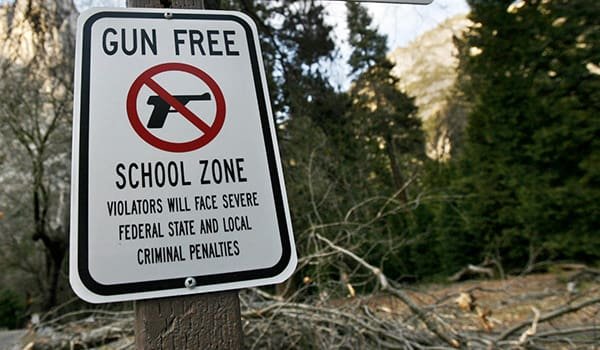
Gun Free School Zone sign | Credit: Duke Center for Firearms Law
Background
Under the Gun-Free School Zones Act of 1990 (18 U.S.C. §922(q)), Congress exercised their authority under the Commerce Clause to make it a crime for any unauthorized individual to knowingly possessing a firearm at a school.
On March 10, 1992, Alfonso Lopez, Jr. brought a .38 caliber revolver and five cartridges to his high school in San Antonio, Texas. The gun wasn’t loaded, as Lopez claimed that he was delivering the revolver to another person for a payment of $40. School officials received an anonymous tip about Lopez, and he was charged the next day with a violation of the Gun-Free School Zones Act.
Lopez was tried in the U.S. District Court for the Western District of Texas, where moved to dismiss his indictment on the grounds that §922(q) was unconstitutional. However, Lopez’s motion was denied and he was ultimately sentenced to six months in prison and two years on probation. Next, Lopez appealed to the U.S. Court of Appeals for the Fifth Circuit, and they reversed his conviction. The U.S. Supreme Court then granted certiorari.
5 - 4 decision for Lopez
U.S.


Lopez



Rehnquist
Kennedy
Stevens
Breyer
Scalia
O’Connor
Ginsburg
Thomas
Souter
-
Writing for the Court, Chief Justice William Rehnquist began by quoting James Madison’s description in Federalist No. 45 of the power sharing agreement created under federalism in which he stated that “[t]he powers delegated by the proposed Constitution to the federal government are few and defined. Those which are to remain in the State governments are numerous and indefinite.” Rehnquist emphasized the importance of balancing power between the State and federal governments, explaining that such a balance is analogous to the separation of powers between the branches of the federal government.
Rehnquist then reviewed the Court’s cases from the expansive Commerce Clause era, stating that cases such as NLRB v. Jones & Laughlin Steel, United States v. Darby, and Wickard v. Filburn, ushered in a era of jurisprudence that greatly expanded Congress’ authority under the Commerce Clause. Rehnquist explained that these decisions were in large part a response to the industrialization and nationalization of some parts of the economy. He further explained that “the doctrinal change also reflected a view that earlier Commerce Clause cases artificially had constrained the authority of Congress ... But even these modern-era precedents which have expanded congressional power under the Commerce Clause confirm that this power is subject to outer limits.”
Rehnquist identified three categories of activity that the Commerce Clause grants Congress the authority to regulate: (1) the use of channels of interstate commerce; (2) the instrumentalities of, and persons or things in interstate commerce, even if activities are purely intrastate; and (3) activities that have a substantial relation or substantially affect interstate commerce. On the third category, Rehnquist explained that the law hasn’t been clear regarding whether an activity must “affect” or “substantially affect” interstate commerce, but he concluded that “consistent with the great weight of our case law, ... the proper test requires an analysis of whether the regulated activity ‘substantially affects’ interstate commerce.”
Evaluating the validity of §922(q), Rehnquist stated that the statute clearly had no authoritative roots in the first or second categories, since it was not regulating a channel or instrumentality of interstate commerce. On the third category, Rehnquist explained that the statute is a criminal statute that, “by its own terms has nothing to do with ‘commerce’ or any sort of economic enterprise, however broadly one might define those terms.” Furthermore, Rehnquist pointed out that §922(q) lacks a jurisdictional element, which would ensure on a case-by-case basis that the firearm in question actually affects interstate commerce. Previously, the Court had interpreted an “additional nexus to interstate commerce”, but they were unable to here because of the statute had no jurisdictional element that could limit its reach. Lastly, Rehnquist noted that there was no legislative history to accompany the statute, which is not dispositive but also lends the government no help to their argument.
The government argued that §922(q) is valid because possession of a firearm in a local school zone substantially affects interstate commerce under a theory of “national productivity.” Rehnquist rejected that argument, writing that granting such an argument would allow Congress to regulate any activity related to the economic productivity of individual citizens and that “if we were to accept the Government’s arguments, we are hard pressed to posit any activity by an individual that Congress is without power to regulate.” Regarding Lopez, Rehnquist found that “[t]he possession of a gun in a local school zone is in no sense an economic activity that might, through repetition elsewhere, substantially affect any sort of interstate commerce.”
Rehnquist concluded that to find in favor of the government, the Court “would have to pile inference upon inference in a manner that would bid fair to convert congressional authority under the Commerce Clause to a general police power of the sort retained by the States.” He closed by arguing that additional expansion of the Commerce Clause “would require us to conclude that the Constitution’s enumeration of powers does not presuppose something not enumerated, and that there never will be a distinction between what is truly national and what is truly local. This we are unwilling to do.”
-
In his concurring opinion, Justice Anthony Kennedy began by acknowledging the long history of the Court’s interpretation of the Commerce Clause, noting that the transition to a single, integrated national economy “counsels great restraint before the Court determines that the [Commerce] Clause is insufficient to support an exercise of the national power.” Kennedy explained that while this long history gives him “pause” about the Court’s decision, it’s the Court’s duty to intervene when the exercise of national power threatens to upset the fundamental federal-state balance, especially when a statute lacks an evident commercial nexus and intrudes upon an area of traditional state concern.
In this case, Kennedy found the Gun Free School Zones Act to be unconstitutional because neither the regulated actors nor their conduct were of a commercial character. The statute criminalized the possession of a gun within 1,000 feet of a school, which is a clear intrusion on education, an area traditionally regulated by the States. Kennedy explained that while there is near universal agreement that guns don’t belong in schools, there’s considerable disagreement on the best policy methods to achieve that goal. He argued that by creating a uniform federal criminal prohibition and drawing an invisible boundary around over 100,000 local schools, the statute displaced state authority and foreclosed States from the chance to solve the problem. Kennedy argued that such an action prevents States from acting as “laboratories for experimentation” to devise localized solutions, which is an important part of the federalist system designed by the framers.
-
In his concurring opinion, Justice Clarence Thomas explained that while he agreed with the Court’s ruling, he wrote separately because he believes that the Court’s case law had drifted far from the original understanding of the Commerce Clause. Thomas argued that at the time of the Constitution’s ratification, the term “commerce” strictly consisted of selling, buying, bartering, and transporting for those purposes, which is clearly different from productive activities like manufacturing and agriculture. Thomas posited that that the original understanding of Congress’ commerce power never encompassed the mere possession of a good or purely personal activities that are completely separated from business or trade.
Thomas further argued that the Constitution didn’t support the idea that Congress possessed authority over any activity that “substantially affected” interstate commerce. Thomas explained that such a test rendered much of Article I, Section 8 “surplusage”, since if the Commerce Clause broadly covered anything with a substantial effect, there would have been no need for the framers to specifically enumerate other federal powers, such as the authority over bankruptcies or tax collection. He wrote, “if a ‘substantial effects’ test can be appended to the Commerce Clause, why not to every other power of the Federal Government? There is no reason for singling out the Commerce Clause for special treatment.” He noted that this broad interpretation was a twentieth-century innovation that wrongly departed from a century and a half of precedent.
Lastly, Thomas criticized the “aggregation principle” embedded in the substantial effects test, arguing that it effectively granted the federal government a limitless police power over the nation. Thomas argued that by aggregating the effects of a class of activities, Congress could regulate entirely noncommercial and trivial human conduct by simply drawing a broad enough statutory circle. Because this framework lacked any principled stopping point and obliterated the distinction between national and local matters, Thomas concluded that the Court needed to temper its Commerce Clause jurisprudence in future cases and construct a standard more faithful to the Constitution’s original design of limited and enumerated powers.
-
In his dissenting opinion, Justice Stephen Breyer argued that the Gun Free School Zones Act was well within Congress’ authority granted by the Commerce Clause and rested his argument on three basic principles. First, that the Commerce Clause encompassed the power to regulate local activities that significantly affected interstate commerce. Second, that the Court had to consider the cumulative effect of all similar instances, rather than just a single act of gun possession. Third, that the Court only needed to determine whether Congress had a “rational basis” for concluding that a significant factual connection existed between the regulated activity and interstate commerce.
In this case, Breyer found that Congress possessed a rational basis for connecting gun-related school violence to interstate commerce. Breyer argued that widespread violence in schools significantly interfered with the quality of education, which impacts the economy. He explained that “[e]ducation, although far more than a matter of economics, has long been inextricably intertwined with the Nation’s economy.”
Breyer also argued that gun violence near classrooms posed a serious economic threat by producing inadequately educated workers for the modern workforce and by depriving communities of a well-educated population. Breyer argued that since the connection between education and national economic well-being was uniquely significant, upholding the statute wouldn’t obliterate the distinction between national and local matters or grant the federal government a limitless police power over a traditionally state-controlled area.
Breyer concluded with a warning that the majority’s holding created three serious legal problems. First, it ran contrary to modern precedents that had upheld congressional actions with even weaker connections to interstate commerce. Second, it relied on a formalistic and unworkable distinction between “commercial” and noncommercial activities, which revived a categorical approach the Court had previously abandoned. Third, it threatened to inject profound legal uncertainty into the law by casting doubt on numerous existing federal statutes that regulated noncommercial activities or lacked explicit jurisdictional elements.
-
In his dissenting opinion, Justice John Paul Stevens argued that guns are “both articles of commerce and articles that can be used to restrain commerce” and that possession of them is the direct or indirect consequence of commercial activity. Stevens explained that in his opinion, “Congress’s power to regulate commerce in firearms includes the power to prohibit possession of guns at any location because of their potentially harmful use; it necessarily follows that Congress may also prohibit their possession in particular markets.” Stevens concluded with a note that “the market for the possession of handguns by school-age children is, distressingly, substantial. Whether or not the national interest in eliminating that market would have justified federal legislation in 1789, it surely does today.”
-
In his dissenting opinion, Justice David Souter argued that the Court should’ve deferred to Congress’ implicit judgment that the regulated activity substantially affected interstate commerce so long as there was a “rational basis” for their legislative finding. Souter argued that the practice of deferring to rationally based legislative judgments was a vital paradigm of judicial restraint. By granting this leeway to the legislative branch, Souter explained that the Court properly respected both Congress’ institutional competence in areas expressly assigned to it by the Constitution and the democratic legitimacy derived from the legislature’s political accountability.
Souter further argued that the Court’s decision ignored the lessons of history, noting that the modern respect for congressional primacy only developed after the Court’s experiences in the 1930s, when it was forced to repudiate an untenably expansive conception of judicial review. Souter criticized the majority’s distinction between “commercial” and “noncommercial” activities, comparing it directly to the old, unworkable distinction between “direct” and “indirect” effects on commerce. Souter argued that by calibrating the level of judicial deference based on whether an activity was patently commercial, the Court was reviving the same formalistic line-drawing that was done away with decades ago. Souter concluded with a warning that the decision would lead to a return to those old pitfalls and explained that he found no reason why the majority’s new qualification of rational basis review would be any more successful.