United States v. Darby
Case Overview
CITATION
ARGUED ON
DECIDED ON
DECIDED BY
OVERRULED
312 U.S. 100
Dec. 19-20, 1940
Feb. 3, 1941
Hammer v. Dagenhart (1918)
Legal Issues
Does Congress have the authority to proscribe a minimum wage and maximum work hours for employees engaged in the production of goods meant for interstate commerce?
If so, can Congress prohibit the shipment of goods in interstate commerce that were manufactured by employees whose wages and work hours are not in accordance with that proscription?
Holding
Yes, Congress may regulate the work conditions of employees engaged in the production of goods meant for interstate commerce, and they have the authority to enforce such regulations.
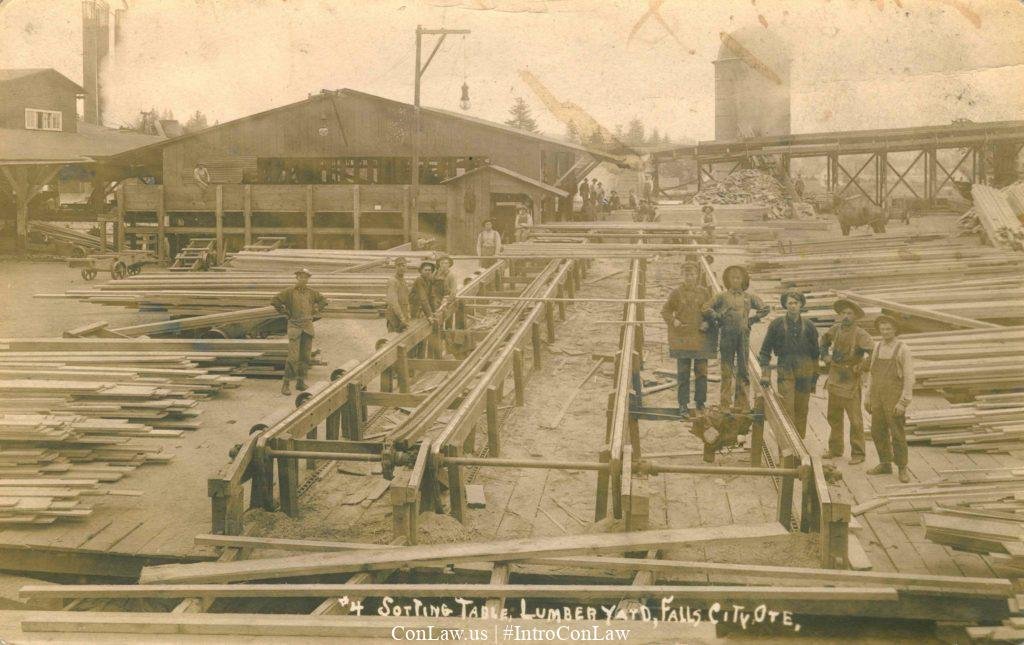
A lumber yard in Falls City | Credit: An Introduction to Constitutional Law/Randy Barnett/Josh Blackman
Background
In 1938, Congress enacted the Fair Labor Standards Act (FLSA), which had two stated goals: (1) “to exclude goods from interstate commerce produced for the commerce and to prevent their production for interstate commerce, under conditions detrimental to the maintenance of the minimum standards of living necessary for health and general well-being;” and “to prevent the use of interstate commerce as the means of competition in the distribution of goods so produced, and as the means of spreading and perpetuating such substandard labor conditions among the workers of the several states.” As a part of the FSLA, a comprehensive legislative scheme was created to prevent the shipment in interstate commerce of goods produced in the U.S. under labor conditions that fail to conform to its standards. Two key requirements imposed were a minimum wage and maximum work hours requirement imposed for employees “engaged in commerce or in the production of goods for commerce”.
In 1919, Fred Darby founded Darby Lumber Co. (Darby) in Statesboro, Georgia after the conclusion of World War I. Darby grew rapidly during the economic boom of the 1920s, and continued to grow in the 1930s despite the economic turmoil brough on by the Great Depression. Darby was subject to the provisions of the FSLA since they manufactured lumber with the intent to ship it in interstate commerce to customers outside the state, and a large amount of the lumber produced is actually shipped. Darby was indicted for violating of the FSLA for not paying his employees the proscribed minimum wage and for requiring them to work more hours than allowed by the FSLA. Darby demurred the indictment to the U.S. District Court for the Southern District of Georgia, which ruled in his favor “based upon the invalidity or construction of the statute upon which the indictment is founded.” The government appealed, and the U.S. Supreme Court granted certiorari.
Unanimous decision for the United States
United States


Darby
Roberts
Stone
Reed
Frankfurter
Black
Hughes
Douglas
Murphy
-
Writing for the Court, Justice Harlan Stone first addressed whether manufacturing constitutes interstate commerce. Stone explained that while manufacturing alone isn’t interstate commerce, the shipment of manufactured goods interstate constitutes such commerce and “the prohibition of such shipment by Congress is indubitably a regulation of the commerce.” Stone further established that “[t]he power to regulate commerce is the power to prescribe the rule by which commerce is to be governed.” Stone then cited the Court’s holding in Gibbons v. Ogden (1824) to state that Congress’ power over interstate commerce “is complete in itself, may be exercised to its utmost extent, and acknowledges no limitations, other than are prescribed by the constitution.” Stone explained that under this authority, Congress “is free to exclude from the commerce articles whose use in the states for which they are destined it may conceive to be injurious to the public health, morals or welfare, even though the state has not sought to regulate their use.”
Stone rejected the argument that Congress’ regulations under the FSLA invaded state power, explaining that the motive and actual affect of the FSLA was to restrict commerce based on its provisions, which “is not prohibited unless by other Constitutional provisions.” He further stated that “[w]hatever their motive and purpose, regulations of commerce which do not infringe some constitutional prohibition are within the plenary power conferred on Congress by the Commerce Clause.” Evaluating the FSLA in light of this authority, Stone found that the prohibition of the shipment of goods produced under labor conditions prohibited by the FSLA is within the constitutional authority of Congress.
Regarding the Court’s decision to overturn Hammer v. Dagenhart (1918), Stone stated that it was a flawed decision that hasn’t since been followed. In Hammer, the Court found that Congress had the authority only to prohibit from interstate commerce articles that were “harmful or deleterious”, a distinction Stone described as “novel when made and unsupported by any provision of the Constitution.” He explained that Hammer “was a departure from the principles which have prevailed in the interpretation of the commerce clause both before and since the decision and that such vitality, as a precedent, as it then had has long since been exhausted. It should be and now is overruled.”
Stone then moved to the question of whether the restrictions imposed by Congress under the FSLA were a permissible exercise of the commerce power, finding that it was. Stone explained that Congress’ power over interstate commerce isn’t limited to regulation of commerce among the states and instead “extends to those activities intrastate which so affect interstate commerce or the exercise of the power of Congress over it as to make regulation of them appropriate means to the attainment of a legitimate end ... it may choose the means reasonably adapted to the attainment of the permitted end, even though they involve control of intrastate activities.”
Lastly, Stone addressed the role of Tenth Amendment in the Court’s decision, finding that it is “but a truism that all is retained which has not been surrendered.” He further stated that nothing in the history of the Tenth Amendment’s adoption suggests that it was “more than declaratory of the relationship between the national and state governments as it had been established by the Constitution before the amendment or that its purpose was other than to allay fears that the new national government might seek to exercise powers not granted, and that the states might not be able to exercise fully their reserved powers.”