Wickard v. Filburn
Case Overview
CITATION
ARGUED ON
REARGUED ON
DECIDED ON
DECIDED BY
317 U.S. 111
May 4, 1942
Oct. 12, 1942
Nov. 9, 1942
Legal Issues
Does the Commerce Clause grant Congress the authority to regulate the production of goods not intended for commerce but rather entirely for an individual’s private consumption?
Holding
Yes, Congress may regulate the production of goods used exclusively in intrastate commerce since the Commerce Clause grants them the authority to regulate production that may affect interstate commerce.
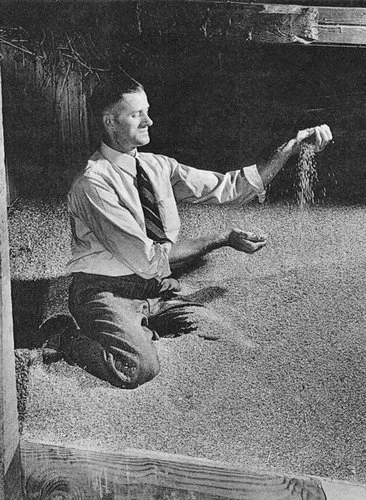
Roscoe Filburn with wheat at his farm around the time the Supreme Court ruled against him | Credit: Mary Lou Filburn/NYT
Background
As a part of President Franklin D. Roosevelt’s “New Deal”, Congress enacted the Agricultural Adjustment Act of 1938. The purpose of the Act was to limit the amount of acreage farmers could devote to the cultivation of wheat and control the volume of wheat being moved in interstate and foreign commerce in order to avoid surpluses and shortages that could lead to abnormal wheat prices. As a part of the Act, the Secretary of Agriculture (then Claude R. Wickard) was directed to determine a national acreage allotment for wheat on an annual basis, which would then be apportioned to the states, their counties, and eventually into allotments for individual farms.
Roscoe Filburn owned and operated a small farm in Montgomery County, Ohio, where he raised dairy cattle and poultry for sale. In addition, Filburn also grew a small amount of wheat of which he sold a portion, used some for home consumption, used some to feed his poultry and livestock, and kept the rest for the following seeding. In July of 1940, the 1941 acreage allotment for wheat was set at 11.1 acres, with a normal yield of 20.1 bushels of wheat per acre. Filburn was given notice of his allotment before the fall planting of his wheat to be harvested 1941, and again in July of 1941, before it was harvested. Filburn ultimately grew 23 acres of wheat and harvested 239 bushels of wheat from his 11.9 excess acres.
Under the Act, Filburn’s yield was considered farm marketing excess, and he was fined a penalty of 49 cents a bushel, or a total of $117.11. Filburn challenged his fine in the U.S. District Court for the Southern District of Ohio, and it was initially overturned. However, the government appealed to the U.S. Supreme Court, who granted certiorari.
Unanimous decision for Wickard
Wickard


Filburn
Roberts
Stone
Reed
Frankfurter
Black
Jackson
Douglas
Murphy
-
Writing for the Court, Justice Robert Jackson first addressed how this case is distinguished from the issue the Court ruled on in United States v. Darby (1941). In Darby, the court upheld Congress’ ability to regulate the production of goods for commerce, but they didn’t go as far as to authorize Congress to regulate the production of goods not intended for commerce in any way but rather entirely for an individual’s private consumption.
Jackson then established a standard of review, writing that “questions of the power of Congress are not to be decided by reference to any formula which would give controlling force to nomenclature such as ‘production’ and ‘indirect’ and foreclose consideration of the actual effects of the activity in question upon interstate commerce.” Jackson explained that “[w]hether the subject of the regulation in question was ‘production,’ ‘consumption,’ or ‘marketing’ is, therefore, not material for purposes of deciding the question of federal power before us.”
Under this broad standard of interpretation, Jackson found that even if an individual’s activity is local and not typically regarded as commerce, “it may still, whatever its nature, be reached by Congress if it exerts a substantial economic effect on interstate commerce and this irrespective of whether such effect is what might at some earlier time have been defined as ‘direct’ or ‘indirect.’”
Applying this to the case at hand, Jackson agreed with the government’s argument that an effective way for the government to sustain or increase demand is to limit the supply, which is what the Agricultural Adjustment Act of 1938 aimed to do by restricting production, even to “the extent ... which one may forestall resort to the market by producing to meet his own needs.” Jackson found that while Filburn’s “contribution to the demand for wheat may be trivial” it’s not “by itself ... enough to remove him from the scope of federal regulation where, as here, his contribution, taken together with that of many others similarly situated, is far from trivial.” He added that “home-grown wheat in this sense competes with wheat in commerce. The stimulation of commerce is a use of the regulatory function quite as definitely as prohibitions or restrictions thereon.”
Jackson concluded, emphasizing that the Court’s precedent has well established “that the power to regulate commerce includes the power to regulate the prices at which commodities in that commerce are dealt in and practices affecting such prices.” Since that function of Congress’ power was the aim of the Act passed by them, it was upheld as constitutional. Ultimately, he held that the “record leaves us in no doubt that Congress may properly have considered that wheat consumed on the farm where grown if wholly outside the scheme of regulation would have a substantial effect in defeating and obstructing its purpose to stimulate trade therein at increased prices.”