JOHN PAUL STEVENS
Associate Justice (1975 - 2010)

QUICK FACTS
APPOINTED BY
Gerald R. Ford
PRECEDED BY
BIRTHPLACE
Illinois
SWORN IN
December 19, 1975
SUCCEEDED BY
LAW SCHOOL
Northwestern University
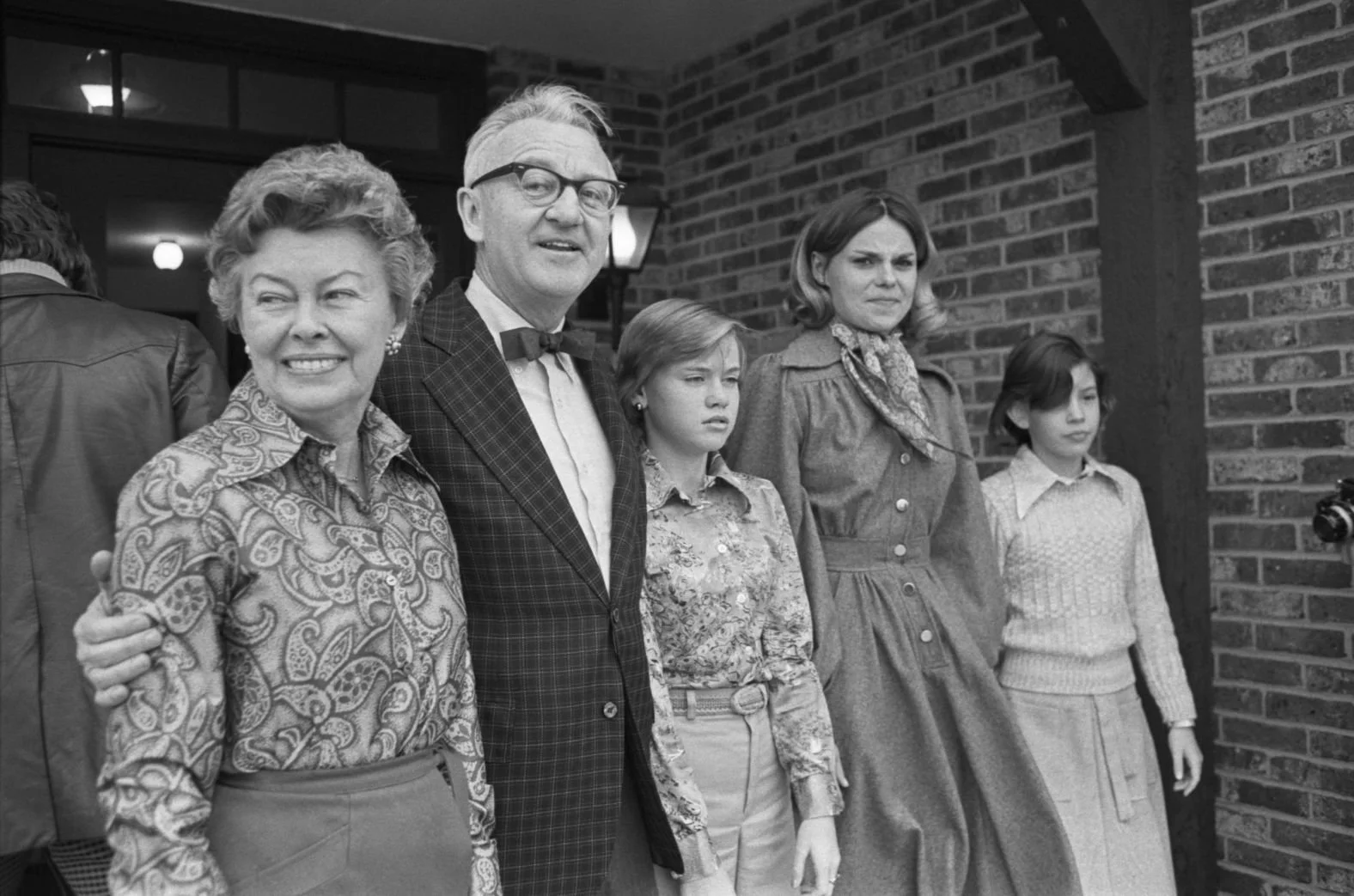
Stevens with members of his family outside their home in Illinois after being nominated to the Supreme Court (1975) | Credit: Bettmann Archive/Getty
Personal Life and Education
John Paul Stevens was born on April 20, 1920, in Chicago, Illinois. He was the youngest of four sons born to Ernest James Stevens and Elizabeth Street. Stevens came from a prominent business family in Illinois. His father owned the Stevens Hotel, which at the time of its construction was the largest hotel in the world, and his grandfather founded the Illinois Life Insurance Company. Stevens grew up in Hyde Park, where he attended the University of Chicago Laboratory Schools and famously witnessed Babe Ruth’s “called shot” at the 1932 World Series. However, his family’s fortune was severely impacted by the Great Depression, and in 1934, his father, grandfather, and uncle were indicted on charges of embezzlement related to their hotel’s finances. His father’s conviction was eventually overturned by the Illinois Supreme Court, but Stevens saw the experience as a miscarriage of justice.
Stevens attended the University of Chicago, where he majored in English literature and was the editor of the campus newspaper. Stevens was a member of Phi Beta Kappa and graduated summa cum laude in 1941. Stevens initially planned to continue his studies in English, but he was recruited by the Navy at the onset of World War II to serve as a codebreaker due to his proficiency in cryptography. Stevens enlisted in the United States Navy on December 6, 1941, the day before the attack on Pearl Harbor, and served throughout the war in the Pacific theater. For his service on the team that helped intercept the flight plan of Japanese Admiral Isoroku Yamamoto, Stevens was awarded the Bronze Star. Upon his return to civilian life, Stevens took the advice of his older brother and used the G.I. Bill to enroll at Northwestern University School of Law.
At Northwestern, Stevens graduated magna cum laude as valedictorian in 1947 with the highest grade point average in the school’s history. Stevens served as the co-editor-in-chief of the Illinois Law Review alongside his close friend Arthur Seder. When a clerkship opportunity at the Supreme Court arose, Northwestern couldn’t decide whether to recommend Stevens or Seder, as both were considered equally qualified. In a private meeting, the two friends flipped a coin to decide who would receive the school’s nomination to Justice Wiley Rutledge. Stevens won the toss and subsequently moved to Washington, D.C. to clerk for Rutledge during the 1947–1948 term. This clerkship exposed him to the inner workings of the Court at a time when Rutledge was part of a liberal bloc that often dissented against the more conservative majority.

Stevens in his office | Credit: Bob Daugherty/AP
Early Career
After his clerkship, Stevens returned to Chicago and joined the law firm of Poppenhusen, Johnston, Thompson & Raymond, where he began a specialized practice in antitrust law. Stevens became an expert in antitrust law and in 1951, he returned to Washington to serve as associate counsel for the House Judiciary Committee’s Subcommittee on the Study of Monopoly Power. Upon returning to Chicago again in 1952, Stevens co-founded his own firm, Rothschild, Stevens, Barry & Myers, where he became a prominent litigator and a respected authority on competition and monopoly. During this time, he was an adjunct professor at both Northwestern and the University of Chicago.
In 1969 Stevens was appointed chief counsel to the Greenberg Commission, which was tasked with investigating a bribery scandal implicating two justices of the Illinois Supreme Court. Stevens’ rigorous and transparent investigation led to the resignation of both justices and earned him widespread praise for his integrity and commitment to judicial ethics. Stevens role caught the attention of Senator Charles Percy (R-IL), a former classmate from Northwestern, who recommended Stevens for a vacancy on the federal bench. In 1970, President Richard Nixon appointed Stevens to the U.S. Court of Appeals for the Seventh Circuit.

Stevens with President Ford and Chief Justice Burger on the day he was confirmed | Credit: U.S. National Archives and Records Administration (Public Domain)
Nomination to the Supreme Court
In 1975, Justice William O. Douglas, the longest-serving justice in the Court’s history, retired. President Gerald Ford, seeking to unify the country in the wake of the Watergate scandal, instructed Attorney General Edward Levi to find the most qualified candidate regardless of political affiliation. Levi, who had known Stevens from the University of Chicago, strongly recommended him as the most qualified to succeed Justice Douglas. Ford formally nominated Stevens on November 28, 1975.
Stevens’ confirmation hearings before the Senate Judiciary Committee were brief and uncontroversial. The American Bar Association gave Stevens its highest possible rating, and he was praised by senators from both parties. The Senate Judiciary Committee unanimously recommended his confirmation after only three days of hearings.
On December 17, 1975, the Senate confirmed Stevens by a unanimous vote of 98–0. He was commissioned the same day and took his judicial oath on December 19, 1975. Stevens served for nearly 35 years, becoming the third-longest-serving justice in history.
Cite this page
