WILLIAM REHNQUIST
Chief Justice (1986 - 2005)
Associate Justice (1972- 1986)
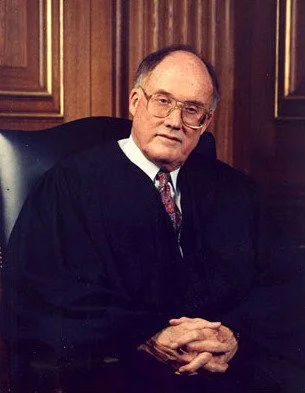
QUICK FACTS
BIRTHPLACE
Wisconsin
CHIEF JUSTICE
APPOINTED BY
Ronald Reagan
PRECEDED BY
ASSOCIATE JUSTICE
APPOINTED BY
Richard Nixon
PRECEDED BY
LAW SCHOOL
Stanford
SWORN IN
September 26, 1986
SUCCEEDED BY
SWORN IN
January 7, 1972
SUCCEEDED BY
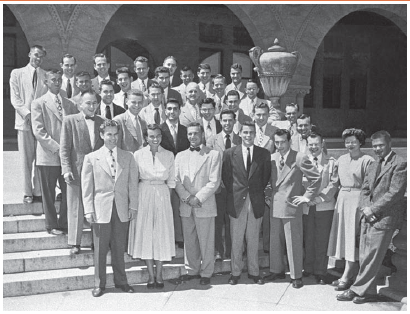
Rehnquist’s law school class (Rehnquist is in the back row, far left; O’Connor is in the first row, second to the left) | Credit: Stanford
Personal Life and Education
William Donald Rehnquist was born on October 1, 1924 in Milwaukee, Wisconsin. His father, William Benjamin Rehnquist was a sales manager. His mother, Margery, was a local civil activist, translator, and homemaker. As a teenager, Rehnquist changed his middle name to Hubbs.
Rehnquist graduated from Shorewood High School in 1942. Rehnquist then attended Kenyon College in Ohio for one quarter before enlisting in the U.S. Army Air Forces, the predecessor of the U.S. Air Force. Rehnquist served from 1943 to 1946. He was stationed at several bases in Ohio, Oklahoma, New Mexico, Texas, Illinois, and New Jersey. In the summer of 1945, Rehnquist was deployed to North Africa as a weather observer. He was honorably discharged in 1946 with the rank of sergeant.
After serving in the military, Rehnquist used the G.I. Bill to attend Stanford University. At Stanford, Rehnquist was a member of Phi Beta Kappa and Pi Sigma Alpha. He graduated in 1948 with a B.A. and M.A. in political science. After, Rehnquist attended Harvard for graduate school, where he studied government and graduated with another M.A. in 1950. Rehnquist then enrolled at Stanford Law School, where he was an editor on the Stanford Law Review. At Stanford, Rehnquist was in the same class as Sandra Day O’Connor, a future colleague on the Supreme Court. Rehnquist and O’Connor briefly dated during law school, and Rehnquist even proposed to her at one point. However, O’Connor turned him down because by that point she was dating the man that would become her future husband. Nonetheless, the two remained close friends throughout the entirety of their careers.
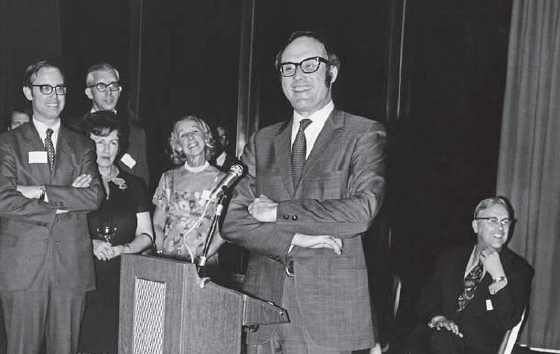
Rehnquist speaking to Stanford faculty and alumni in Washington, D.C. shortly after being confirmed as an Associate Justice to the Supreme Court in 1972 | Credit: Stanford
Early Career
After law school, Rehnquist served as a law clerk for Justice Robert Jackson from 1952 to 1953. After, Rehnquist began working in private practice in Pheonix, Arizona. During this time, he served as the national manager of Barry Goldwater’s 1964 presidential campaign. Rehnquist worked in private practice until 1969.
Following the election of Richard Nixon, Rehnquist served as Assistant Attorney General of the Office of Legal Counsel until 1971. In this position, Rehnquist was the chief lawyer to Attorney General John Mitchell.
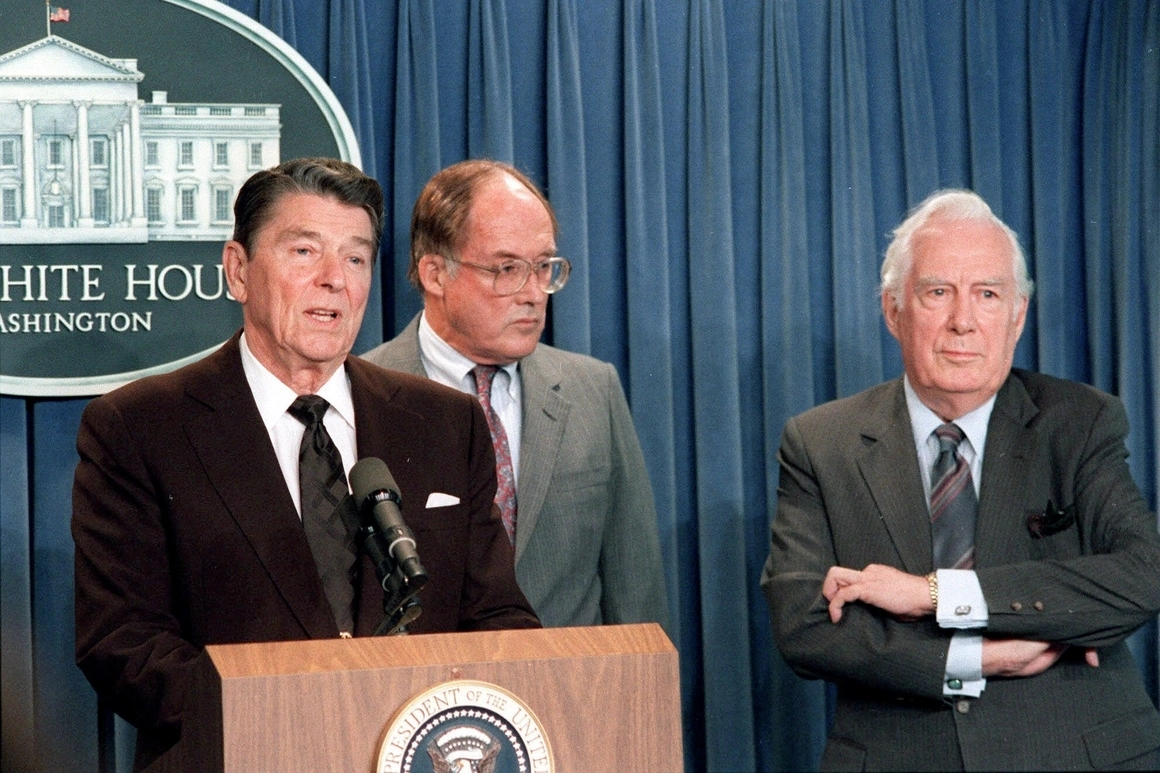
President Reagan announcing his nomination of Justice Rehnquist to succeed retiring Chief Justice Burger | Credit: POLITICO
Nomination to the Supreme Court
Associate Justice Nomination
On October 21, 1971, President Nixon nominated Rehnquist to succeed retiring Justice John Marshall Harlan II. Rehnquist’s confirmation hearings before the Senate Judiciary Committee took place in early November. On November 23, 1971, the committee voter 12-4 to advance his nomination to the Senate with a favorable recommendation.
On December 10, 1971, the Senate initially voted 52-42 against a cloture motion to end debate on Rehnquist’s nomination. However, the Senate then voted 22-70 against a motion to postpone consideration of Rehnquist’s nomination to July of 1972. Later the same day, the Senate voted 68-26 to confirm his nomination. Rehnquist was sworn in as an Associate Justice of the Supreme Court on January 7, 1972. Since there were two vacancies on the Court in the fall of 1971, Rehnquist was sworn in on the same day as Justice Lewis Powell. During his time as an Associate Justice on the Burger Court, Rehnquist was the most frequent sole dissenter, which earned him the nickname “the Lone Ranger”.
Chief Justice Nomination
In 1986, Chief Justice Warren Burger announced his retirement to become the Chairman of the Commission on the Bicentennial of the United States Constitution. As a result, President Ronald Reagan nominated Rehnquist to succeed him. Rehnquist’s elevation to Chief Justice was met with unanimous support from his colleagues on the Court, even those who vehemently disagreed with his judicial philosophy.
On July 20, 1986, Rehnquist’s nomination was submitted to the Senate Judiciary Committee. On August 14, the committee voted send the nomination to the Senate with a favorable recommendation. His hearing before the committee was the first confirmation hearing for a Chief Justice to have “gavel-to-gavel” television coverage. Despite efforts from Democrat Senators (primarily Ted Kennedy of Massachusetts and Joe Biden of Delaware) to defeat his nomination, cloture was invoked in a 68-21 vote and he was confirmed by a vote of 68-33. At the time, 33 was the highest number of “nay” votes cast against a successful Supreme Court nomination. Rehnquist was sworn in on September 26, becoming the first member of the Supreme Court since Harlan Stone to serve as both an Associate Justice and Chief Justice.


