Illinois v. Caballes
Home | All Cases | Criminal Procedure | Illinois v. Caballes
Case Overview
CITATION
ARGUED ON
DECIDED ON
DECIDED BY
543 U.S. 405
Nov. 10, 2004
Jan. 24, 2005
Legal Issue
Does the Fourth Amendment require reasonable, articulable suspicion of criminal drug activity to justify the use of a drug-detection dog to sniff a vehicle during a legitimate traffic stop?
Holding
No, because criminal drug activity doesn’t constitute a legitimate privacy interest, a dog sniff conducted around the exterior of a vehicle during a lawful traffic stop doesn’t violate the Fourth Amendment as long as the encounter isn’t unreasonably prolonged beyond the time required to fulfill the purpose of the traffic stop.
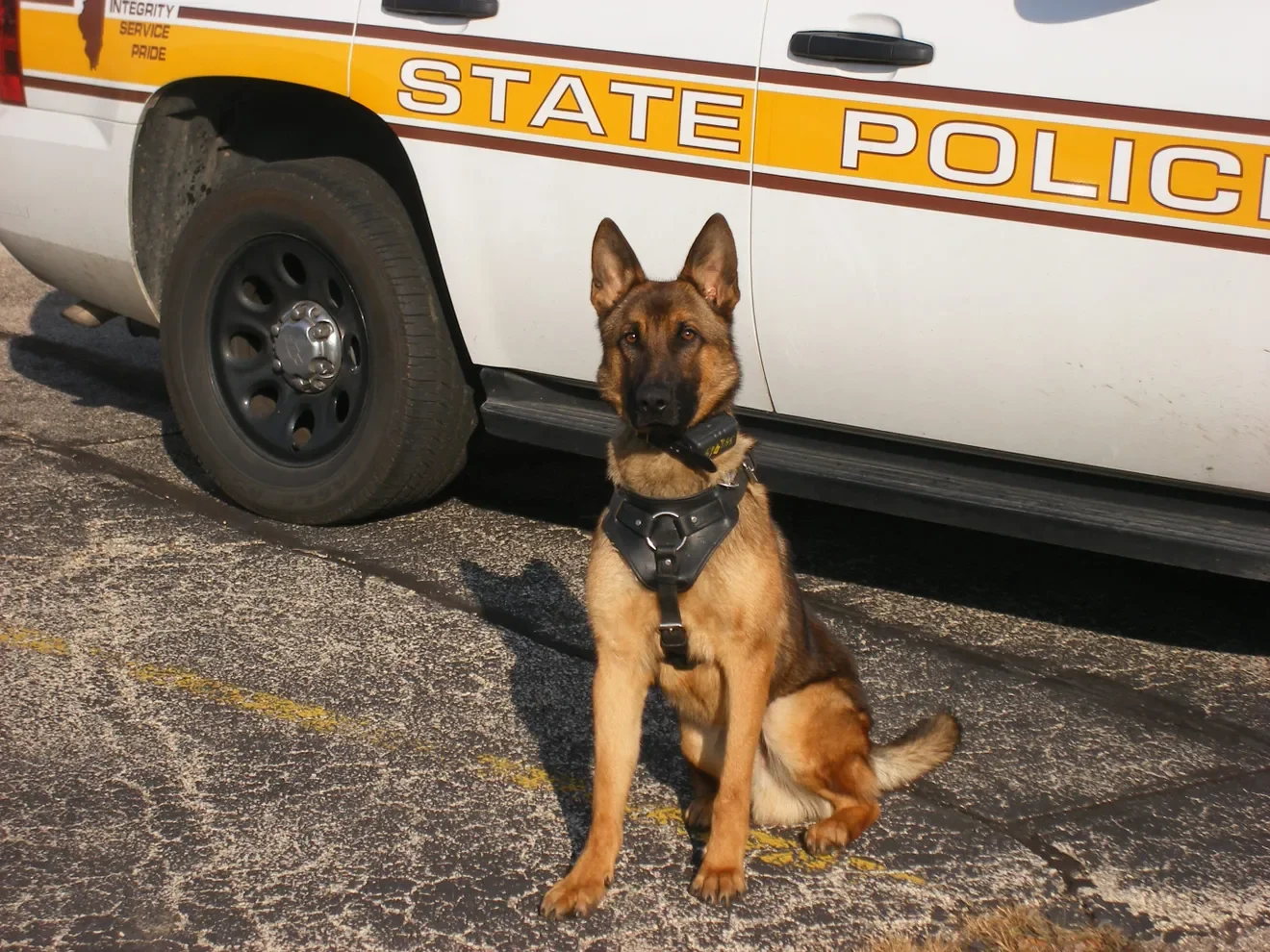
Bodhi, a K-9 with the Illinois State Police | Credit: Rockford Register Star
Background
On November 12, 1998, Roy Caballes was stopped for speeding on the interstate by Illinois State Trooper Daniel Gillette. When Gillette notified the police dispatcher of the stop, Craig Graham, a member of the Illinois State Police Drug Interdiction Team, immediately began traveling to the scene with his narcotics-detection dog. When Graham arrived with his dog, Caballes’ vehicle was stopped on the road shoulder and Caballes was in Gillette’s vehicle. While Gillette wrote a warning ticket for Caballes, Graham walked his dog around his vehicle and the dog alerted to the trunk. A search of the trunk revealed marijuana and Caballes was arrested. The entire stop lasted less than 10 minutes.
At trial, Caballes moved to suppress the seized evidence and quash his arrest, but his motion was denied. Caballes was convicted of a narcotics offense and sentenced to 12 years in prison and a fine of $256,136. On appeal, the Appellate Court affirmed the trial court’s denial of Caballes’ motion. The Illinois Supreme Court reversed, however, finding that because the drug-detection dog’s sniff of Caballes’ vehicle was performed without any specific or articulable facts to suggest drug activity, the use of the dog impermissibly expanded the scope of the traffic stop into a drug investigation. The U.S. Supreme Court then granted certiorari.
7 - 2 decision for Illinois
Illinois
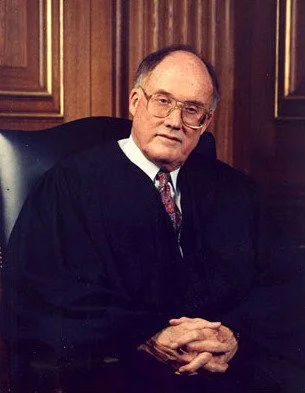


Stevens
Rehnquist


Caballes

Kennedy
Souter
Thomas
Scalia
O’Connor
Ginsburg
Breyer
-
Writing for the Court, Justice John Paul Stevens first addressed the narrow question facing the court, noting that the Court “proceed[ed] on the assumption that the officer conducting the dog sniff had no information about [Caballes] except that he had been stopped for speeding.” He added that the initial seizure of Caballes for speeding was lawful and that the only question facing the court was whether the subsequent use of the drug-sniffing dog was permissible.
Stevens began his analysis by establishing that “a seizure that is lawful at its inception can violate the Fourth Amendment if its manner of execution unreasonably infringes interests protected by the Constitution.” Regarding traffic stops, Stevens noted that “[a] seizure that is justified solely by the interest in issuing a warning ticket to the driver can become unlawful if it is prolonged beyond the time reasonably required to complete that mission.” He further elaborated that “conducting a dog sniff would not change the character of a traffic stop that is lawful at its inception and otherwise executed in a reasonable manner, unless the dog sniff itself infringed respondent’s constitutionally protected interest in privacy.” Stevens emphasized that there is no “legitimate” interest in possessing contraband, so “governmental conduct that only reveals the possession of contraband ‘compromises no legitimate privacy interest.’” He explained that “[t]his is because the expectation ‘that certain facts will not come to the attention of the authorities’ is not the same as an interest in ‘privacy that society is prepared to consider reasonable.’” Therefore, Stevens found that “the use of a well-trained narcotics-detection dog—one that ‘does not expose noncontraband items that otherwise would remain hidden from public view,’… during a lawful traffic stop generally does not implicate legitimate privacy interests.”
Regarding Caballes’ case, Stevens highlighted that the dog sniff was conducted on the exterior of his vehicle while he was lawfully seized for a speeding, meaning that “[a]ny intrusion on respondent’s privacy expectations does not rise to the level of a constitutionally cognizable infringement.” Stevens emphasized the distinction between legitimate interests protected by the Fourth Amendment and those that are not, writing “[t]he legitimate expectation that information about perfectly lawful activity will remain private is categorically distinguishable from respondent’s hopes or expectations concerning the nondetection of contraband in the trunk of his car.” Ultimately, Stevens concluded that “[a] dog sniff conducted during a concededly lawful traffic stop that reveals no information other than the location of a substance that no individual has any right to possess does not violate the Fourth Amendment.”