RUTH BADER GINSBURG
Associate Justice (1993 - 2020)

QUICK FACTS
APPOINTED BY
Bill Clinton
PRECEDED BY
BIRTHPLACE
New York
SWORN IN
August 10, 1993
SUCCEEDED BY
LAW SCHOOL
Columbia
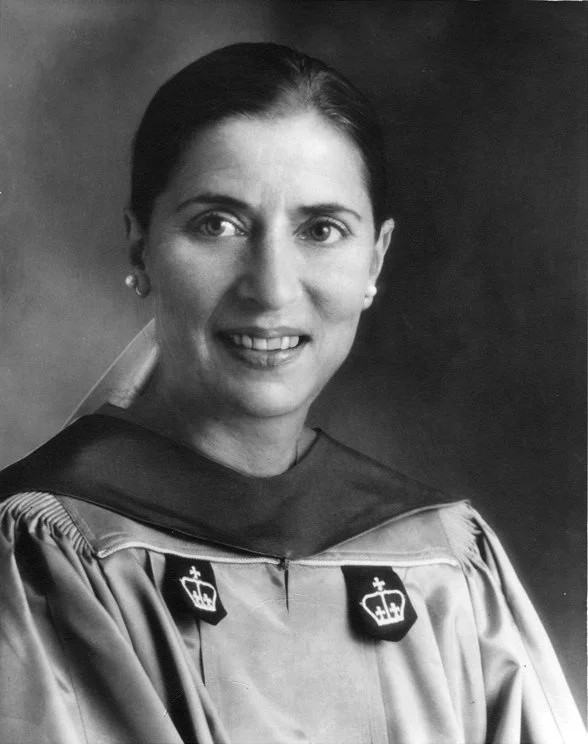
Ginsburg in her Columbia Law School regalia (1959) | Credit: Columbia University (Public Domain)
Personal Life and Education
Ruth Bader Ginsburg (born Joan Ruth Bader) was born on March 15, 1933, in Brooklyn, New York. Ginsburg was the second daughter of Nathan Bader, a Jewish emigrant from Odessa, Ukraine who worked as a furrier, and Celia Bader, the daughter of Austrian Jewish immigrants. Her family faced early tragedy when her older sister, Marilyn, died of meningitis at age six, leaving Bader as an only child for most of her upbringing. This loss deepened Ginsburg’s relationship with her mother, who played a vital role in her education.
Although Celia was a brilliant student who graduated from high school at age 15, she was forced to work in a garment factory to pay for her brother’s college education. Determined that her daughter would not face similar limitations, Celia instilled a love of reading and academic excellence in Ginsburg and frequently took her on trips to the local library. Celia famously taught Ginsburg to be a “lady” which she defined as not being overcome by useless emotions like anger. Celia battled cervical cancer throughout Ginsburg’s high school years and passed away the day before Ginsburg graduated from James Madison High School, which caused Ginsburg to miss her own graduation ceremony.
After high school, Ginsburg attended Cornell University, where she studied government and met her future husband, Martin “Marty” Ginsburg. She graduated in 1954 as the highest-ranking female student in her class and was a member of Phi Beta Kappa. After a brief period in Fort Sill, Oklahoma, Ginsburg enrolled at Harvard Law School in 1956, where she was one of only nine women in a class of over 500. While there, the Dean of Harvard Law asked the female students why they were taking up seats that could have gone to men.
Additionally, Ginsburg cared for a newborn daughter and a husband diagnosed with cancer while still excelling in law school. Ginsburg took notes for Martin while he was sick and eventually becoming the first woman on the Harvard Law Review. When Martin’s career took them to New York, Ginsburg transferred to Columbia Law School, where she served on the Columbia Law Review, becoming the first woman to serve on two prominent law journals. Ginsburg graduated from Columbia Law School in 1959, tying for first in her class.

Ginsburg with President Carter in 1980 | Credit: Jimmy Carter’s Presidential Photographs
Early Career
Despite her strong academic record, Ginsburg faced immense discrimination when entering the legal workforce. Justice Felix Frankfurter refused to interview her for a clerkship solely because of her gender, and several top-tier New York law firms turned her down for the same reason. Ginsburg eventually secured a clerkship with Judge Edmund L. Palmieri of the U.S. District Court for the Southern District of New York, where she served from 1959 to 1961. After, Ginsburg joined the Columbia Law School Project on International Procedure and spent time in Sweden, learning the language and co-authoring a text on Swedish civil procedure.
In 1963, Ginsburg became a professor at Rutgers Law School, where she was one of only twenty female law professors in the entire country. During her tenure, Ginsburg was forced to hide her second pregnancy by wearing oversized clothes to ensure her contract would be renewed. Her work at Rutgers shifted toward litigation as she began taking on cases for the ACLU of New Jersey. In 1972, Ginsburg returned to Columbia Law School as its first tenured female professor. That same year, she co-founded the Women’s Rights Project at the ACLU, where she strategically chose cases to challenge the legal architecture of gender discrimination. She specifically looked for male plaintiffs to demonstrate to the all-male Supreme Court that gender-based distinctions harmed both men and women and were based on outdated stereotypes.
Ginsburg's litigation strategy was meticulously incremental, aiming to persuade the court one step at a time rather than demanding a total revolution overnight. Between 1973 and 1976, she argued six gender-based cases before the Supreme Court, winning five. Her work led to the invalidation of numerous state and federal laws that treated men and women differently. In 1980, President Jimmy Carter nominated her to the United States Court of Appeals for the D.C. Circuit. While on the D.C. Circuit, Ginsburg worked alongside conservative jurists Antonin Scalia, Clarence Thomas, and Robert Bork, with whom she remained life-long friends.

Ginsburg accepting President Clinton’s nomination to the Supreme Court | Credit: U.S. National Archives and Records Administration (Public Domain)
Nomination to the Supreme Court
Following the retirement of Justice Byron White in 1993, President Bill Clinton was given the opportunity to select his successor. Wanting to avoid the political war fought during the nominations of Robert Bork and Justice Clarence Thomas, Clinton consulted with Republican leader Chuck Grassley (IA), who recommended he nominate Ginsburg or Stephen Breyer. Clinton initially considered Breyer as well as New York Governor Mario Cuomo, but he was reportedly moved by his personal meeting with Ginsburg. Ginsburg’s husband, a prominent tax attorney, also engaged in a tireless behind-the-scenes campaign to mobilize friends in the legal community to support her nomination. On June 14, 1993, Clinton officially introduced Ginsburg in the Rose Garden as his selection to succeed Justice White.
Ginsburg’s confirmation process was relatively smooth compared to the contentious hearings of the previous decade. During her testimony before the Senate Judiciary Committee, Ginsburg spoke about the “living” nature of the Constitution and defended the precedent of Roe v. Wade, which a Supreme Court nominee had never done before. She also established the “Ginsburg Rule” by refusing to provide “previews” of how she might vote on specific issues that might come before the court, arguing that a judge must maintain independence and neutrality. Her performance was so commanding that even staunchly conservative senators praised her qualifications and temperament.
On August 3, 1993, the Senate confirmed Ginsburg by a vote of 96–3, with the only dissenting votes coming from Senators Jesse Helms (R-NC), Don Nickles (R-OK), and Bob Smith (R-NH). Ginsburg was sworn in on August 10, 1993, becoming the second woman and the first Jewish Justice since the resignation of Abe Fortas in 1969 to serve on the Supreme Court.