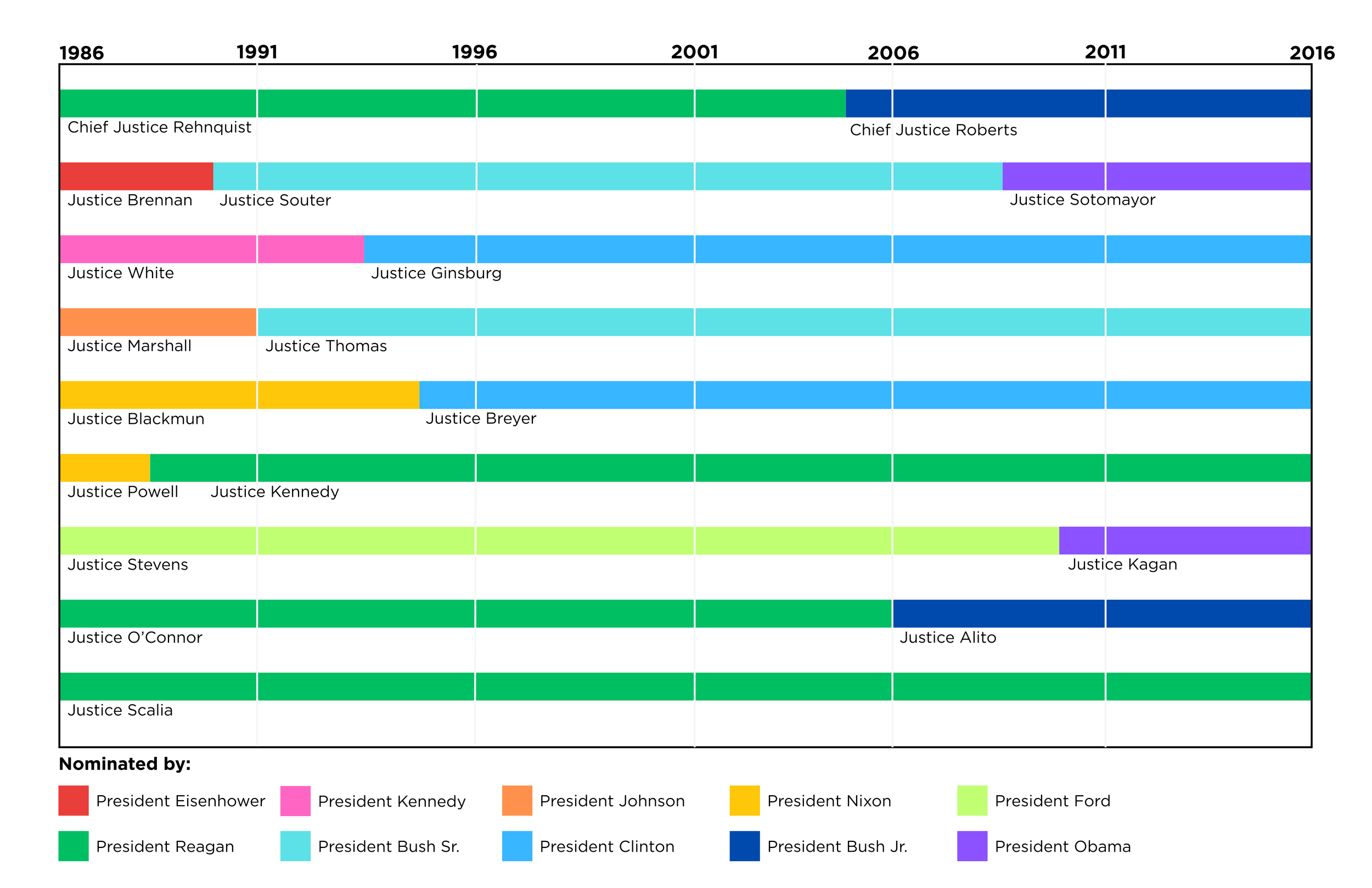
ANTONIN SCALIA
Associate Justice (1986 - 2016)

QUICK FACTS
APPOINTED BY
Ronald Reagan
PRECEDED BY
BIRTHPLACE
New Jersey
SWORN IN
September 26, 1986
SUCCEEDED BY
LAW SCHOOL
Harvard
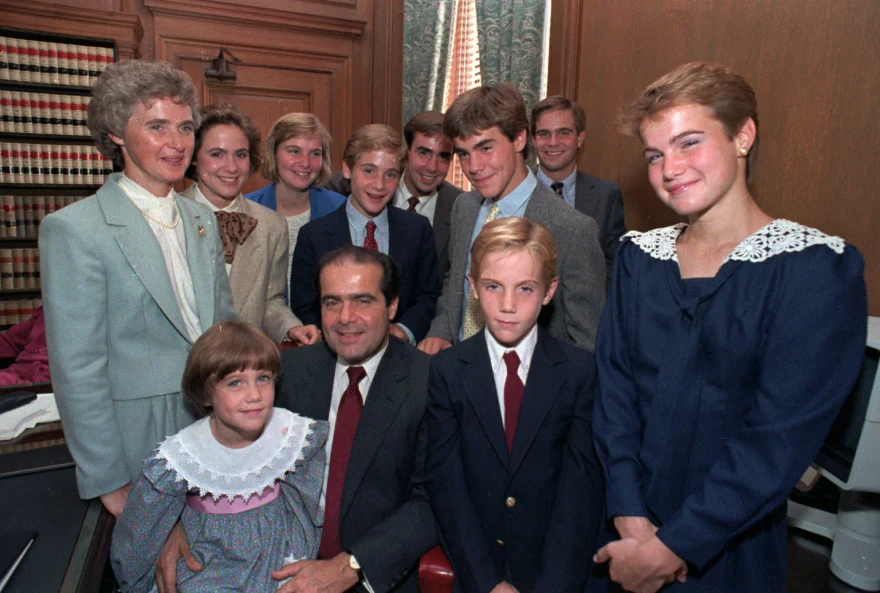
Scalia and his family at the Supreme Court | Credit: Bob Daugherty/AP/CNN
Personal Life and Education
Antonin Scalia was born on March 11, 1936, in Trenton, New Jersey, as the only child of Salvatore Eugene Scalia and Catherine Panaro. His father was an immigrant from Sicily who arrived at Ellis Island with a suitcase full of books and eventually became a professor of Romance languages at Brooklyn College. His mother, the daughter of Italian immigrants, was an elementary school teacher. When Scalia was five years old, the family moved to Elmhurst, Queens. Scalia grew up in a Roman Catholic household and maintained a strong faith throughout his life.
Scalia attended Xavier High School, a Jesuit military academy in Manhattan. At Xavier, Scalia studied Latin and Greek while also achieving the rank of lieutenant colonel in the student regiment. Scalia graduated first in his class from high school and enrolled at Georgetown University for college. At Georgetown University, where Scalia was a champion debater and and studied abroad at the University of Fribourg in Switzerland. In 1957, he graduated summa cum laude from Georgetown as valedictorian with a B.A. in history.
Scalia then attended Harvard Law School, where he was the Notes Editor for the Harvard Law Review. In 1960, he graduated magna cum laude and married his wife, Maureen McCarthy. The same year, Scalia was also awarded the Sheldon Prize Fellowship, which allowed him to spend a year traveling through Europe with his new wife. Together, they had nine children.

President Reagan and Scalia in the Oval Office | Credit: The Wall Street Journal
Early Career
In 1961, Scalia began working at the Cleveland office of Jones, Day, Cockley and Reavis, where he spent six years specializing in commercial law. Despite his success in private practice, he stated that he felt a stronger pull toward the theoretical and academic dimensions of the law. In 1967, Scalia accepted a position as a professor at the University of Virginia School of Law, where he taught administrative law. In 1971, Scalia he was called to Washington, D.C., to serve as the first general counsel for the Office of Telecommunications Policy under President Richard Nixon. In this role, Scalia was instrumental in formulating federal policies for the then-emerging cable television industry.
In 1972, Scalia was appointed chairman Administrative Conference of the United States, where he was tasked with improving the efficiency of the federal bureaucracy. In 1974, Nixon nominated Scalia for the position of Assistant Attorney General for the Office of Legal Counsel (OLC). Following Nixon’s resignation, President Gerald Ford reaffirmed his nomination, and Scalia was confirmed that August. At the end of the Ford administration in 1977, Scalia became a professor at the University of Chicago Law School and later a visiting professor at Stanford and Georgetown. During this time, he also served as an editor for Regulation magazine at the American Enterprise Institute.
In 1982, President Ronald Reagan appointed Scalia to the United States Court of Appeals for the D.C. Circuit. In his time on the D.C. Circuit, Scalia served with then-Judge Ruth Bader Ginsburg, who he would later serve with on the Supreme Court and become life long friends with.
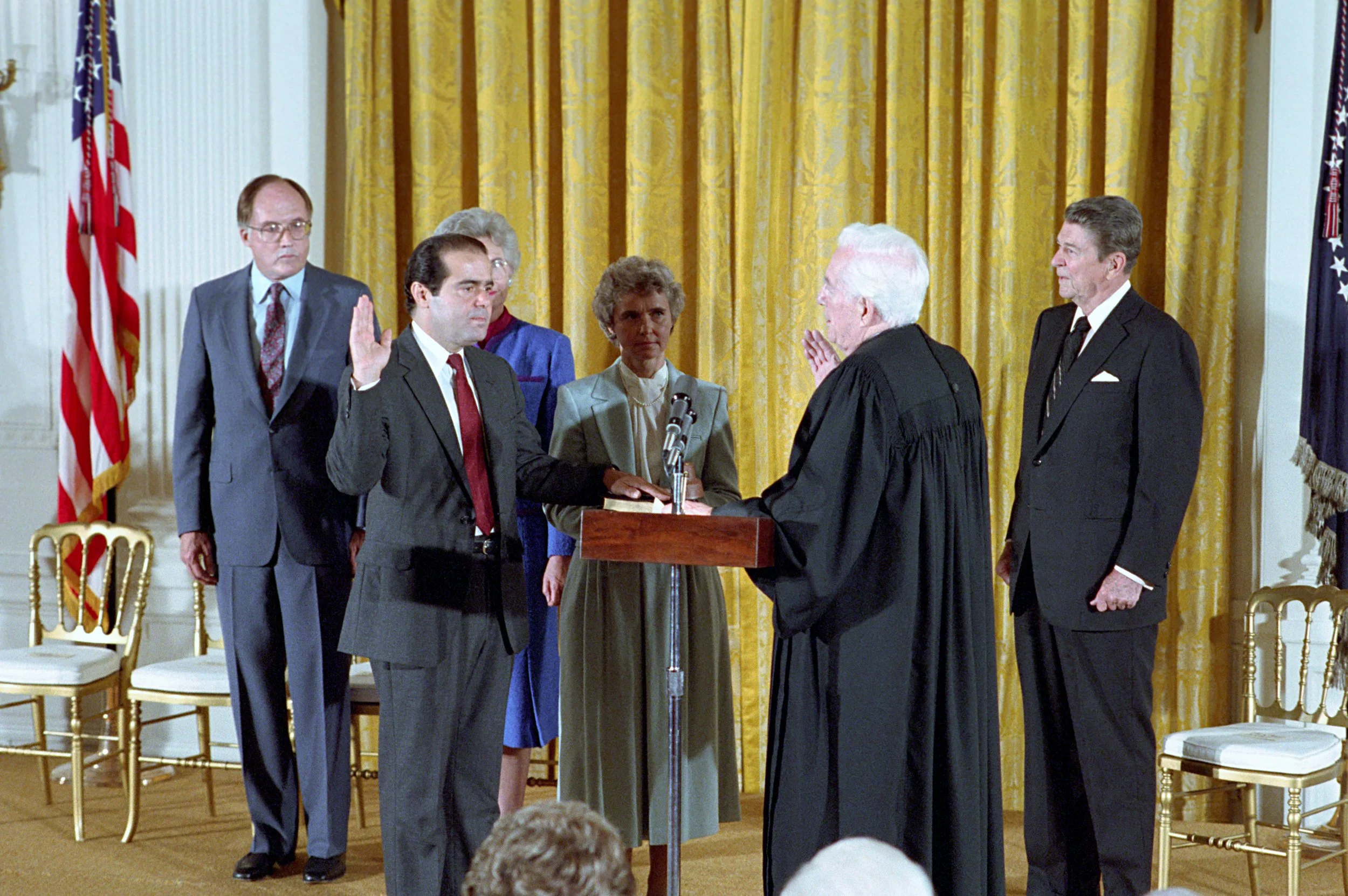
Scalia being sworn in as an Associate Justice of the Supreme Court at the White House | Credit: White House Photo Collection
Nomination to the Supreme Court
When Chief Justice Warren Burger retired in June of 1986, President Reagan elevated Associate Justice William Rehnquist to succeed him, creating a vacancy for Rehnquist’s seat on the Court. Reagan’s advisors proposed two names for the vacancy, Robert Bork and Antonin Scalia. While Bork was older and more established as a scholar, Reagan ultimately chose Scalia because he was younger, more charismatic, and carried the historic significance of being the first Italian American nominated to the high court. Reagan officially announced Scalia’s nomination on June 17, 1986.
Scalia’s confirmation hearings before the Senate Judiciary Committee went smoothly, which contrasted with the contentious battle over Rehnquist’s elevation that occurred simultaneously. On September 17, 1986, the United States Senate confirmed Scalia by a unanimous vote of 98–0. Scalia was commissioned on September 25, 1986, and he took his judicial oath the following day.
Opinions
by Justice Scalia
R.A.V. v. City of St. Paul (1992)
Alabama v. Shelton (2002)
Crawford v. Washington (2004)
Gall v. United States (2008)
District of Columbia v. Heller (2008)
Melendez-Diaz v. Massachusetts (2009)
McDonald v. Chicago (2010)
Brown v. Entertainment Merchants (2011)
McQuiggens v. Perkins (2013)
What the Court looked like during Justice Scalia’s tenure