Alabama v. White
Home | All Cases | Criminal Procedure | Alabama v. White
Case Overview
CITATION
ARGUED ON
DECIDED ON
DECIDED BY
496 U.S. 325
Apr. 17, 1990
Jun. 11, 1990
Legal Issue
Does an anonymous tip provide the police with reasonable suspicion sufficient to stop and search an individual’s car?
Holding
Yes, an anonymous tip may create reasonable suspicion to conduct a traffic stop if the police can corroborate their observations with the tip’s assertions.
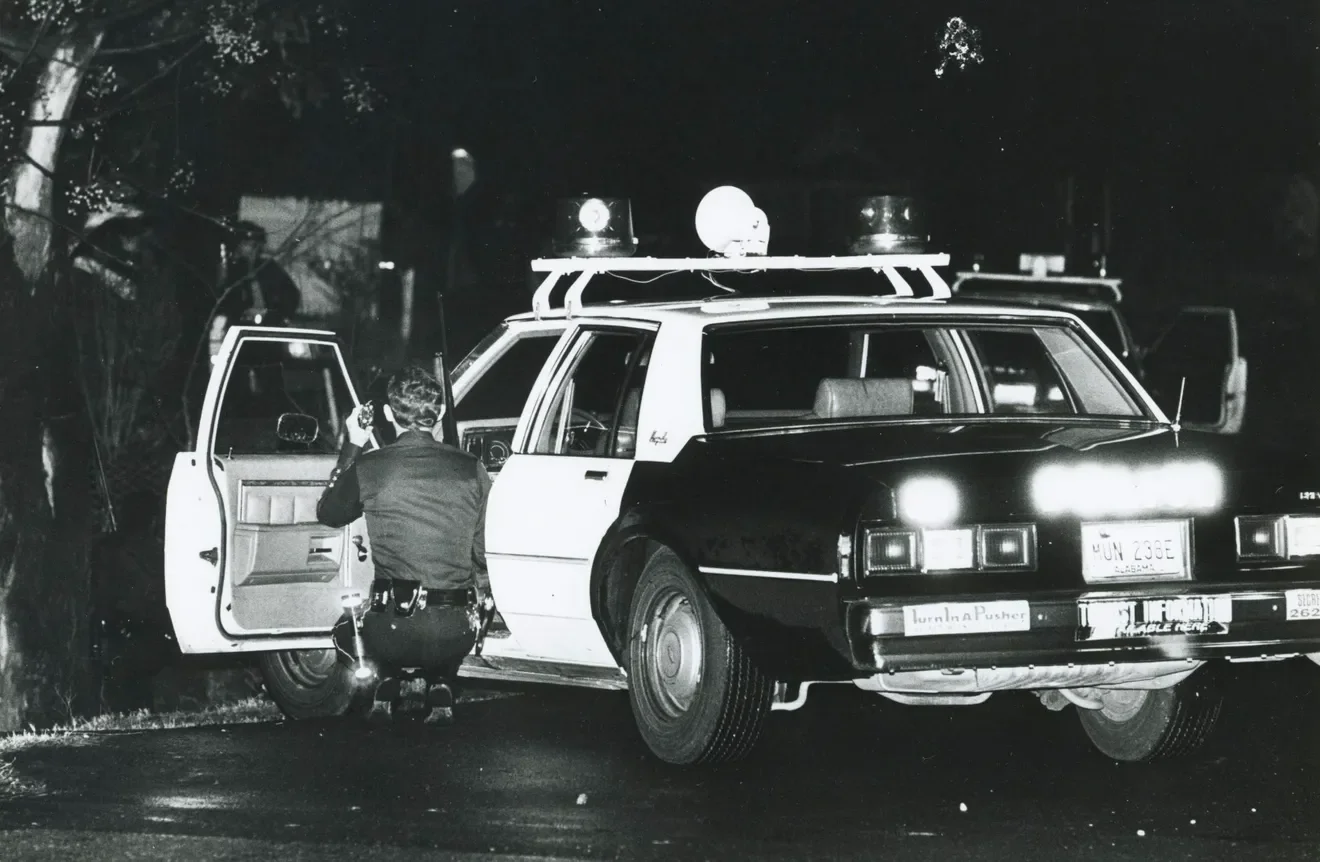
Photograph of a vehicle from the Montgomery County Sheriff’s Department | Credit: Montgomery Advertiser
Background
On April 22, 1987, Corporal B. H. Davis of the Montgomery Police Department received an anonymous telephone call stating that Vanessa White would be leaving 235-C Lynwood Terrace Apartments at a specific time in a brown Plymouth station wagon with a broken right taillight lens. The caller alleged that White would be heading to Dobey’s Motel and “would be in possession of about an ounce of cocaine inside a brown attaché case.” Corporals Davis and P. A. Reynolds traveled to the apartment complex, located the described vehicle, and observed White leave the building carrying nothing in her hands before entering the station wagon. The officers followed the vehicle along the most direct route toward Dobey’s Motel and requested a patrol unit to execute an investigatory stop just short of the motel. After Corporal Davis informed White of the drug suspicion and obtained her consent to search the vehicle, officers located a locked brown attaché case in the car, and White provided the lock combination. Marijuana was found inside the attaché case, and White was arrested. A subsequent search during processing at the station revealed three milligrams of cocaine in White’s purse.
White was charged in Montgomery County Court with possession of marijuana and possession of cocaine. The trial court denied White’s motion to suppress the drug evidence, so she entered a guilty plea while reserving her right to appeal the denial of her suppression motion. On appeal, the Court of Criminal Appeals of Alabama reversed her conviction, holding that the officers lacked the reasonable suspicion necessary under Terry v. Ohio to justify the investigatory stop of her vehicle and that the seized drugs were therefore inadmissible. The State appealed but were denied by the Supreme Court of Alabama. The U.S. Supreme Court then granted certiorari.
6 - 3 decision for Alabama
Alabama
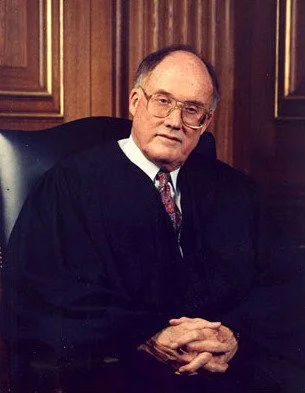


White


O’Connor
Scalia
Kennedy
Rehnquist
Stevens
Marshall
White
Brennan
Blackmun
-
Writing for the Court, Justice Byron White established that while an unverified anonymous tip standing alone rarely demonstrates the veracity of an informant’s basis of knowledge, an informant’s tip may nevertheless carry sufficient “indicia of reliability” to justify an investigative stop under the rules established in Terry v. Ohio (1968). Drawing upon the principles established in Illinois v. Gates (1983), White found that an informant’s veracity, reliability, and basis of knowledge remain “highly relevant in determining the value of his report” when establishing reasonable suspicion, “although allowance must be made in applying them for the lesser showing required to meet that standard.” White emphasized that “[r]easonable suspicion is a less demanding standard than probable cause not only in the sense that reasonable suspicion can be established with information that is different in quantity or content than that required to establish probable cause, but also in the sense that reasonable suspicion can arise from information that is less reliable than that required to show probable cause.” White explained both the quantity and quality of information must be evaluated under the “totality of the circumstances—the whole picture,” meaning that “if a tip has a relatively low degree of reliability, more information will be required to establish the requisite quantum of suspicion than would be required if the tip were more reliable.”
In this case, White conceded that “[a]lthough it is a close case, we conclude that under the totality of the circumstances the anonymous tip, as corroborated, exhibited sufficient indicia of reliability to justify the investigatory stop of respondent's car". While acknowledging that an anonymous tip predicting existing conditions could be made by anyone, White stressed that “[w]hat was important was the caller's ability to predict respondent’s future behavior, because it demonstrated inside information—a special familiarity with respondent’s affairs.” He reasoned that “[b]ecause only a small number of people are generally privy to an individual’s itinerary, it is reasonable for police to believe that a person with access to such information is likely to also have access to reliable information about that individual’s illegal activities.” Ultimately, White concluded that “when significant aspects of the caller’s predictions were verified, there was reason to believe not only that the caller was honest but also that he was well informed, at least well enough to justify the stop.”
-
In his dissenting opinion, Justice John Paul Stevens criticized the majority for upholding an investigative stop based on an anonymous tip that he argued merely predicted ordinary, innocent routine. Stevens wrote that “[m]illions of people leave their apartments at about the same time every day carrying an attaché case and heading for a destination known to their neighbors. Usually, however, the neighbors do not know what the briefcase contains.” He further wrote that “[a]n anonymous neighbor’s prediction about somebody’s time of departure and probable destination is anything but a reliable basis for assuming that the commuter is in possession of an illegal substance—particularly when the person is not even carrying the attaché case described by the tipster.” Stevens pointed out that the record doesn’t reflect “whether Officer Davis made any effort to ascertain the informer’s identity, his reason for calling, or the basis of his prediction about respondent’s destination,” leading Stevens to allege that “for all that this record tells us, the tipster may well have been another police officer who had a ‘hunch’ that respondent might have cocaine in her attaché case.”
Expanding on the supposed risks created by the Court’s ruling, Stevens argued that verifying unexceptional predictive details fails to distinguish genuine inside information regarding criminal activity from malicious or manufactured allegations. Stevens asserted that “[a]nybody with enough knowledge about a given person to make her the target of a prank, or to harbor a grudge against her, will certainly be able to formulate a tip about her like the one predicting Vanessa White’s excursion.” Furthermore, Stevens expressed concern regarding the potential for arbitrary law enforcement intrusions, writing that “under the Court's holding, every citizen is subject to being seized and questioned by any officer who is prepared to testify that the warrantless stop was based on an anonymous tip predicting whatever conduct the officer just observed.” Stevens acknowledged that “the vast majority of those in our law enforcement community would not adopt such a practice,” but he emphasized that “the Fourth Amendment was intended to protect the citizen from the overzealous and unscrupulous officer as well as from those who are conscientious and truthful.” Ultimately, Stevens concluded that the court’s ruling “makes a mockery of that protection.”