Terry v. Ohio
Home | All Cases | Criminal Procedure | Terry v. Ohio
Case Overview
CITATION
ARGUED ON
DECIDED ON
DECIDED BY
392 U.S. 1
Dec. 12, 1967
Jun. 10, 1968
Legal Issue
Does a police officer violate the Fourth Amendment’s protection against unreasonable searches and seizures by stopping an individual and conducting a limited search for weapons without probable cause for an arrest?
Holding
No, police may stop a person if they have a reasonable suspicion that the person has committed or is about to commit a crime, and they may frisk the suspect for weapons if they have reasonable suspicion that the suspect is armed and dangerous.
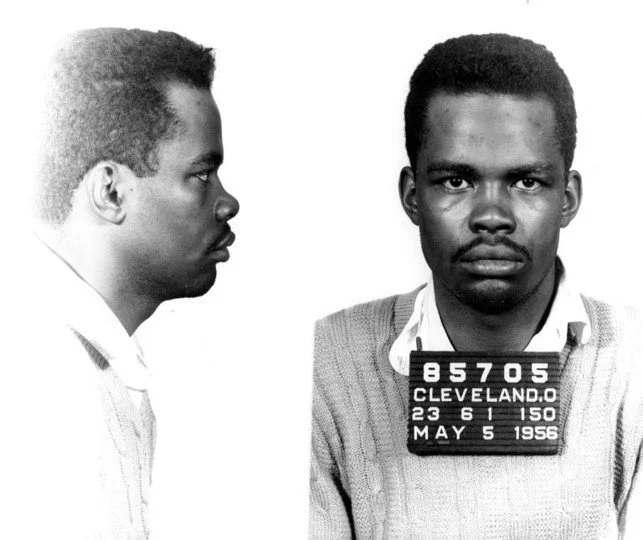
Mugshot of John Terry | Credit: Brett Hammond/Cleveland Civil Rights Trail
Background
On October 31, 1963, Cleveland Police Detective Martin McFadden was on duty in downtown Cleveland when he noticed John Terry and Richard Chilton standing on a street corner. McFadden stated that he’d never seen the two men before and was unable to say what first drew his attention to them, but he testified that he had been on the force for 39 years (35 of that as a detective) and had been assigned to patrol this part of downtown Cleveland for shoplifters and pickpockets for 30 years. McFadden observed Terry walk down the street, look through a store window, then walk a short distance further before turning around and returning to where he started, stopping to peer in the store window again on his way back. Chilton then did the same, and McFadden watched as the pair practiced this routine several times. At some point, a third man, Katz, joined them and the three began walking down the street toward the store. McFadden suspected the men were casing the store in preparation for a robbery, so he followed and confronted them. McFadden asked for their names, but they only mumbled in response. McFadden then frisked Terry and felt a pistol in his jacket, but he was unable to remove it. McFadden ordered three men into the store, where he removed Terry’s jacket and discovered a .38 caliber revolver. At that point, McFadden ordered all three men to raise their hands and face the wall. McFadden then searched Chilton and Katz, discovering a revolver in Chilton’s coat but nothing on Katz.
McFadden arrested Terry and Chilton for suspicion of carrying illegally concealed weapons, and both men were charged and tried in the Ohio Court of Common Pleas for Cuyahoga County. Terry’s lawyer filed a motion to suppress the evidence of the discovered pistol under the exclusionary rule, arguing that McFadden’s frisk violated the Fourth Amendment’s protection from unreasonable search and seizure. The trial judge denied his motion and Terry was convicted. Terry appealed to the Ohio District Court of Appeals, which affirmed his conviction. He subsequently appealed to the Supreme Court of Ohio, but his appeal was dismissed. The U.S. Supreme Court then granted certiorari.
8 - 1 decision for Ohio
Terry

Ohio




Marshall
Stewart
Harlan II
Black
White
Douglas
Brennan
Warren
Fortas

-
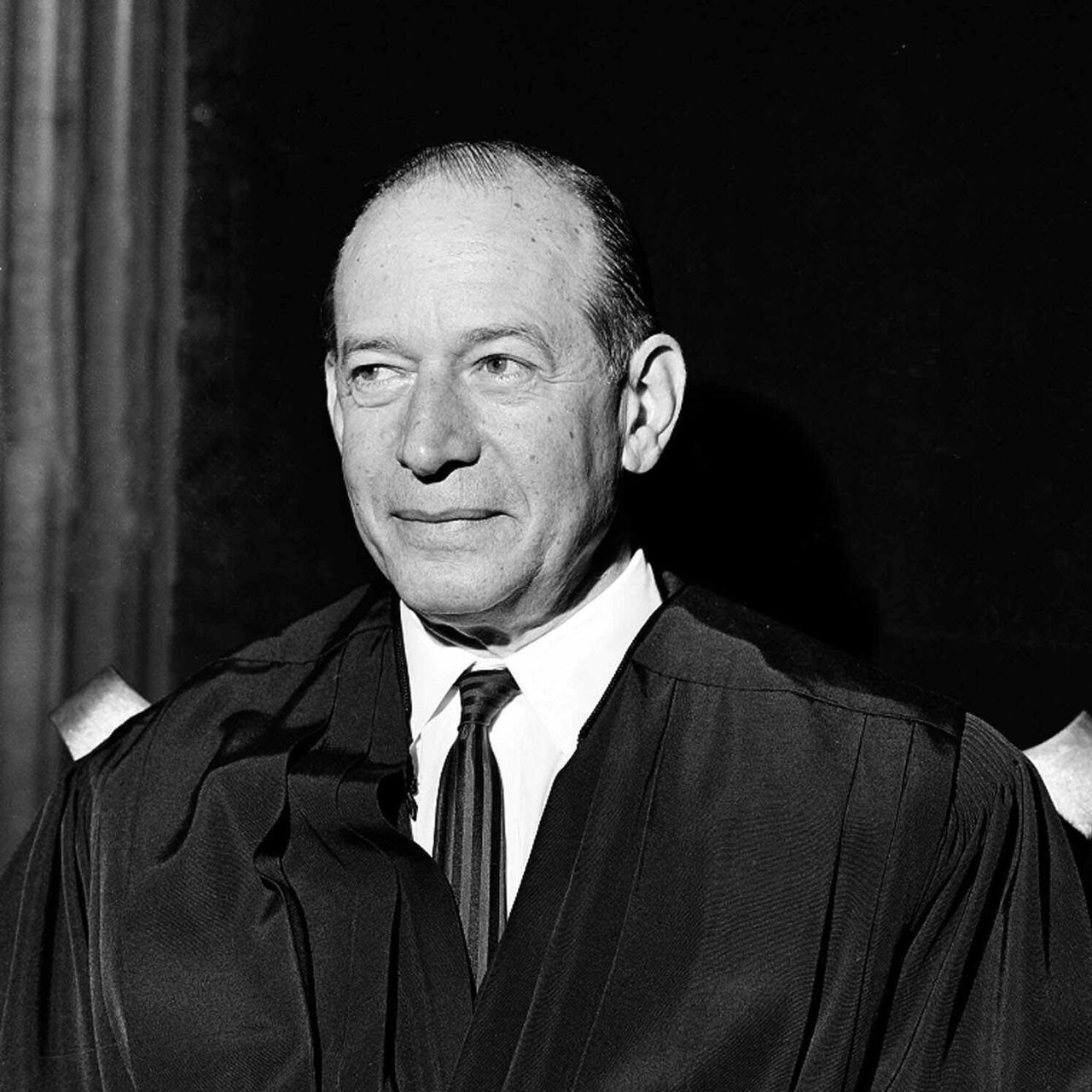
Writing for the Court, Chief Justice Earl Warren first addressed the threshold question of whether a “stop and frisk” fell outside the scope of the Fourth Amendment. Warren emphasized that the Fourth Amendment protects people rather than places, writing that “personal security belongs as much to the citizen on the streets of our cities as to the homeowner closeted in his study to dispose of his secret affairs.” He defined a “seizure” as occurring whenever a police officer restrains an individual’s freedom to walk away, and a “search” as including any careful exploration of the outer clothing in an attempt to find weapons. Warren rejected the argument that a stop and frisk was exempt from constitutional oversight merely because it didn’t constitute an arrest or a full-blown search, writing that it’s “a serious intrusion upon the sanctity of the person, which may inflict great indignity and arouse strong resentment, and it is not to be undertaken lightly.” In this case, Warren stated that Terry was “[u]nquestionably… entitled to the protection of the Fourth Amendment as he walked down the street in Cleveland,” and that the proper inquiry was whether the intrusion was reasonable under all the circumstances.
To evaluate the constitutionality of a stop and frisk, Warren turned to the Fourth Amendment’s general proscription against unreasonable searches and seizures, noting that swift, on-the-spot street investigations can’t practically be subjected to the warrant procedure. Warren established that the reasonableness of such an intrusion had to be evaluated by balancing the need to search or seize against the invasion that the action entailed. Under this framework, the police must be able to justify an intrusion by pointing to specific and articulable facts, alongside rational inferences based on their experience, rather than relying on inarticulate hunches or subjective good faith. Warren emphasized that the facts had to be judged against an objective standard: whether the information available to the officer at the moment of the search or seizure would “warrant a man of reasonable caution” to believe the action taken was appropriate.
Recognizing the state’s interest in crime prevention and detection, Warren acknowledged that officers could approach individuals to investigate suspicious behavior even without probable cause to arrest. However, Warren identified a more immediate and compelling interest in ensuring that the officer was not vulnerable to hidden, deadly weapons during an investigation. To protect law enforcement and the public, Warren explained that officers may conduct a protective search for weapons if a reasonably prudent person under similar circumstances would believe that their safety or the safety of others was endangered. Under this rule, officers aren’t required to be absolutely certain that an individual was armed, but the scope of the search is limited to an intrusion designed solely to discover weapons that could be used for an assault, preventing it from being used as a general exploratory search for evidence.
Applying this rule to Terry’s case, Warren concluded that the McFadden’s actions and the subsequent seizure of the weapons were reasonable. Warren explained that McFadden observed the men engage in conduct consistent with casing a store for an armed robbery, which would predictably involve the use of weapons. Warren found that McFadden’s specific, articulable observations, combined with his decades of experience, would lead a reasonably prudent man to believe that the suspects were armed and dangerous, justifying the initial street encounter and later protective seizure. Furthermore, Warren determined that the physical intrusion itself was reasonable in scope because McFadden confined the search to what was minimally necessary to detect weapons. McFadden only patted down the outer clothing of the men and reached inside their garments after detecting the presence of firearms, not before. Warren stated that since the search was strictly limited to neutralizing the immediate threat of danger, the resulting evidence was deemed admissible.
-
In his brief concurrence, Justice Hugo Black noted that he concurs with the judgment and opinion of the Court in this case except where it quotes from Katz v. United States (1967) and the concurring opinion in Warden v. Hayden (1967).
-
In his concurring opinion, Justice John Marshal Harlan II joined in the Court’s judgment but stated that he wrote separately to “fill in a few gaps, as I see them, in its opinion.” Harlan emphasized that an officer’s authority to conduct an on-the-street stop and frisk was bounded by the Fourth Amendment and depended on whether the activity was “reasonable under the circumstances as the officer credibly relates them in court.” Because Ohio didn’t provide statutory authority for police to frisk a suspect based on suspicion generally, Harlan argued that the state court correctly rested its decision on the narrower principle that “when an officer is lawfully confronting a possibly hostile person in the line of duty he has a right, springing only from the necessity of the situation and not from any broader right to disarm, to frisk for his own protection.” Harlan viewed this as “the only satisfactory basis I can think of for affirming this conviction,” but noted that it contained “two logical corollaries that I do not think the Court has fully expressed.”
Regarding the first corollary, Harlan argued that before a protective search could occur, “if the frisk is justified in order to protect the officer during an encounter with a citizen, the officer must first have constitutional grounds to insist on an encounter, to make a forcible stop.” He reasoned that while any citizen or officer possessed the liberty to address questions to others, an individual normally retained an equal right to ignore inquiries and walk away. Thus, he stated, “I would make it perfectly clear that the right to frisk in this case depends upon the reasonableness of a forcible stop to investigate a suspected crime.” Under the second corollary, Harlan asserted that “[w]here such a stop is reasonable, however, the right to frisk must be immediate and automatic if the reason for the stop is, as here, an articulable suspicion of a crime of violence.” He stressed that “[t]here is no reason why an officer, rightfully but forcibly confronting a person suspected of a serious crime, should have to ask one question and take the risk that the answer might be a bullet.”
Applying these principles, Harlan argued that McFadden lacked probable cause for an arrest but possessed an articulable suspicion that Terry was planning a burglary or robbery. Because McFadden’s “justifiable suspicion afforded a proper constitutional basis for accosting Terry, restraining his liberty of movement briefly, and addressing questions to him,” the initial threshold of a lawful forced encounter was satisfied. As a result, Harlan concluded that “Officer McFadden’s right to interrupt Terry’s freedom of movement and invade his privacy arose only because circumstances warranted forcing an encounter with Terry in an effort to prevent or investigate a crime.” Once that threshold encounter was constitutionally justified, Harlan stated that “the officer's right to take suitable measures for his own safety followed automatically,” meaning that the seized revolvers were admissible as evidence.
-
In his concurring opinion, Justice Byron White joined the opinion of the Court but reserved judgment on “some of the Court’s general remarks about the scope and purpose of the exclusionary rule which the Court has fashioned in the process of enforcing the Fourth Amendment.” White noted that he wrote separately to address the constitutional status of street interrogation during an investigative stop, an issue he noted the majority had put aside. He observed that as a general matter, “[t]here is nothing in the Constitution which prevents a policeman from addressing questions to anyone on the streets,” and that “[a]bsent special circumstances, the person approached may not be detained or frisked but may refuse to cooperate and go on his way.” However, when suspicious circumstances justified police intervention, White maintained that “the person may be briefly detained against his will while pertinent questions are directed to him.”
Turning to the constitutional protections retained by the individual during such an interrogation, White stated that “the person stopped is not obliged to answer, answers may not be compelled, and refusal to answer furnishes no basis for an arrest, although it may alert the officer to the need for continued observation.” Regarding the legal foundation of the protective frisk, White asserted that “it is temporary detention, warranted by the circumstances, which chiefly justifies the protective frisk for weapons.” He reasoned that a frisk could serve preventive ends by signaling that suspicion had been aroused, regardless of whether questions were asked or answered. Ultimately, White concluded that “if the investigative stop is sustainable at all, constitutional rights are not necessarily violated if pertinent questions are asked and the person is restrained briefly in the process.”
-
In his dissenting opinion, Justice William Douglas agreed that petitioner was seized and frisked within the meaning of the Fourth Amendment but strongly dissented from the Court’s ruling that such intrusions could be constitutionally justified on less than probable cause. Douglas expressed a fundamental disagreement with the creation of a lower standard than probable cause, writing, “it is a mystery how that ‘search’ and that ‘seizure’ can be constitutional by Fourth Amendment standards, unless there was ‘probable cause’ to believe that (1) a crime had been committed or (2) a crime was in the process of being committed or (3) a crime was about to be committed.” Douglas pointed out that the Court itself disclaimed the existence of probable cause to believe Terry was committing a crime and observed that had an officer sought a warrant prior to the encounter, no magistrate could’ve issued one. Douglas criticized the majority for expanding executive discretion beyond judicial oversight, writing that “[w]e hold today that the police have greater authority to make a ‘seizure’ and conduct a ‘search’ than a judge has to authorize such action. We have said precisely the opposite over and over again.”
Highlighting constitutional history, Douglas argued that warrantless searches and seizures had traditionally been constrained by the strict standard of probable cause and shouldn’t be replaced by vague concepts. He wrote, “[t]he term ‘probable cause’ rings a bell of certainty that is not sounded by phrases such as ‘reasonable suspicion.’” Tracing the Fourth Amendment’s origins back to the colonial rejection of general warrants and writs of assistance, Douglas observed that “common rumor or report, suspicion, or even ‘strong reason to suspect’ was not adequate to support a warrant for arrest” under established jurisprudence. He argued that departing from this historic standard compromised personal security, maintaining, “[t]he infringement on personal liberty of any ‘seizure’ of a person can only be ‘reasonable’ under the Fourth Amendment if we require the police to possess ‘probable cause’ before they seize him. Only that line draws a meaningful distinction between an officer’s mere inkling and the presence of facts within the officer’s personal knowledge which would convince a reasonable man that the person seized has committed, is committing, or is about to commit a particular crime.”
Douglas concluded by warning against bowing to societal pressures to dilute constitutional protections for the sake of police efficiency. He contended that granting law enforcement the power to conduct searches and seizures on suspicion represented a profound departure from constitutional design, writing that “[t]o give the police greater power than a magistrate is to take a long step down the totalitarian path.” Reaffirming the strict mandate of the Fourth Amendment, Douglas wrote, “[u]ntil the Fourth Amendment, which is closely allied with the Fifth, is rewritten, the person and the effects of the individual are beyond the reach of all government agencies until there are reasonable grounds to believe (probable cause) that a criminal venture has been launched or is about to be launched.” While Douglas acknowledged the “powerful hydraulic pressures throughout our history that bear heavily on the Court to water down constitutional guarantees and give the police the upper hand,” but he warned against eroding fundamental liberties. Ultimately, Douglas concluded that "if the individual is no longer to be sovereign, if the police can pick him up whenever they do not like the cut of his jib, if they can ‘seize’ and ‘search’ him in their discretion, we enter a new regime. The decision to enter it should be made only after a full debate by the people of this country.”