United States v. Jones
Home | All Cases | Criminal Procedure | United States v. Jones
Case Overview
CITATION
ARGUED ON
DECIDED ON
DECIDED BY
565 U.S. 400
Nov. 8, 2011
Jan. 23, 2012
Legal Issue
Does the warrantless use of a tracking device on a suspect’s vehicle to monitor its movements on public streets violate the Fourth Amendment’s protection from unreasonable search and seizure?
Holding
Yes, the warrantless use of a tracking device on a suspect’s vehicle violates the Fourth Amendment because it constitutes a search requiring a warrant.
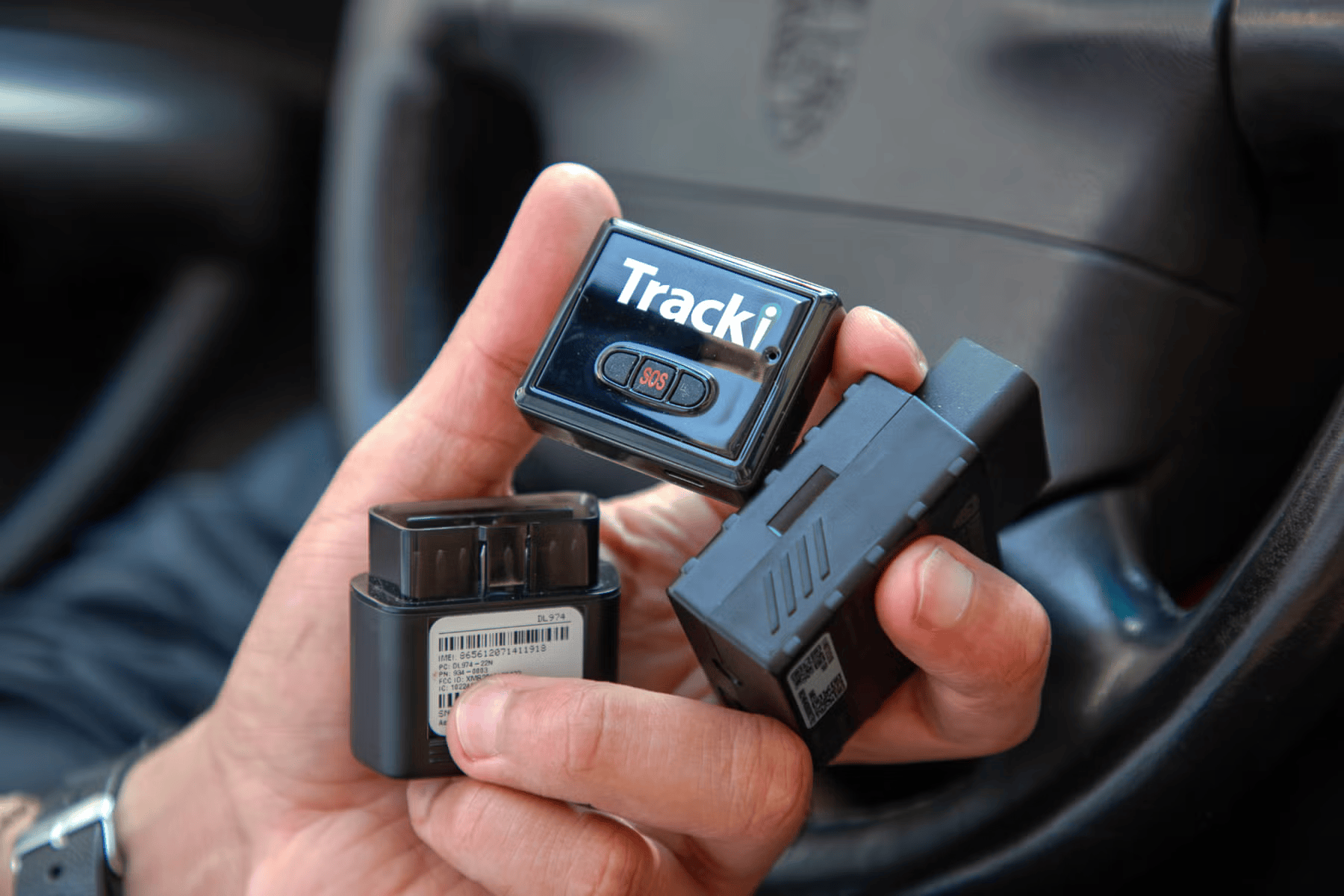
GPS car trackers | Credit: Sheilah Vellari/Road & Track
Background
In 2004, Antoine Jones, the owner and operator of a nightclub in Washington, D.C., became the target of a joint drug trafficking investigation conducted by the FBI and the Metropolitan Police Department. Investigators initially used standard surveillance techniques, including visual monitoring of the nightclub, a camera focused on the front entrance, and a pen register and wiretap on Jones’ cell phone. Based in part on this information, the government applied to the U.S. District Court for the District of Columbia in 2005 for a search warrant to install an electronic tracking device on a Jeep Grand Cherokee registered to Jones’ wife, which Jones exclusively drove. The magistrate issued a warrant authorizing officers to install the device within D.C. and within a 10-day window. However, federal agents failed to comply with either condition, installing the tracking device on the 11th day while the vehicle was parked in a public parking lot in Maryland.
Over the next 28 days, law enforcement continuously tracked the vehicle’s movements, even replacing the device’s battery in a different Maryland parking lot. In total, law enforcement collected over 2,000 pages of locational data. Based on this surveillance, a federal grand jury indicted Jones and several co-conspirators for conspiracy to distribute and possession with intent to distribute cocaine. Before trial, Jones filed a motion to suppress the evidence from the tracking device, arguing that the warrantless tracking violated his Fourth Amendment rights. The District Court granted the motion only in part, suppressing data collected while the vehicle was parked in the garage at Jones’ residence, but admitting the remaining data because drivers on public thoroughfares have no reasonable expectation of privacy. Jones’ first trial in October 2006 ended in a hung jury on the conspiracy charge, but in March 2007, a grand jury returned a second indictment charging Jones with the same conspiracy. At his second trial, the prosecution re-introduced the data from the tracking device. The jury found Jones guilty, and the district court sentenced Jones to life in prison. On appeal, the U.S. Court of Appeals for the District of Columbia Circuit reversed Jones’ conviction, holding that the admission of evidence obtained from the warrantless use of the GPS tracking device violated the Fourth Amendment. The U.S. Supreme Court subsequently granted certiorari.
Unanimous decision for Jones
U.S.
Jones






Thomas
Scalia
Kennedy
Roberts
Ginsburg
Sotomayor
Alito
Kagan
Breyer
-
Writing for the Court, Justice Antonin Scalia held that “the Government’s installation of a GPS device on a target’s vehicle, and its use of that device to monitor the vehicle’s movements, constitutes a ‘search’” under the Fourth Amendment. Scalia emphasized that it’s “beyond dispute that a vehicle is an ‘effect’ as that term is used in the Amendment” and stated that at its core, the Fourth Amendment embodies “a particular concern for government trespass upon the areas (‘persons, houses, papers, and effects’) it enumerates.” Scalia explained that when the government “physically occupied private property for the purpose of obtaining information,” it engaged in an intrusion that “would have been considered a ‘search’ within the meaning of the Fourth Amendment when it was adopted.”
Scalia noted among the Court’s precedent, Fourth Amendment jurisprudence “was tied to common-law trespass, at least until the latter half of the 20th century.” Scalia clarified that while later decisions following Katz v. United States (1967) established that “the Fourth Amendment protects people, not places” and focused on whether officers violated an individual’s reasonable expectation of privacy, “the Katz reasonable-expectation-of-privacy test has been added to, but not substituted for, the common-law trespassory test.” He asserted that at the very least, courts must “assur[e] preservation of that degree of privacy against government that existed when the Fourth Amendment was adopted.” Scalia distinguished prior electronic beeper cases such as United States v. Knotts (1983) and United States v. Karo (1984), pointing out that in those cases, the tracking devices were installed in containers with the consent of third-party owners before coming into the defendants’ possession. By contrast, “Jones, who possessed the Jeep at the time the Government trespassorily inserted the information-gathering device, is on much different footing.” Scalia explained that while a technical trespass alone is insufficient, a search undoubtedly occurs when a physical trespass on an enumerated area is combined with “an attempt to find something or to obtain information.”
Turning to Jones’ case, Scalia found that law enforcement conducted an unconstitutional search by physically attaching the tracking device Jones’ vehicle, noting that it was installed on the vehicle in Maryland on the 11th day after warrant was issued, failing to comply with the magistrate’s authorization to install it within 10 days and within D.C. Regarding the government’s argument that the search was reasonable based on reasonable suspicion or probable cause, Scalia ruled that it was “forfeited because it was not raised below.” Ultimately, Scalia concluded that because officers physically invaded personal property to gather information, their actions constituted a Fourth Amendment search, and because they did so without a warrant, it was unreasonable.