Navarette v. California
Home | All Cases | Criminal Procedure | Navarette v. California
Case Overview
CITATION
ARGUED ON
DECIDED ON
DECIDED BY
572 U.S. 393
Jan. 21, 2014
Apr. 22, 2014
Legal Issue
Does the Fourth Amendment’s protection from unreasonable search and seizure require an officer who received information regarding drunken or reckless driving to independently corroborate the behavior before stopping the vehicle?
Holding
No, when acting on information provided by an anonymous tip, officers do not need to personally verify the existence of ongoing criminal activity before initiating an investigatory stop.
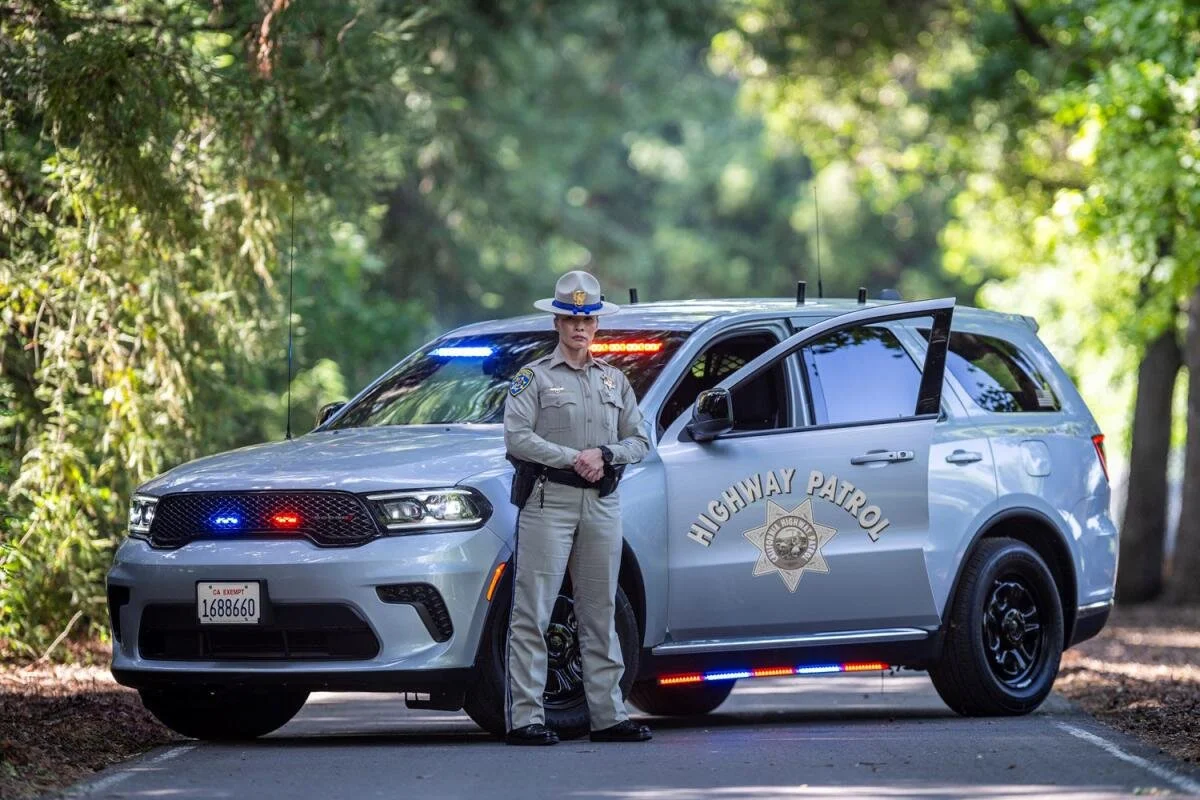
Photograph of a vehicle from the California Highway Patrol | Credit: LA Times
Background
On August 23, 2008, a Mendocino County dispatch team for the California Highway Patrol received a relayed 911 call reporting that a pickup truck had forced the caller off the road. The caller provided specific details identifying the vehicle, location, and direction of travel. A highway patrol officer observed the truck and stopped the vehicle. The officers approached the vehicle, smelled marijuana, and uncovered 30 pounds of marijuana in the trunk. The driver, Lorenzo Prado Navarette, and the passenger, José Prado Navarette, were arrested.
Following their arrests, the Navarettes moved to suppress the seized marijuana, but both the magistrate at the suppression hearing and the Superior Court denied the motion. The Navarettes subsequently pleaded guilty to transporting marijuana and were sentenced to 90 days in jail and three years of probation. The California Court of Appeal affirmed the judgment and the California Supreme Court denied review. The U.S. Supreme Court then granted certiorari.
5 - 4 decision for California
Navarette


California


Thomas
Scalia
Kennedy
Roberts
Ginsburg
Sotomayor
Alito
Kagan
Breyer
-
Writing for the Court, Justice Clarence Thomas held that the traffic stop of Navarette was valid under the Fourth Amendment because “under the totality of the circumstances, the officer had reasonable suspicion that the truck’s driver was intoxicated.” Thomas reaffirmed that brief investigative stops are permissible when an officer possesses “a particularized and objective basis for suspecting the particular person stopped of criminal activity,” and acknowledged that while an anonymous tip alone rarely demonstrates sufficient reliability, it may do so under appropriate circumstances. In this case, Thomas found that the 911 call in this case bore adequate indicia of reliability because “[b]y reporting that she had been run off the road by a specific vehicle—a silver Ford F-150 pickup, license plate 8D94925—the caller necessarily claimed eyewitness knowledge of the alleged dangerous driving.” Thomas also pointed out that the use of the 911 emergency system indicated credibility, explaining that “[g]iven the foregoing technological and regulatory developments, however, a reasonable officer could conclude that a false tipster would think twice before using such a system.”
Turning to whether the reliable tip created reasonable suspicion of an ongoing crime, Thomas reasoned that “the behavior alleged by the 911 caller, ‘viewed from the standpoint of an objectively reasonable police officer, amount[s] to reasonable suspicion’ of drunk driving.” He emphasized that running another vehicle off the highway was not a minor traffic infraction or a conclusory allegation, but rather a specific and dangerous maneuver that “bears too great a resemblance to paradigmatic manifestations of drunk driving to be dismissed as an isolated example of reckless driving.” Regarding the Navarette’s arguments that the conduct could have resulted from innocent distractions or that reasonable suspicion was dispelled when officers observed no additional illegal driving during a five-minute pursuit, Thomas emphasized that reasonable suspicion “need not rule out the possibility of innocent conduct.” Thomas determined that the lack of subsequent suspicious driving didn’t negate the officers’ reasonable suspicion, writing that “the officer’s failure to observe additional suspicious conduct during the short period that he followed the truck did not dispel the reasonable suspicion of drunk driving, and the officer was not required to surveil the truck for a longer period.” Ultimately, Thomas concluded that “[u]nder the totality of the circumstances, we find the indicia of reliability in this case sufficient to provide the officer with reasonable suspicion that the driver of the reported vehicle had run another vehicle off the road.”
-
Joined by: Justice Ruth Bader Ginsburg, Justice Sonia Sotomayor, Justice Elena Kagan
In his dissenting opinion, Justice Antonin Scalia sharply criticized the majority for departing from established Fourth Amendment jurisprudence by permitting an investigative traffic stop based on an uncorroborated anonymous tip. Scalia emphasized that law enforcement knew nothing about the tipster’s identity, location, or credibility, noting that “eliminating accountability . . . is ordinarily the very purpose of anonymity” and that an unnamed tipster “can lie with impunity.” Scalia rejected the majority’s assertion that the tip was reliable simply because it accurately described the truck’s license plate and location, stating that “everyone in the world who saw the car would have that knowledge.” Scalia dismissed the majority’s attempt to classify the call as a “present sense impression” or “excited utterance,” pointing out that the caller had sufficient time to observe the license plate, bring her car to a halt, write down the number, and dial police, thereby negating the immediacy required for such a hearsay exception. Scalia similarly rejected the Court’s reliance on modern 911 tracing technology, asserting that “[i]t is the tipster’s belief in anonymity, not its reality, that will control his behavior.”
Regarding the Navarettes’ stop, Scalia argued that an allegation of being run off the road didn’t establish reasonable suspicion of an ongoing crime such as intoxicated driving. Scalia noted that a single isolated driving maneuver could result from numerous non-intoxicated causes, including cell phone distractions, arguments, avoiding obstacles, or personal animus. He stressed that the officers’ subsequent five-minute surveillance of the truck, during which the petitioners drove irreproachably and committed no traffic violations—did not merely fail to corroborate the tip, but affirmatively undermined the suspicion of drunkenness. Responding to the majority’s argument that an intoxicated driver might temporarily drive carefully upon spotting a marked patrol car, Scalia wrote, “I subscribe to the more traditional view that the dangers of intoxicated driving are the intoxicant’s impairing effects on the body—effects that no mere act of the will can resist,” concluding that “a driver soused enough to swerve once can be expected to swerve again—and soon.”
Scalia summarized the majority’s framework as a “freedom-destroying cocktail consisting of two parts patent falsity: (1) that anonymous 911 reports of traffic violations are reliable so long as they correctly identify a car and its location, and (2) that a single instance of careless or reckless driving necessarily supports a reasonable suspicion of drunkenness.” Scalia warned of the far-reaching consequences for the general public, writing that “[d]runken driving is a serious matter, but so is the loss of our freedom to come and go as we please without police interference.” Ultimately, Scalia concluded that “[a]fter today’s opinion all of us on the road, and not just drug dealers, are at risk of having our freedom of movement curtailed on suspicion of drunkenness, based upon a phone tip, true or false, of a single instance of careless driving.”