Michigan v. Long
Home | All Cases | Criminal Procedure | Michigan v. Long
Case Overview
CITATION
ARGUED ON
DECIDED ON
DECIDED BY
463 U.S. 1032
Feb. 23, 1983
Jul. 6, 1983
Legal Issue
Does the protective search of the passenger compartment of a suspect’s vehicle during a lawful investigatory stop violate the Fourth Amendment’s protection from unreasonable search and seizure?
Holding
No, a protective search of a vehicle’s passenger compartment is permissible under the Fourth Amendment if police officers possess a reasonable belief based on specific and articulable facts that the suspect is dangerous and may gain immediate control of weapons.
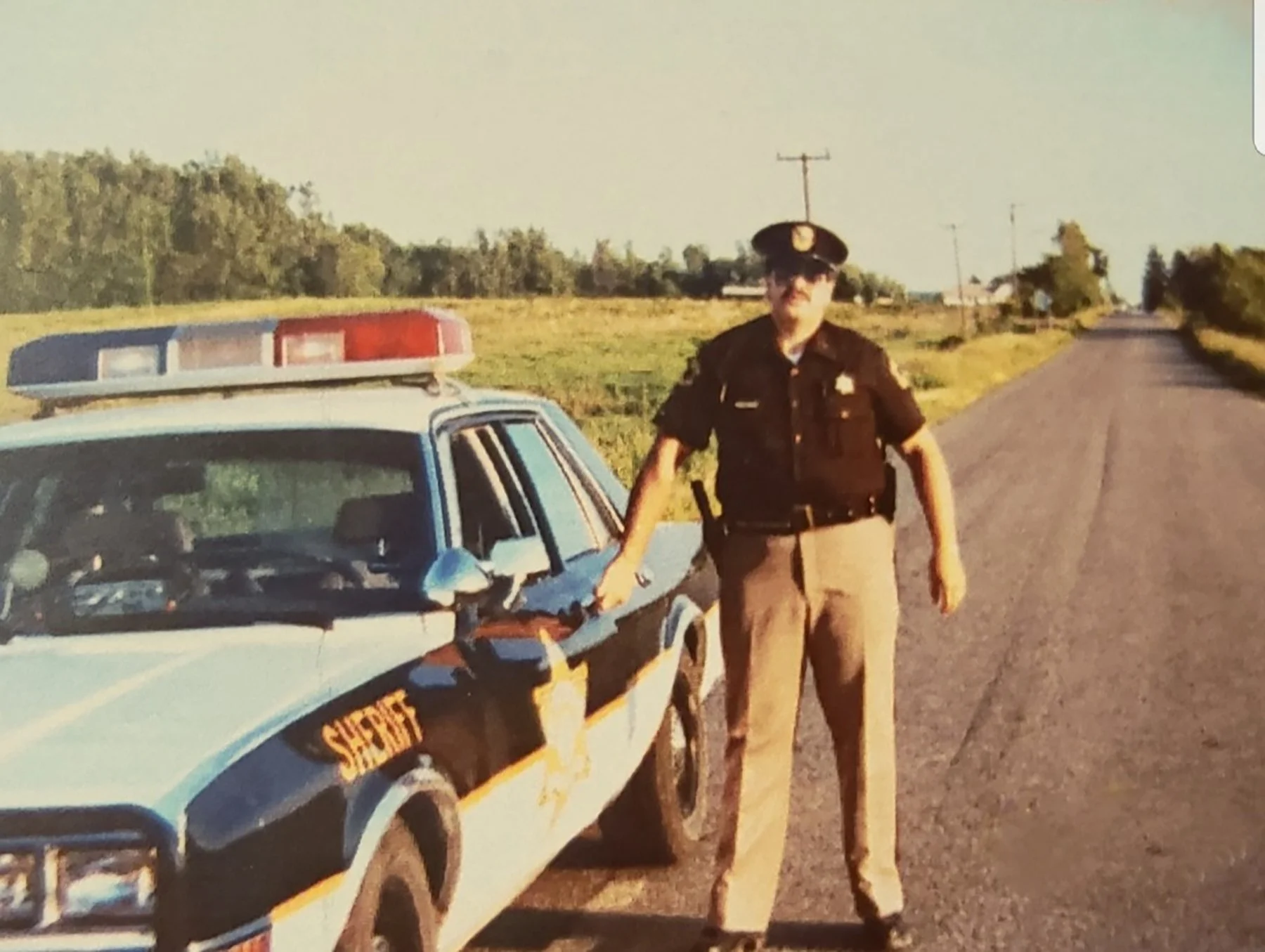
Montcalm County, Michigan Sheriff Deputy Richard White photographed in the 1980s | Credit: Elizabeth Walden/Daily News
Background
Shortly after midnight one evening, Deputies Howell and Lewis of the Barry County Sheriff’s Department were on patrol in a rural area when they observed a vehicle traveling erratically and at excessive speed. The deputies observed the vehicle turn down a side road and swerve into a ditch. When the deputies investigated, the driver, David Long, met deputies at the rear of his vehicle. Long left his driver-side door open and his car was still in the ditch with the trunk protruding out into the road.
Deputy Howell requested Long’s driver’s license, but Long ignored his initial request. After asking again, Long produced his driver’s license. Deputy Howell then asked Long for his vehicle’s registration, but Long again failed to respond. When Deputy Howell repeated his request, Long began walking back to the open door of his vehicle. The deputies followed Long as he approached his vehicle and observed a large hunting knife on the floorboard of the driver’s side. The deputies then stopped Long from walking closer to his vehicle and subjected him to a protective patdown in accordance with Terry; no weapons were found on Long. After the patdown, Deputy Howell used his flashlight to look for weapons inside Long’s vehicle without entering it. Deputy Howell noticed something protruding from the armrest of the front seat, which he discovered to be an open pouch containing marijuana. A further search of the vehicle’s interior, including the glovebox, revealed no additional contraband. The deputies decided to impound Long’s vehicle, and a later search of Long’s trunk revealed approximately 75 pounds of marijuana.
After being charged in the Barry County Circuit Court, Long moved to suppress the marijuana seized from the interior and trunk of his vehicle. Long’s motion was denied and he was subsequently convicted of possession of marijuana. The Michigan Court of Appeals affirmed Long’s conviction, holding that the search of Long’s passenger compartment was a valid protective search under Terry v. Ohio (1968) and the search of Long’s trunk was valid as an inventory search under South Dakota v. Opperman (1976). On appeal, the Michigan Supreme Court reversed, holding that the Marijuana seized was inadmissible as fruit of the poisonous tree. The U.S. Supreme Court then granted certiorari.
6 - 3 decision for Michigan
Michigan



Long


O’Connor
Burger
Powell
Rehnquist
Stevens
Marshall
White
Brennan
Blackmun
-
Writing for the Court, Justice Sandra Day O’Connor first addressed the jurisdictional issue raised by Long. Long contended that the Supreme Court lacked jurisdiction over the case because the lower court’s decision rested on an adequate and independent state ground. O’Connor pointed out that prior jurisdictional approaches had been ad hoc and inconsistent, and aimed to establish a uniform standard that respects state court independence while avoiding advisory opinions. Going forward, O’Connor established a “plain statement” presumption, dictating that when a state court decision fairly appears to rest primarily on federal law or to be interwoven with federal law, the Court will assume the state court acted under the belief that federal law compelled its decision. Under this rule, the Court retains jurisdiction unless the state court opinion includes a clear and express statement that federal cases are used merely for guidance and that the decision rests on separate, adequate, and independent state grounds. Applying this presumption to the lower court’s decision in Long’s case, O’Connor concluded that the Court had jurisdiction existed because the Michigan Supreme Court relied exclusively on its understanding of Terry and cited no state authority to support its Fourth Amendment ruling.
Regarding the search of Long’s vehicle, O’Connor held that while the Court’s decision in Terry v. Ohio (1968) involved the protective frisk of a person, the police action in Long’s case “is justified by the principles that we have already established in Terry and other cases.” O’Connor emphasized that the justification behind the frisk in Terry was to protect the officer from a potentially armed and dangerous suspect, and she noted that in Terry, the Court explicitly stated that “ there is ‘no ready test for determining reasonableness other than by balancing the need to search [or seize] against the invasion which the search [or seizure] entails.’” She explained that “the protective search of the passenger compartment of an automobile, limited to those areas in which a weapon may be placed or hidden, is permissible if the police officer possesses a reasonable belief based on ‘specific and articulable facts which, taken together with the rational inferences from those facts, reasonably warrant’ the officer in believing that the suspect is dangerous and the suspect may gain immediate control of weapons.”
O’Connor reaffirmed that the central holding of Terry is neutralizing the threat of physical harm, explaining that “[a]lthough Terry involved the stop and subsequent patdown search for weapons of a person suspected of criminal activity, it did not restrict the preventive search to the person of the detained suspect.” O’Connor stressed that “[r]oadside encounters between police and suspects are especially hazardous, and danger may arise from the possible presence of weapons in the area surrounding a suspect,” creating an “inordinate risk confronting an officer as he approaches a person seated in an automobile.” O’Connor rejected the contention that a suspect briefly detained outside a vehicle poses no danger, writing that “a Terry investigation . . . involves a police investigation ‘at close range’ . . . when the officer remains particularly vulnerable in part because a full custodial arrest has not been effected, and the officer must make a ‘quick decision as to how to protect himself and others from possible danger.’” She explained that a suspect could “break away from police control and retrieve a weapon from his automobile,” or, if not placed under arrest, “will be permitted to reenter his automobile, and he will then have access to any weapons inside.” Regarding any additional evidence that may be found, O’Connor stated that “[i]f, while conducting a legitimate Terry search of the interior of the automobile, the officer should, as here, discover contraband other than weapons, he clearly cannot be required to ignore the contraband, and the Fourth Amendment does not require its suppression in such circumstances.”
Applying this rule to Long’s case, O’Connor determined that the circumstances “clearly justified Deputies Howell and Lewis in their reasonable belief that Long posed a danger if he were permitted to reenter his vehicle.” O’Connor explained that “[t]he hour was late and the area rural,” Long was driving erratically at excessive speed before swerving into a ditch, appeared to be under the influence, failed to respond to repeated requests for his license and registration, and turned back toward his open car door where officers spotted a large hunting knife on the floorboard. O’Connor emphasized that “Long was not frisked until the officers observed that there was a large knife in the interior of the car into which Long was about to reenter,” meaning that the subsequent area search which revealed an open pouch of marijuana was a valid protective measure. Finally, because the Michigan Supreme Court suppressed the marijuana found in the trunk as the fruit of an unlawful interior search without addressing the trial court’s inventory search holding under South Dakota v. Opperman (1976), O’Connor declined to address the trunk search in the first instance, concluding that “[w]e remand this issue to the court below, to enable it to determine whether the trunk search was permissible under Opperman, supra, or other decisions of this Court.”