Florida v. J.L.
Home | All Cases | Criminal Procedure | Florida v. J.L.
Case Overview
CITATION
ARGUED ON
DECIDED ON
DECIDED BY
529 U.S. 266
Feb. 29, 2000
Mar. 28, 2000
Legal Issue
Does the search of an individual based solely on an anonymous tip received by the police violate their Fourth Amendment rights against unreasonable search and seizure?
Holding
Yes, the police may not stop and frisk an individual based solely on an anonymous tip that only describes their location and appearance without providing information regarding any illegal conduct that the individual might be planning.
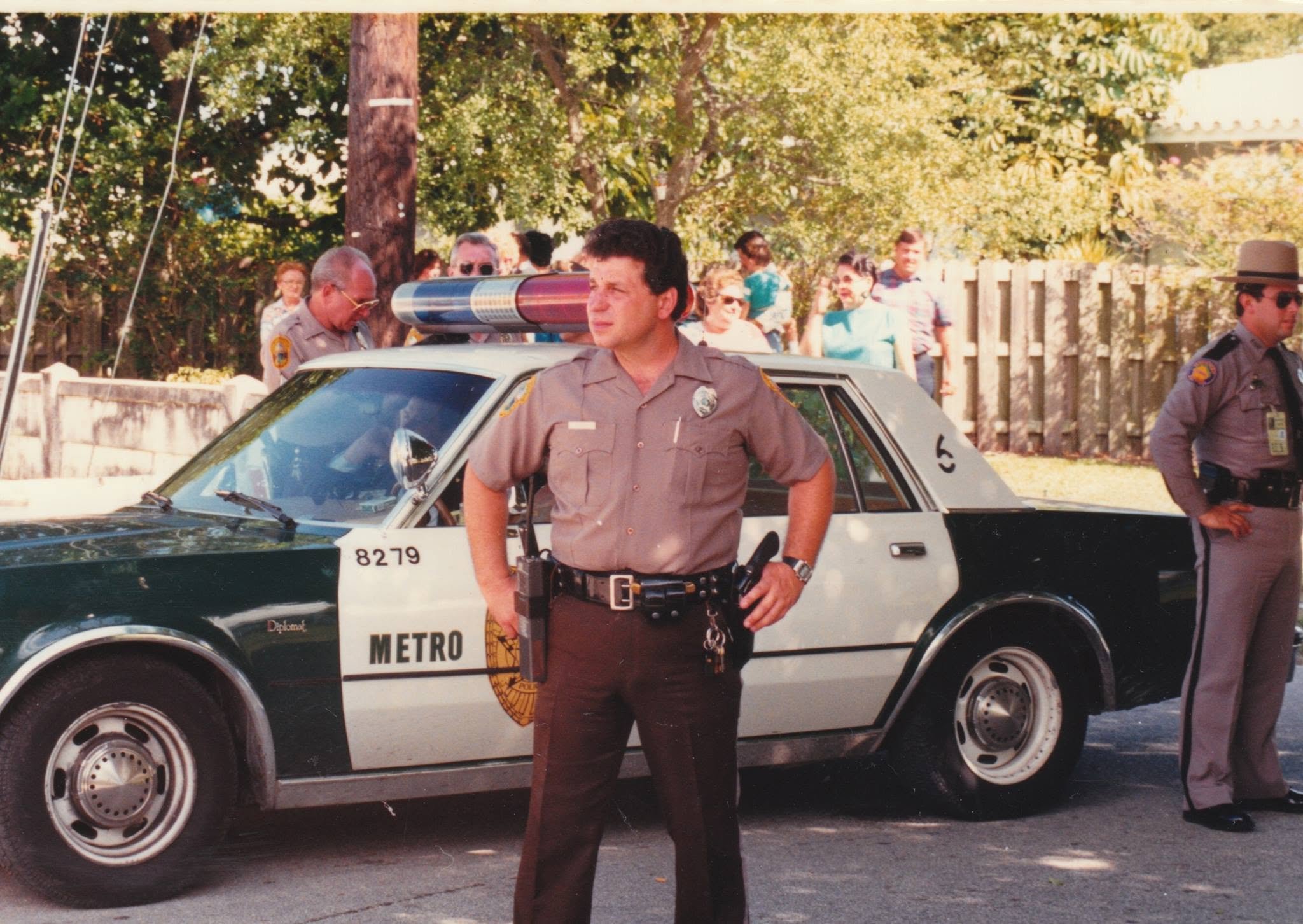
Photograph of an officer from the Miami Dade Sheriff’s Office | Credit: Miami Dade Sheriff’s Office/Facebook
Background
On October 13, 1995, an anonymous caller reported to the Miami-Dade Police Department that a young black male was standing at a specific bus stop, wearing a plaid shirt, and carrying a gun. Two officers responded to the call and arrived to find three black males hanging out at the location. One of the individuals, J.L., who was ten days short of his sixteenth birthday, was wearing a plaid shirt. Apart from the anonymous report, the officers observed no firearm, witnessed no threatening or unusual movements, and had no independent reason to suspect any illegal conduct. One officer approached J.L., ordered him to place his hands against the bus stop, conducted a pat-down search, and seized a gun from his pocket. The second officer frisked the remaining two individuals and located no weapons.
J.L. was charged under Florida law with carrying a concealed firearm without a license and possessing a firearm while under eighteen years of age. J.L. filed a motion to suppress the weapon, arguing that it was the product of an unlawful search, and the trial court granted the motion. An intermediate appellate court reversed the trial court’s order, but the Supreme Court of Florida ultimately invalidated the search under the Fourth Amendment. The U.S. Supreme Court then granted certiorari.
Unanimous decision for J.L.
Florida
J.L.


Thomas
Scalia
Kennedy
Rehnquist
Stevens
Souter
O’Connor
Ginsburg
Breyer
-
Writing for the Court, Justice Ruth Bader Ginsburg established that while Terry v. Ohio (1968) permits protective searches when officers observe unusual conduct creating a reasonable suspicion that criminal activity is afoot and suspects are armed, suspicion arising solely from an unknown caller requires independent corroboration. Ginsburg emphasized that unlike a tip from a known informant whose reputation can be assessed and who can be held accountable for fabrication, “an anonymous tip alone seldom demonstrates the informant’s basis of knowledge or veracity.” Ginsburg clarified that while Alabama v. White (1990) recognized that an anonymous tip could become reliable if police verified the informant’s predictions of future movements, it was a “borderline case” where verified predictive details demonstrated an inside knowledge of the suspect. Ginsburg rejected the State’s argument that verifying a suspect’s visible location and clothing provided sufficient reliability, writing that “[a]n accurate description of a subject’s readily observable location and appearance is of course reliable in this limited sense: It will help the police correctly identify the person whom the tipster means to accuse. Such a tip, however, does not show that the tipster has knowledge of concealed criminal activity. The reasonable suspicion here at issue requires that a tip be reliable in its assertion of illegality, not just in its tendency to identify a determinate person.”
Ginsburg also declined to create a broad “firearm exception” that would lower Fourth Amendment requirements whenever an anonymous call alleged the presence of an illegal gun. Ginsburg acknowledged that firearms pose serious dangers to public safety, but she explained that Terry already addressed that concern by requiring reasonable suspicion rather than probable cause. Ginsburg warned that creating a special firearm exception “would enable any person seeking to harass another to set in motion an intrusive, embarrassing police search of the targeted person simply by placing an anonymous call falsely reporting the target’s unlawful carriage of a gun.” Furthermore, Ginsburg noted that such an exception could easily swallow Fourth Amendment protections by expanding to tips alleging narcotics or other contraband.
Turning to J.L.’s case, Ginsburg concluded that the officers lacked the reasonable suspicion required to stop and frisk J.L.. Ginsburg highlighted that the police acted solely on a phone call from an unknown location by an unknown informant reporting a young black male in a plaid shirt carrying a gun at a bus stop. When officers arrived, they observed three young men standing together, saw no firearm, witnessed no unusual movements, and possessed no independent reason to suspect criminal conduct apart from the tip itself. Because the tip contained no predictive information or other qualifying indicia of reliability, Ginsburg argued that “[a]ll the police had to go on in this case was the bare report of an unknown, unaccountable informant who neither explained how he knew about the gun nor supplied any basis for believing he had inside information about J. L.” She stressed that the fact that the allegation turned out to be correct after the search did not retroactively validate the intrusion, maintaining that “[t]he reasonableness of official suspicion must be measured by what the officers knew before they conducted their search.” Ultimately, Ginsburg concluded that the uncorroborated tip failed to satisfy Fourth Amendment standards, meaning the frisk was unlawful and the seized firearm was inadmissible.