United States v. Hemani
Case Overview
CITATION
608 U.S. __
ARGUED ON
Mar. 2, 2026
DECIDED ON
Jun. 18, 2026
DECIDED BY
Legal Issue
Does a federal law prohibiting the possession of firearms by an unlawful user or addict of any controlled substance violate the Second Amendment’s protection of the right to keep and bear arms?
Holding
Yes, the government’s prosecution under §922(g)(3)’s unlawful user provision is inconsistent with the Second Amendment.
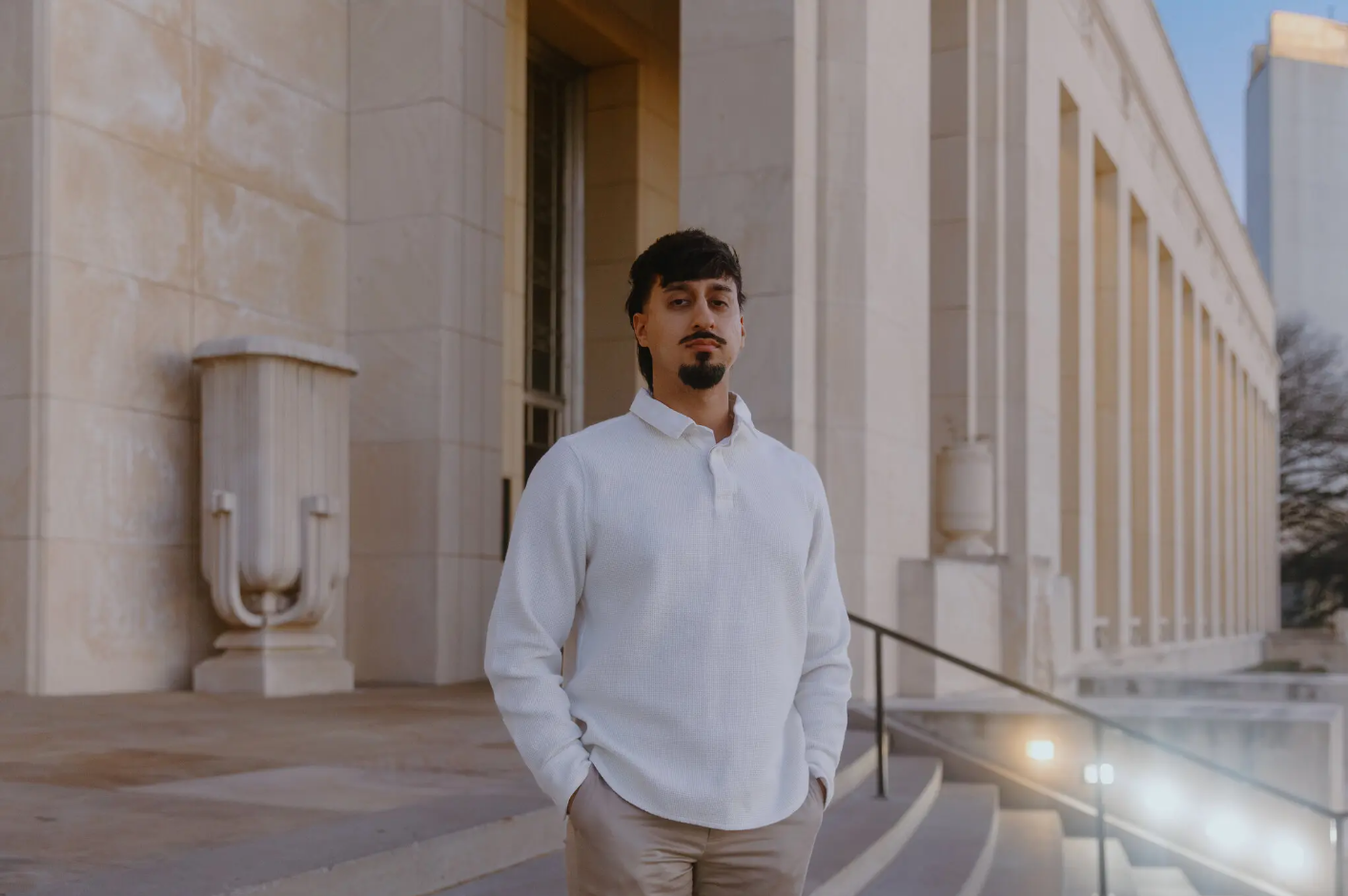
Ali Hemani, the respondent in the case, photographed outside the Supreme Court | Credit: NYT
Background
Ali Hemani was a dual citizen of the United States and Pakistan who was born in Texas. In 2022, the government searched Hemani’s family home after suspecting him and his family members of terrorism-related activities. Hemani was cooperative with law enforcement, surrendering a gun he kept in the house, pointing agents to some marijuana on the property, and consenting to an interview during which he told law enforcement agents that he used marijuana about every other day.
More than six months after the search, and relying solely on Hemani’s admitted use of marijuana, the government prosecuted him under 18 U. S. C. §922(g)(3) for knowingly possessing a gun in his home while being an unlawful user of a controlled substance. Hemani moved to dismiss the indictment, arguing that the government’s effort to enforce §922(g)(3) against him violated the Second Amendment. The U.S. District Court for the Eastern District of Texas granted his motion, which was upheld by the U.S. Court of Appeals for the Fifth Circuit. The U.S. Supreme Court then granted certiorari.
Unanimous decision for Hemani
U.S.
Hemani






Roberts
Thomas
Kavanaugh
Alito
Kagan
Jackson
Barrett
Sotomayor
Gorsuch
-
Writing for the Court, Justice Neil Gorsuch began by analyzing the federal Gun Control Act of 1968, which Hemani was charged under, and the Controlled Substances Act (CSA). Gorsuch explained that §922(g)(3) of the Gun Control Act criminalized the possession of firearms by any individual classified as an “unlawful user of or addicted to any controlled substance.” To define the scope of “controlled substance,” the federal government relied entirely on the classifications of the CSA. As a result, a vast array of substances were swept into the scope of §922(g)(3), including illicit narcotics such as heroin, prescription medications such as Ambien or Adderall, and marijuana. Gorsuch noted that §922(g)(3) imposed severe criminal penalties of up to fifteen years in prison and mandated lifetime disarmament based strictly on one’s status as an unauthorized user of these substances, regardless of whether they were actively intoxicated when they possessed the weapon or even had an intent to misuse it.
Recalling the Court’s holding in District of Columbia v. Heller (2008), Gorsuch reaffirmed that the Second Amendment protects the right of all Americans to keep and bear firearms for self-defense. Gorsuch acknowledged that like most individual rights, the Second Amendment has limits and has historically been regulated by American legislatures. He clarified, however, that “when the government crosses the line from permissible regulation into unconstitutional infringement, courts have a duty to say so in the cases before them—no less in the Second Amendment context than in any other.” Relying on the Court’s holding in New York State Rifle & Pistol Ass’n v. Bruen (2022), Gorsuch explained that to determine whether the government infringed upon the Second Amendment, the Court begins by asking whether the Second Amendment’s terms cover the conduct in question. If it does, the conduct is “presumptively” protected by the Constitution. To overcome that presumption, the government must meet the burden of showing that its regulation is “consistent with the Nation’s historical tradition of firearm regulation.”
As the Court did in United States v. Rahimi (2024), Gorsuch elaborated that the government isn’t required to identify an exact “historical twin” or colonial law identical to its proposed gun regulation. Instead, “the appropriate analysis involves considering whether the challenged regulation is consistent with the principles that underpin our regulatory tradition.” Further, the government may reason by analogy to show that its modern gun regulation is “relevantly similar” to regulations “well-established” in the Nation’s history. Gorsuch noted that while the Court hasn’t exhaustively examined what makes a modern regulation ‘relevantly similar’ to a proposed historical analogue, two factors play a central role: why the government imposed the regulation on that social problem and how the law burdened the right and operated procedurally.
To meet the burden Gorsuch described, the government compared §922(g)(3) to habitual drunkard laws from the Founding Era, arguing that those laws established a tradition of disarming individuals who regularly consumed intoxicating substances in order to safeguard the public.
Gorsuch first responded to the government’s argument that historical drunkard laws are “closely analogous” to why §922(g)(3) targets unlawful users because both groups regularly use intoxicants. Gorsuch pointed out that historical habitual drunkard laws didn’t target citizens who merely drank frequently or regularly, but rather targeted only those who drank so excessively that they became practically incapacitated, lost all self-control, or were rendered entirely incapable of managing their own personal and financial affairs. Gorsuch explained that “[h]ad habitual drunkard laws applied to those who simply drank regularly, many notable early Americans could have faced trouble.” He noted historical examples such as John Adams drinking hard cider with breakfast, George Washington consuming madeira in the evening, and the impressive bar tab the Founding Fathers ran up at a farewell party for then-General Washington shortly before the signing of the Constitution. Since §922(g)(3) swept in individuals who used a controlled substance regularly without any requirement of actual incapacitation, the government’s analogy to habitual drunkard laws failed.
The government argued that historical drunkard laws were “closely analogous” to §922(g)(3) because both disarmed “unusually dangerous” individuals who will misuse firearms to commit violent crimes. Gorsuch responded, however, that “the government misapprehends the purposes animating the historical analogues it invokes.” Beginning with vagrancy laws, which targeted those who didn’t “meet the societal expectation of work,” Gorsuch explained that “laws like these might have sought to promote productivity and suppress any number of real or perceived vices. But they scarcely focused on protecting the public from a ‘categor[y]’ of ‘unusually dangerous’ persons.” Gorsuch moved next to civil commitment laws, which allowed a judge to assign a guardian to a habitual drunkard to take care of them and their estate. He explained that “[b]y their own terms, laws like these did not seek to protect the public from violence so much as to protect habitual drunkards from themselves and their families from financial devastation.” Lastly, Gorsuch addressed surety laws. In some cases, surety laws were designed to “keep the peace” and prevent violence, but even the merely being a habitual drunkard wasn’t enough. The government instead pointed to surety statutes that allowed a judicial officer to require individuals to post sureties of good behavior on individuals who threatened a scandal. Gorsuch explained that such laws typically sought to prevent the community from scandals against good morals, which “is nothing like the purpose the government ascribes to §922(g)(3)’s unlawful user provision.” Gorsuch concluded that these vagrancy, civil commitment, and surety laws were designed to protect the impaired individuals from themselves, preserve their families from financial ruin, and shield communities from scandal. Since these laws didn’t stem from a tradition of disarming individuals based on a generalized presumption of violence or dangerousness, they couldn’t be used to support the government’s prosecution under §922(g)(3).
Gorsuch then shifted to examining how the regulation burdens the right to keep and bear arms, establishing that “[e]ven when a law regulates arms-bearing for a permissible reason… it may not be compatible with the [Second Amendment] if it does so to an extent beyond what was done at the founding.” Gorsuch stated that “the way habitual drunkard statutes worked in the past differs significantly from how §922(g)(3)’s unlawful user provision works today.” He explained that the historical laws targeting habitual drunkards required an individualized judicial process before an individual’s rights or property could be confiscated, whereas §922(g)(3) was essentially an automatic, sweeping status-based ban that immediately stripped a person of their constitutional rights the moment their drug use began without any adjudication or due process.
Gorsuch criticized the underlying purpose of the modern statutory scheme, highlighting the government’s faulty reliance on the CSA to define constitutional boundaries. He explained that “[w]ithout question, some unlawful users of controlled substances can pose a risk of violence. But, by defining its scope through the CSA—a statute animated by a variety of other concerns—it is far from obvious that 18 U. S. C. §922(g)(3) confines its reach to those who are categorically and unusually dangerous.” Gorsuch pointed out that §922(g)(3) treated a person using highly lethal illicit narcotics or occasionally taking a spouse’s prescription sleep aid in the exact same manner as someone who regularly used marijuana, a substance whose legal and cultural status has shifted dramatically across dozens of states. Gorsuch added that “[w]hatever one thinks of these developments, the federal government has not just tolerated them; it helped fuel them. All of which leaves it awkwardly positioned to suggest that the millions of Americans who now regularly use marijuana are categorically and unusually dangerous.”
Gorsuch concluded by clarifying the boundaries of the Court’s ruling by identifying several areas that weren’t implicated by its ruling. He explained that the Court’s ruling doesn’t address efforts to ban addicts or those presently intoxicated from possessing a firearm, nor does it address other prophylactic laws Congress might adopt after determining that users of a particular drug pose a special risk of misusing firearms. Furthermore, the Court’s ruling doesn’t address §922(g)(1)’s provision disarming individuals convicted of felonies or whether the government could prosecute someone under §922(g)(3) with individualized proof that the defendant’s use of marijuana (or any other drug) renders him a danger to himself or others, or that a certain drug always renders its users dangerous because of its potency or for some other reason. Gorsuch stated, “[n]one of those issues is before us and we do not pass on them either way.”
Gorsuch ultimately found that the government failed to meet its burden of providing a regulatory analogue in the Nation’s history and tradition to support its modern regulation of the right to keep and bear arms. Gorsuch concluded that “the government’s analogy fails under every measure it asks us to consider: The historical laws on which it relies targeted different kinds of people, did so for different reasons, and operated in different ways. And faced with all these shortcomings in the government’s submission, we cannot say it has carried its conceded burden of showing its prosecution of Mr. Hemani complies with the Second Amendment.”
-
In his concurring opinion, Justice Clarence Thomas wrote that while he joined the Court’s opinion in full, he wrote separately to call attention to his belief that §922(g)(3) exceeds Congress’ power to regulate interstate commerce under the Commerce Clause.
First, Thomas argued that §922(g)(3) criminalizes intrastate gun possession by making it a felony for certain categories of people to “possess in or affecting commerce, any firearm or ammunition.” In Hemani’s case, federal prosecutors alleged only that the handgun he possessed in his home had moved through interstate commerce at some unspecified time in the past. The government wasn’t required to allege, nor would it have been forced to prove at trial, that Hemani bought the firearm from an out-of-state vendor or personally transported the weapon across state lines. Thomas argued that because §922(g)(3) permits the prosecution of a citizen for purely local, sedentary possession based on the historical transit of the firearm, its jurisdictional hook is merely a nominal requirement that fails to impose any meaningful limit on federal power.
Thomas then evaluated §922(g) under the Court’s Commerce Clause doctrine to demonstrate that the regulation of mere gun possession falls outside the three recognized categories of congressional power. Thomas explained that the statute doesn’t regulate the channels of interstate commerce because it penalizes the possession of a firearm within a state long after any commercial transit through those channels has concluded. Next, he explained that the law doesn’t regulate or protect the instrumentalities, persons, or things in interstate commerce because the government isn’t required to show that the possession in question poses any immediate risk to interstate commerce. Lastly, Thomas argued that §922(g) doesn’t regulate activities that substantially affect interstate commerce because the “mere possession of a firearm that long ago crossed state lines is not ‘economic activity’ in any sense, and the Court has never upheld regulation of intrastate activity that is not ‘economic in nature’ under this category.” Thomas compared the regulation at hand to that which the Court examined in United States v. Lopez (1995), writing that “[l]ike the gun-possession statute at issue in Lopez, §922(g) is not a regulation of economic activity, but a law to combat ‘crime and violence,’ even at the local level.”
Thomas concluded by quoting Marbury v. Madison (1803) to emphasize that “[t]he powers of the legislature are defined, and limited; and that those limits may not be mistaken, or forgotten, the constitution is written.” Ultimately, Thomas ended with a note stating, “[i]t has now been 26 years since a party has received relief in this Court based on a Commerce Clause challenge… This question merits a closer look in an appropriate case. For, like Judge Batchelder, ‘I . . . am unprepared to reduce the Supreme Court’s Lopez decision to an anachronism to be noted in passing but ignored. Congress’s enumerated powers, like Supreme Court opinions setting forth their limits, are, in my view, to be taken seriously.’”