Minnesota v. Dickerson
Home | All Cases | Criminal Procedure | Minnesota v. Dickerson
Case Overview
CITATION
ARGUED ON
DECIDED ON
DECIDED BY
508 U.S. 366
Mar. 3, 1993
Jun. 7, 1993
Legal Issues
1) Does the Fourth Amendment permit police officers to execute a warrantless seizure of nonthreatening contraband detected through the sense of touch during a protective patdown search?
2) Did the officer exceed the scope of the search allowed by Terry when he gained probable cause to believe that the lump in Dickerson’s jacket was contraband?
Holding
1) Yes, police officers may seize nonthreatening contraband detected through touch during a lawful Terry frisk if its identity is immediately apparent.
2) Yes, because the further search of Dickerson’s pocket was constitutionally invalid, the seizure of the cocaine that followed is likewise unconstitutional.
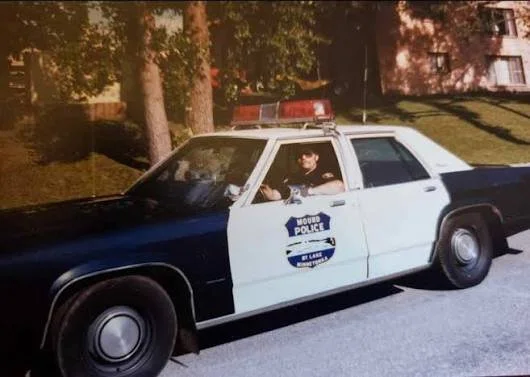
An officer of the Minneapolis Police Department pictured in the 1980s | Credit: Facebook
Background
On the evening of November 9, 1989, two Minneapolis police officers were on patrol in a marked squad car when one of the officers observed Dickerson leaving a 12-unit apartment building known to be a notorious “crack house.” Dickerson began walking toward the police but upon spotting the squad car and making eye contact with one of the officers, he abruptly began walking in the opposite direction and entered a nearby alley.
Based on Dickerson’s evasive actions and the fact that he was leaving a building known for cocaine traffic, the officers followed Dickerson into the alley and ordered him to stop and submit to a patdown search. The officers found no weapons during the patdown search, but one officer noticed a small lump in Dickerson’s jacket pocket. The officer then reached into the pocket and retrieved a small plastic bag containing 1/5 gram of crack cocaine.
Dickerson was arrested and charged in Hennepin County District Court with possession of a controlled substance. Before trial, Dickerson filed a motion to suppress the cocaine, but the trial court denied his motion. Dickerson proceeded to trial and was found guilty. On appeal, the Minnesota Court of Appeals reversed, finding that the initial patdown search was lawful but that the officers exceeded their authority by seizing the cocaine. The Minnesota Supreme Court affirmed, and the U.S. Supreme Court then granted certiorari.
Issue #1
Unanimous decision for Minnesota
Minnesota


Dickerson
Thomas
Scalia
Kennedy
Rehnquist
Stevens
Souter
O’Connor
Ginsburg
Breyer
Issue #2
6 - 3 decision for Dickerson
Minnesota
Dickerson
Thomas
Scalia
Kennedy
Rehnquist
Stevens
Souter
O’Connor
Blackmun
White
-
Writing for the Court, Justice Byron White held that police officers may seize nonthreatening contraband detected through the sense of touch during a protective patdown search, but only if the search is within the bounds established in Terry v. Ohio (1968). White established the plain feel doctrine by drawing an analogy to the plain view doctrine, explaining that the rule permitting warrantless seizures of observed contraband has an “obvious application by analogy to cases in which an officer discovers contraband through the sense of touch during an otherwise lawful search.” Under this framework, if an officer lawfully pats down a suspect’s outer clothing and feels an object “whose contour or mass makes its identity immediately apparent, there has been no invasion of the suspect’s privacy beyond that already authorized by the officer's search for weapons.” White rejected the argument that touch is inherently unreliable or overly intrusive, explaining that Terry itself relies on touch to detect weapons and that requiring probable cause before the seizure “ensures against excessively speculative seizures.” White emphasized that once an object’s identity is known, its seizure "occasions no further invasion of privacy.”
Turning to Dickerson’s case, White found that the officer in this case overstepped the lawful limits of Terry because he gained probable cause only after conducting an unauthorized search. White explained that while the initial stop and patdown for weapons were valid, the officer admitted he didn’t suspect the small lump in Dickerson’s jacket pocket was a weapon. Rather than recognizing it immediately as crack cocaine, the officer determined its identity only after “squeezing, sliding and otherwise manipulating the contents of the defendant’s pocket,” which is troublesome because he already knew the pocket contained no weapon. White warned that allowing officers to expand a weapons frisk in this way creates the danger that police will convert a limited search into the “equivalent of a general warrant to rummage and seize at will.” Ultimately, White concluded that because the officer’s continued search was completely unrelated to the protection of the police officer and others, it constituted an illegal evidentiary search, rendering the resulting seizure of cocaine unconstitutional.
-
In his concurring opinion, Justice Antonin Scalia explained that while he joined the Court’s opinion in its entirety, he was skeptical as to whether the underlying Terry frisk complied with the original meaning of the Fourth Amendment. Scalia emphasized the originalist principle that “the terms in the Constitution must be given the meaning ascribed to them at the time of their ratification and criticized the Court in Terry v. Ohio for making no serious attempt to evaluate historical standards, writing that the decision “simply adjudged that such a search was ‘reasonable’ by current estimations.” Scalia noted that historical night-walker statutes supported the common law authority of police to execute brief investigatory stops of suspicious persons, but he stressed that he was “unaware, however, of any precedent for a physical search of a person thus temporarily detained for questioning.” He explained that at common law, physical searches were permitted incident to a full custodial arrest based on probable cause, but there’s no clear historical support for physically searching a suspect during a brief detention prior to arrest.
Continuing his originalist critique, Scalia doubted whether the Framers would have accepted non-custodial frisks, writing, “I frankly doubt, moreover, whether the fiercely proud men who adopted our Fourth Amendment would have allowed themselves to be subjected, on mere suspicion of being armed and dangerous, to such indignity.” Scalia noted that while changing technological realities or 1868 understandings under the Fourteenth Amendment might influence reasonableness, Terry never addressed those historical or technological factors. Nevertheless, because the constitutionality of the initial Terry frisk wasn’t at issue in this case, Scalia accepted the premise that the frisk was lawful. Ultimately, Scalia concluded that any contraband incidentally discovered during a valid search is admissible under the plain feel doctrine, leading him to join the majority’s opinion in full.
-
Joined by: Justice Harry Blackmun and Justice Clarence Thomas
In his separate opinion, Chief Justice William Rehnquist stated that while he joined parts of the Court’s opinion adopting the plain view doctrine for investigative stops, he would vacate the judgment of the Supreme Court of Minnesota and remand the case for further proceedings.
Rehnquist agreed with the Court that the “dispositive question” in this case was “whether the officer who conducted the search was acting within the lawful bounds marked by Terry… at the time he gained probable cause to believe that the lump in respondent's jacket was contraband.” Rehnquist noted that the lower courts acknowledged that they didn’t make precise findings on this point, and he explained that he believed their findings to be “imprecise and not directed expressly to the question of the officer’s probable cause to believe that the lump was contraband.” Ultimately, Rehnquist concluded that “[b]ecause the Supreme Court of Minnesota employed a Fourth Amendment analysis which differs significantly from that now adopted by this Court, I would vacate its judgment and remand the case for further proceedings there in the light of this Court’s opinion.”