Katz v. United States
Home | All Cases | Criminal Procedure | Katz v. United States
Case Overview
CITATION
ARGUED ON
DECIDED ON
DECIDED BY
389 U.S. 347
Oct. 17, 1967
Dec. 18, 1967
Legal Issue
Does the Fourth Amendment’s protection against unreasonable searches and seizures require the police to obtain a search warrant in order to wiretap a public pay phone?
Holding
Yes, the Fourth Amendment’s protection from unreasonable search and seizure extends to any area where a person has a reasonable expectation of privacy, including public pay phones.
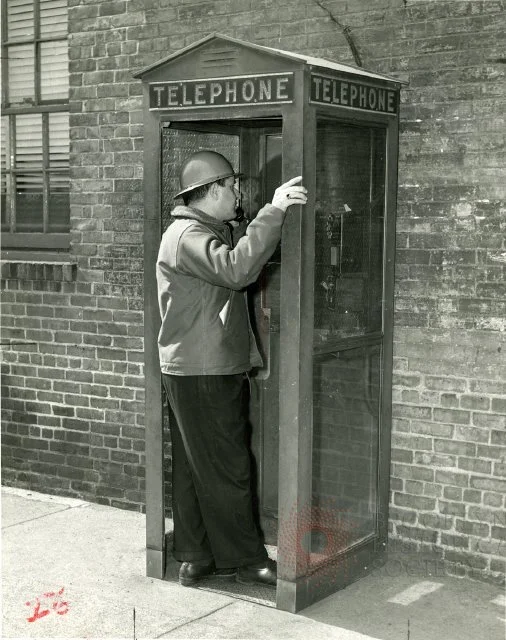
Photograph of a man using a telephone booth | Credit: Brooklyn Public Library
Background
FBI agents placed Charles Katz under surveillance, suspecting him of running an illegal gambling operation. Based on prior visual observations, the agents correctly predicted that Katz would routinely use a specific set of public telephone booths at the same time each morning to transmit bets and wagering information from Los Angeles to Miami and Boston. To gather evidence without obtaining a warrant, FBI agents attached an electronic listening and recording device to the outside top of the public telephone booth Katz frequented. During predetermined periods, the agents recorded six short phone conversations averaging three minutes each, capturing the end of Katz’s calls while ensuring the equipment was turned off when other individuals used the booth.
Following the surveillance, Katz was charged in the U.S. District Court for the Southern District of California for transmitting wagering information across state lines in violation of federal law. At trial, Katz objected to the introduction of the audio recordings, arguing that the FBI’s warrantless electronic surveillance violated the Fourth Amendment. The district court denied his motion and Katz was convicted. Katz appealed to the U.S. Court of Appeals for the Ninth Circuit, which affirmed his conviction on the grounds that the FBI’s device hadn’t physically penetrated the telephone booth. The U.S. Supreme Court subsequently granted certiorari.
7 - 1 decision for Katz
Katz


White
Black
Harlan II
Stewart
Douglas
Brennan
Warren
U.S.

Fortas
* Justice Marshall took no part in the consideration or decision of this case

-
Writing for the Court, Justice Potter Stewart held that the Fourth Amendment protects people, not places, and that warrantless electronic wiretapping of private telephone communications constitutes an unconstitutional search and seizure regardless of whether there a physical trespass took place. Stewart rejected the parties’ narrow framing of whether a public telephone booth is a “constitutionally protected area,” explaining that “the correct solution of Fourth Amendment problems is not necessarily promoted by incantation of the phrase ‘constitutionally protected area.’” Rather, Stewart established that “the Fourth Amendment protects people, not places.” He stated that what a person “knowingly exposes to the public, even in his own home or office, is not a subject of Fourth Amendment protection,” but “what he seeks to preserve as private, even in an area accessible to the public, may be constitutionally protected.”
Overruling the traditional physical trespass doctrine of Olmstead v. United States (1928) and Goldman v. United States (1942), Stewart wrote that “the reach of that [Fourth] Amendment cannot turn upon the presence or absence of a physical intrusion into any given enclosure.” Stewart noted that when an individual enters a telephone booth, closes the door, and pays the toll to place a call, they’re entitled to assume that “the words he utters into the mouthpiece will not be broadcast to the world,” as he seeks to exclude not the “intruding eye” but the “uninvited ear.” While Stewart commended the FBI’s restraint in limiting their recordings to brief periods when Katz was on the phone, he emphasized that “this restraint was imposed by the agents themselves, not by a judicial officer.” He asserted that bypassing a neutral magistrate “bypasses the safeguards provided by an objective predetermination of probable cause,” leaving individuals secure “only in the discretion of the police.” Thus, Stewart reaffirmed that “searches conducted outside the judicial process, without prior approval by judge or magistrate, are per se unreasonable under the Fourth Amendment—subject only to a few specifically established and well-delineated exceptions.”
Turning Katz’s case, Stewart found that the FBI’s warrantless surveillance of him violated the Fourth Amendment. Stewart explained that the agents’ surveillance was so narrowly circumscribed that a neutral magistrate could’ve constitutionally authorized it in advance under precise safeguards, the agents’ failure to secure prior judicial approval was fatal. Ultimately, Stewart concluded that because the officers ignored the “procedure of antecedent justification... that is central to the Fourth Amendment,” the recording of Katz’s telephone conversations was unconstitutional.
-
Joined by: Justice William Brennan
In his concurring opinion, Justice William Douglas wrote separately to respond to the suggestion in Justice Byron White’s concurrence that electronic surveillance in national security cases could be exempted from the Fourth Amendment’s warrant requirement. Douglas rejected the creation of an executive exception for national security, viewing White’s opinion as “a wholly unwarranted green light for the Executive Branch to resort to electronic eavesdropping without a warrant in cases which the Executive Branch itself labels ‘national security’ matters.” Douglas emphasized that neither the President nor the Attorney General can fulfill the constitutional function of a neutral judicial officer and noted that in national security matters “they are not detached, disinterested, and neutral as a court or magistrate must be.”
Under our system of the separation of powers, Douglas explained that the executive branch is designed to act as a vigorous adversary rather than an impartial arbiter, making it constitutionally incapable of providing authorization for its own searches. Douglas asserted that the Fourth Amendment’s warrant requirement applies uniformly across all criminal investigations and wrote, “[s]ince spies and saboteurs are as entitled to the protection of the Fourth Amendment as suspected gamblers like petitioner, I cannot agree that where spies and saboteurs are involved adequate protection of Fourth Amendment rights is assured when the President and Attorney General assume both the position of adversary-and-prosecutor and disinterested, neutral magistrate.” He emphasized that constitutional history recognizes “no distinction under the Fourth Amendment between types of crimes,” and insisted that courts must not “improvise because a particular crime seems particularly heinous.”
Douglas argued that no branch of government, including the Executive Branch, possesses the inherent power to bypass the Fourth Amendment’s warrant requirement, and warned that allowing the executive branch to serve as both the prosecutor and magistrate in national security investigations would strip individuals of their Fourth Amendment protections whenever the government invoked national security concerns. Ultimately, Douglas concluded by insisting that prior judicial authorization by a neutral magistrate is a strict constitutional requirement for electronic surveillance, regardless of the nature or gravity of the offense.
-
In his concurring opinion, Justice John Marshall Harlan II agreed with the Court’s ruling but wrote separately to clarify the constitutional framework for determining when a government action constitutes a Fourth Amendment search. While Harlan agreed that “the Fourth Amendment protects people, not places,” he noted that determining what protection is afforded “requires reference to a ‘place.’” To define these constitutional boundaries, Harlan established a two-part requirement. He explained that first, individuals must have “exhibited an actual (subjective) expectation of privacy,” and second, “the expectation [must] be one that society is prepared to recognize as ‘reasonable.’” Under this test, objects or statements exposed to the plain view of outsiders receive no Fourth Amendment protection because no intention to keep them private has been exhibited, but communications held where privacy is reasonably expected remain constitutionally protected.
Harlan noted that advancing technology required the Court formally overrule the physical trespass doctrine of Olmstead v. United States (1928) and Goldman v. United States (1947). Harlan argued that limiting constitutional protection strictly to physical intrusions was, “in the present day, bad physics as well as bad law, for reasonable expectations of privacy may be defeated by electronic as well as physical invasion.” Harlan explained that because electronic eavesdropping into a private space constitutes a search and seizure, any such invasion by federal officers remains “presumptively unreasonable in the absence of a search warrant.”
Applying this standard to Katz, Harlan concluded that the FBI’s warrantless electronic surveillance was unconstitutional. Harlan noted that the critical fact was that “[o]ne who occupies it, [a telephone booth] shuts the door behind him, and pays the toll that permits him to place a call is surely entitled to assume” that his conversation is not being intercepted. Harlan emphasized that the public availability of the booth didn’t impact his analysis, noting that the key point was not whether the booth was accessible to the public at other times, but that it functioned as “a temporarily private place whose momentary occupants’ expectations of freedom from intrusion are recognized as reasonable.”
-
In his concurring opinion, Justice Byron White explained that while he agreed with the Court’s ruling, he wrote separately to clarify the boundaries of the decision regarding participant monitoring and national security. White emphasized that the Court’s ruling didn’t disturb prior decisions upholding evidence obtained with the consent of one party, noting that “[w]hen one man speaks to another he takes all the risks ordinarily inherent in so doing, including the risk that the man to whom he speaks will make public what he has heard.” White argued that the logical extension of this principle is that a speaker assumes the risk that their hearer “is instead recording it or transmitting it to another.” He then explained that in contrast to participant monitoring, Katz “sought to exclude . . . the uninvited ear” while speaking under circumstances where a reasonable person would assume others weren’t listening.
Additionally, White argued that the Fourth Amendment’s warrant requirement should not automatically extend to electronic surveillance conducted in national security matters. He noted that successive presidential administrations had authorized wiretapping to protect the nation, and asserted that courts “should not require the warrant procedure and the magistrate’s judgment if the President of the United States or his chief legal officer, the Attorney General, has considered the requirements of national security and authorized electronic surveillance as reasonable.” White emphasized that applying Fourth Amendment protections to ordinary wiretapping “need not interfere with legitimate needs of law enforcement,” provided that national security operations remained exempt from prior judicial authorization.
Turning to Katz’s case, White explained that he joined the Court’s opinion because the prosecution involved an ordinary criminal gambling investigation rather than national security or participant monitoring. White concluded that because the FBI agents acted without a warrant to overhear Katz’s private calls from a public telephone booth, where he had a reasonable expectation of privacy against uninvited ears, and no national security justification was present, the warrantless electronic surveillance was unconstitutional.
-
In his dissenting opinion, Justice Hugo Black argued that contrary to the Court’s holding, the Fourth Amendment’s protection against unreasonable searches and seizures doesn’t apply to electronic eavesdropping or wiretapping. Black emphasized that constitutional interpretation must be grounded strictly in the language of the document, noting that the Fourth Amendment protects only “persons, houses, papers, and effects” against unreasonable searches and seizures. Black argued that these words “connote the idea of tangible things with size, form, and weight, things capable of being searched, seized, or both.” He reasoned that a conversation overheard through wiretapping is intangible and, under the normally accepted meaning of the words, “can neither be searched nor seized.” Black also pointed out that the Warrant Clause requires police to particularly describe the things to be seized, which implies “something already in existence,” whereas eavesdropping intercepts future conversations that are “nonexistent until they take place.”
Black rejected the majority’s effort to modernize the Fourth Amendment, asserting that it is not the proper role of the Court to “rewrite the Amendment in order ‘to bring it into harmony with the times’” or substitute an abstract right to privacy for the Constitution’s specific text. Black argued that eavesdropping was an ancient practice well known at common law, so if the Framers intended to limit it, they would’ve used explicit language rather than leaving the task to “language-stretching judges.” Black contended that earlier precedents like Olmstead v. United States (1928) correctly recognized that eavesdropping falls entirely outside the scope of the Fourth Amendment and argued that the majority was usurping lawmaking power by transforming the Court into a “continuously functioning constitutional convention.”
Applying these principles to Katz’s prosecution, Black concluded that the FBI’s interception of Katz’s telephone calls didn’t violate the Fourth Amendment because the agents merely overheard and recorded oral statements without searching or seizing any tangible person, house, paper, or effect, meaning that no constitutional search occurred. Black concluded that while eavesdropping might be regulated by state or federal statutes, the Court had distorted the language of the Fourth Amendment to overturn Katz’s conviction.