EARL WARREN
Chief Justice (1953 - 1969)

QUICK FACTS
APPOINTED BY
Dwight Eisenhower
PRECEDED BY
BIRTHPLACE
California
SWORN IN
October 10, 1953
SUCCEEDED BY
LAW SCHOOL
UC Berkeley
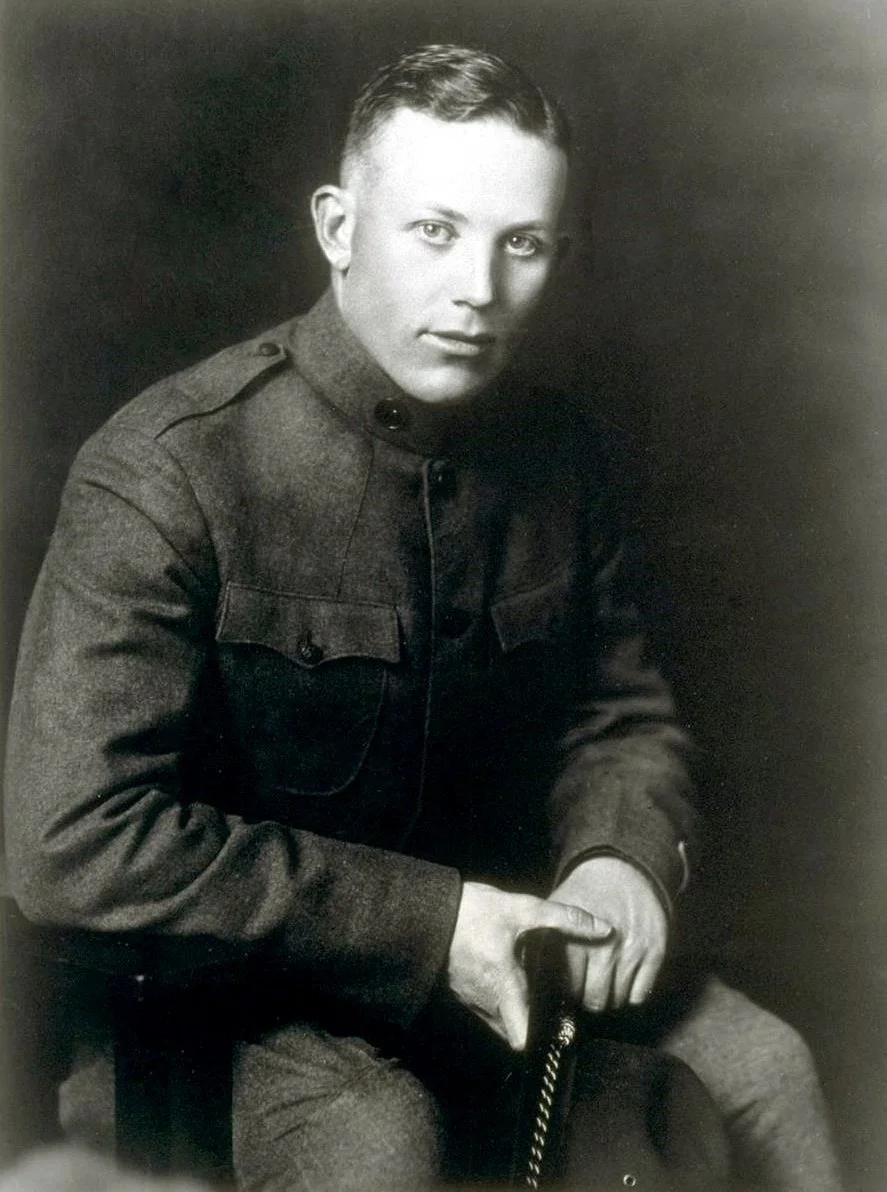
Warren as an officer in the U.S. Army (1918) | Credit: McCurry Foto Co. (Public Domain)
Personal Life and Education
Earl Warren was born in Los Angeles, California, on March 19, 1891 to Matthias and Crystal Warren. His father was born in Norway but immigrated to the United States in 1866, when he was just two years old. His mother was born in Sweden, but her family also immigrated the United States when she was an infant. Warren’s father worked for Southern Pacific Railroad.
Warren attended Kern County High School, graduating in 1908. Warren then enrolled at the University of California, Berkeley, where he was a member of the Sigma Phi fraternity and majored in political science. He graduated in 1911. After, Warren enrolled in UC Berkeley’s Department of Jurisprudence (now the UC Berkeley School of Law), where he graduated in 1914.
While working in Oakland in 1921, Warren met Nina Elisabeth Meyers, a 28 year old widowed store manager with a three year old son. The two began dating and on October 4, 1925, they got married. Together they had five children.
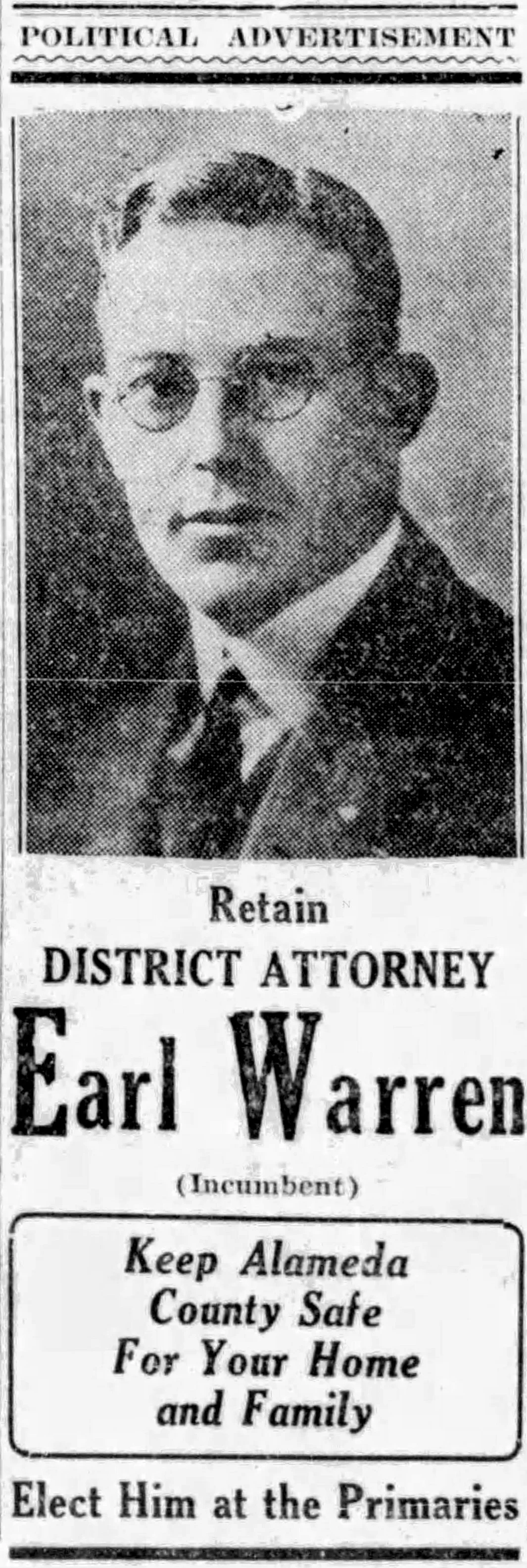
Advertisement for Warren’s district attorney reelection campaign | Credit: Earl Warren for District Attorney (Public Domain)
Early Career
After graduating law school, Warren began working for the Associated Oil Company in San Francisco. However, after observing corruption in San Francisco, Warren left that position for a job in Oakland with the law firm Robinson and Robinson.
After the United States entered World War I in 1917, Warren volunteered for an officer training camp but was rejected due to hemorrhoids. Warren underwent a procedure to have them removed, but by the time he recovered the training camp was closed. Nonetheless, Warren enlisted in the U.S. Army as a private in August of 1917 and was designated acting first sergeant of his company before being sent to an officer training course. He returned in May 1918 as a second lieutenant, and his regiment was tasked with training draftees at Camp Lee, Virginia for the rest of the war. Warren was promoted to first lieutenant and discharged less than a month a month after Armistice Day on November 11, 1918. Warren remained in the U.S. Army Reserve until 1934, ultimately achieving the rank of captain.
After his military service, Warren returned to Oakland in late 1918 and accepted a position as the legislative assistant for Leon E. Gray, a newly elected member of the California State Assembly. Warren was then appointed as clerk of the California State Assembly’s Judiciary Committee. Warren briefly served as a deputy district attorney for Oakland before being hired as a deputy district attorney for Alameda County in 1920. In 1924, Warren entered politics by serving as the campaign manager for Republican Assemblyman Frank Anderson.
In 1925, Warren was appointed as the Alameda County district attorney. When he ran for election in 1926, Warren refused political contributions and largely self-funded his campaign. He ultimately defeated his opponent in a landslide, earning over 2/3 of the vote. Warren gained a reputation for being a tough, no-nonsense official who fought corruption and rejected partisanship. When Warren ran for reelection in 1930, he faced only token opposition. In 1932, Warren argued his first case before the Supreme Court, Central Pacific Railway Co v. Alameda County, which he won. This case was the last oral argument heard by Justice Oliver Wendell Holmes, who announced his retirement the same afternoon.
While district attorney of Alameda County, Warren served as the county chairman for Herbert Hoover’s 1932 presidential campaign. In 1934, Warren became chairman of the California Republican Party and publicly advocated against the Democrat candidate for governor, Upton Sinclair. Warren gained national notoriety when he successfully elected a slate of unpledged delegates to the 1936 Republican National Convention, where he supported Alf Landon. Landon won the party’s nomination but ultimately lost to Franklin Roosevelt in the general election.
In 1934, Warren aided in the passage of a state ballot measure that turned the position of California’s Attorney General into a full-time office. After incumbent Attorney General Ulysses Webb announced his retirement, Warren entered the 1938 election. While still a Republica, Warren won the Republican, Democrat, and Progressive nominations. He faced no serious opposition in the general election and easily won.
As California’s Attorney General, Warren often fought with Democrat Governor Culbert Olson. In April 1942, Warren announced his candidacy for Governor in the upcoming election. Warren again won both the Republican and Democrat party nominations for Governor and defeated Olson in the general election with 57% of the vote. In his 1946 reelection campaign, Warren again won both the Republican and Democrat party nominations and won the general election in a landslide, earning 92% of the vote. Warren’s 1946 victory made him the first Governor of California to be reelected to a second term since Hiram Johnson in 1914. Warren ran for reelection in 1950, this time winning only the Republican party nomination but still winning the general election in a landslide with 65% of the vote. After his victory in 1950, Warren became the first Governor of California to be elected to three terms.
In 1944, Warren ran as a favorite son candidate in the Republican presidential primaries to secure California’s delegation, but he lost the nomination to Thomas Dewey. Warren delivered the keynote address at the Republican National Convention, and Dewey asked him to serve as his running mate, but he declined. After being reelected Governor in 1946, Warren began planning his own run for president in 1948, but Dewey ultimately won the nomination a second time. Dewey again asked Warren to be his running mate, but this time Warren agreed. The ticket was widely expected to win the election, but President Truman was reelected in a surprise upset. Warren again ran for the presidency in 1952, but he ultimately lost to Dwight Eisenhower. After the 1952 election, Eisenhower promised Warren that he would appoint him to the next vacancy that arose on the Supreme Court.
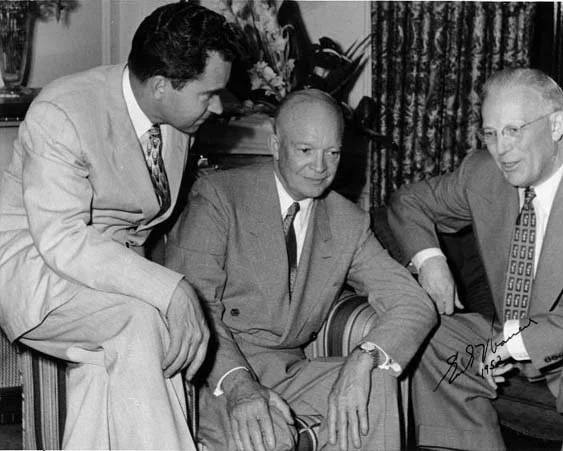
Then-candidates Dwight Eisenhower and Richard Nixon with Warren while he was still Governor of California (1952) | Credit: California Secretary of State
Nomination to the Supreme Court
After Eisenhower was inaugurated as President in 1953, he offered Warren the position of Secretary of the Interior, but Warren turned him down. In August, Eisenhower offered him the position of Solicitor General, which he accepted. Before the nomination was announced, however, Chief Justice Fred Vinson died. Eisenhower initially offered the position to Dewey, but Dewey declined. Eisenhower considered other candidates, but ultimately honored his promise to Warren and offered him the position.
On September 30, 1953, Eisenhower made a received a recess appointment of Warren to be Chief Justice. He was sworn in on October 5. Warren’s nomination was formally submitted to the Senate on January 11, 1954, and hearings before the Senate Judiciary Committee were held in February. On February 24, Warren’s nomination was advanced by the committee with a favorable recommendation by a 12-3 vote. On March 1, Warren’s nomination was confirmed by the Senate unanimously in a voice vote.
What the Court looked like during Chief Justice Warren’s tenure.

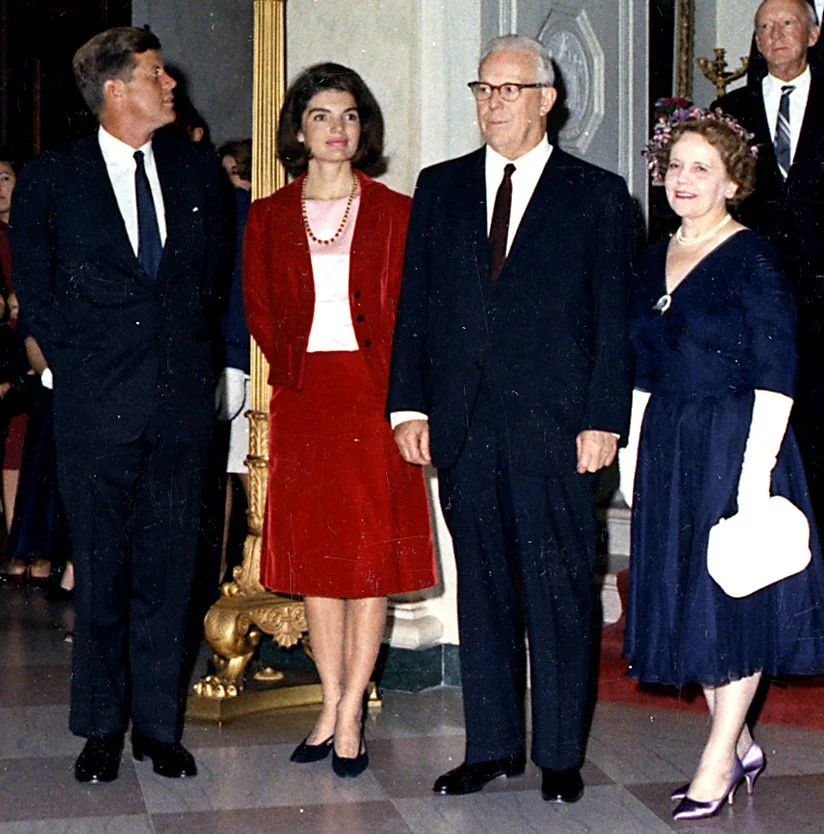
“You sit up there, and you see the whole gamut of human nature. Even if the case being argued involves only a little fellow and $50, it involves justice. That's what is important.”
— Chief Justice Earl Warren