United States v. Virginia
Case Overview
CITATION
ARGUED ON
DECIDED ON
DECIDED BY
518 U.S. 515
Jan. 17, 1996
Jun. 26, 1996
Legal Issue
Does the exclusion of women from VMI violate the Equal Protection Clause of the Fourteenth Amendment? If so, is the creation of the VWIL a sufficient remedy?
Holding
Yes, the exclusion of women from VMI denies equal protection of the laws to women, and the creation of a separate institution for women, the VWIL, is an insufficient remedy.

The Virginia Military Institute | Credit: Virginia Military Institute
Background
By the mid 1970s, the Virginia Military Institute (VMI) was the only single-sex public higher education institution for men in Virginia. VMI’s stated educational mission is to produce “citizen-soldiers” through a distinctive “adversative method,” emphasizing physical rigor, mental stress, and character development. In 1990, a female high-school student sought admission to VMI, prompting a complaint to the Virginia Attorney General.
The United States then filed suit against Virginia and VMI, alleging the school’s male-only admissions policy violated the Equal Protection Clause of the Fourteenth Amendment. At trial, the district court ruled in favor of VMI, finding single-gender education yielded substantial benefits and VMI’s exclusion of women supported diversity in education. The U.S. Court of Appeals for the Fourth Circuit reversed, holding Virginia failed to advance any state policy to justify VMI’s gender restriction, and remanded for remedy. Virginia proposed a separate all-women’s program at Mary Baldwin College, the Virginia Women’s Institute for Leadership (VWIL), designed differently from VMI. The district court held Virginia’s parallel program satisfied equal protection, and the Fourth Circuit affirmed, concluding the educational opportunities were “sufficiently comparable.” The decision was appealed to the Supreme Court, which granted certiorari.
7 - 1 decision for the United States
United States


Virginia

Scalia
O’Connor
Rehnquist
Breyer
Ginsburg
Souter
Stevens
Kennedy

* Justice Thomas took no part in the consideration or decision of this case.
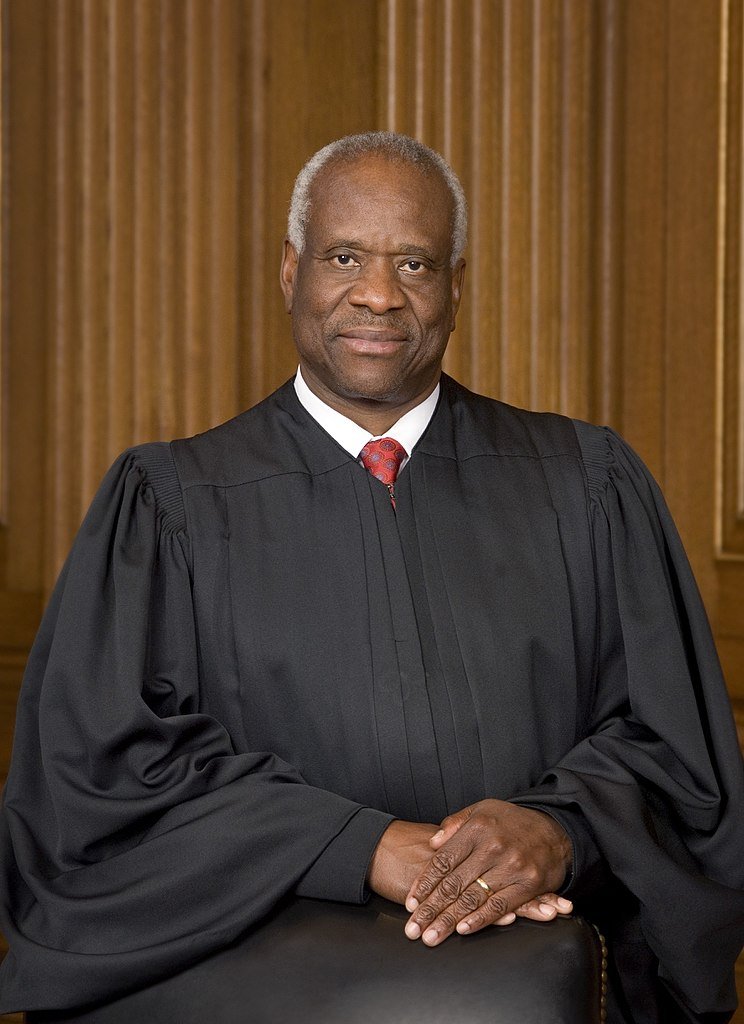
-
Writing for the Court, Justice Ruth Bader Ginsburg first established that to defend gender-based government action, an “exceedingly persuasive justification” must be demonstrated. Ginsburg explained that the Court’s precedent does not make sex a proscribed classification like race or natural origin. In such cases, “inherent differences” cannot be the basis for a race or national origin classification.
For sex, however, Ginsburg stated that “[p]hysical differences between men and women … are enduring. ‘Inherent differences’ between men and women, we have come to appreciate, remain cause for celebration, but not for denigration of the members of either sex or for artificial constraints on an individual’s opportunity.” She added that while such classifications can be used to compensate for economic disabilities or to advance equal opportunity, they “may not be used, as they once were, to create or perpetuate the legal, social, and economic inferiority of women.”
Responding to Virginia’s argument single sex education provides important educational benefits and allows the State to contribute to “diversity in educational approaches,” Ginsburg wrote that “’benign’ justifications proffered in defense of categorical exclusions will not be accepted automatically; a tenable justification must describe actual state purposes, not rationalizations for actions in fact differently grounded.”
In response to Virginia’s argument that VMI’s program would be destroyed if forced to accommodate women, Ginsburg wrote that “[t]he notion that admission of women would downgrade VMI’s stature, destroy the adversative system and, with it, even the school, is a judgment hardly proved, a prediction hardly different from other ‘self-fulfilling prophec[ies],’ once routinely used to deny rights or opportunities.” Ginsburg added that VMI’s goal to produce honorable citizen-soldiers “is great enough to accommodate women, who today count as citizens in our American democracy equal in stature to men.”
Ultimately, Ginsburg concluded that Virginia “has fallen far short of establishing the ‘exceedingly persuasive justification,’ that must be the solid base for any gender-defined classification.”
-
In his dissenting opinion, Justice Antonin Scalia sharply criticized the Court for shutting down “an institution that has served the people of the Commonwealth of Virginia with pride and distinction for over a century and a half.” Scalia noted that the Court ignored the findings of the lower courts, the facts of the case, the Court’s precedent, and the Nation’s history. He wrote, “[t]o achieve that desired result, it rejects (contrary to our established practice) the factual findings of two courts below, sweeps aside the precedents of this Court, and ignores the history of our people. As to facts: It explicitly rejects the finding that there exist ‘gender-based developmental differences’ supporting Virginia’s restriction of the ‘adversative’ method to only a men’s institution, and the finding that the all-male composition of the Virginia Military Institute (VMI) is essential to that institution’s character. As to precedent: It drastically revises our established standards for reviewing sex-based classifications. And as to history: It counts for nothing the long tradition, enduring down to the present, of men’s military colleges supported by both States and the Federal Government.”
Scalia derided the Court for its narrow view of the Founders, writing that much of its opinion “is devoted to deprecating the closed-mindedness of our forebears with regard to women’s education, and even with regard to the treatment of women in areas that have nothing to do with education.” He acknowledged their outdated views, stating, “[c]losed-minded they were—as every age is, including our own, with regard to matters it cannot guess, because it simply does not consider them debatable.” However, Scalia asserted that “[t]he virtue of a democratic system with a First Amendment is that it readily enables the people, over time, to be persuaded that what they took for granted is not so, and to change their laws accordingly. That system is destroyed if the smug assurances of each age are removed from the democratic process and written into the Constitution.”
Scalia responded that “to counterbalance the Court’s criticism of our ancestors, let me say a word in their praise: They left us free to change. The same cannot be said of this most illiberal Court, which has embarked on a course of inscribing one after another of the current preferences of the society (and in some cases only the counter-majoritarian preferences of the society’s law-trained elite) into our Basic Law.” He added that “[t]oday [the Court] enshrines the notion that no substantial educational value is to be served by an all-men’s military academy—so that the decision by the people of Virginia to maintain such an institution denies equal protection to women who cannot attend that institution but can attend others.”
Scalia ultimately concluded, “[s]ince it is entirely clear that the Constitution of the United States—the old one—takes no sides in this educational debate, I dissent.”