HARLAN STONE
Chief Justice (1941 - 1946) | Associate Justice (1925 - 1941)

QUICK FACTS
BIRTHPLACE
New Hampshire
CHIEF JUSTICE
APPOINTED BY
Franklin D. Roosevelt
PRECEDED BY
ASSOCIATE JUSTICE
APPOINTED BY
Calvin Coolidge
PRECEDED BY
Joseph McKenna
LAW SCHOOL
Columbia
SWORN IN
July 3, 1941
SUCCEEDED BY
SWORN IN
March 2, 1925
SUCCEEDED BY
Stone with his wife, Agnes, in Cleveland, Ohio | Credit: Getty
Personal Life and Education
Harlan Fiske Stone was born on October 11, 1872 in Chesterfield, New Hampshire to Fred and Ann Stone. When Stone was two years old, his family moved Massachusetts after his father purchased a farm a few miles south of Amherst in Red Hill Valley.
Stone initially enrolled at the Massachusetts Agricultural College in 1888, but he was expelled at the end of his second year after an interaction with a professor ended in “words and blows.” After being expelled, Stone returned to his family’s farm. Stone later enrolled at Amherst College, where he was elected class President for three years and graduated with honors. While there, Stone was a member of the Phi Beta Kappa fraternity and played guard on the football team.
After graduating from Amherst in 1894, Stone briefly served as the principal of a high school in Newburyport, Massachusetts. There, he also taught science and coached the football team. In 1895, Stone enrolled at Columbia Law School. While in law school, Stone tutored and taught physics and chemistry at the Adelphi Academy in Brooklyn. Stone graduated and was admitted to the bar in 1898.
On September 2, 1899, Stone married Agnes Harvey, a childhood friend from his hometown. Together, they had two sons.
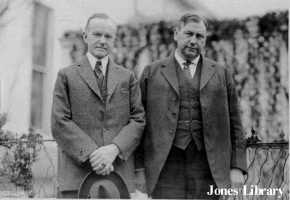
Stone with President Coolidge after being sworn in as the 52nd Attorney General (1924) | Credit: Jones Library
Early Career
After graduating from Columbia Law School, Stone joined the New York firm Wilmer and Canfield (later Satterlee, Canfield & Stone) and eventually became a partner at the prestigious firm Sullivan & Cromwell.
In addition to his work in private practice, Stone returned to Columbia as a lecturer and eventually became a professor. In 1910, Stone was appointed Dean of Columbia Law School, a position he held for thirteen years. During his deanship, he was credited with elevating the school’s academic standards and emphasizing a scholarly approach to legal education.
For several months during World War I, Stone served on the a Board of Inquiry for the Department of War, where he was tasked with reviewing the appeals of men whose requests conscientious objections had been denied.
In 1924, Stone's former college classmate, President Calvin Coolidge, appointed him as his Attorney General. During his brief tenure at the Department of Justice, Stone was credited for restoring public confidence and integrity to the office following the political scandals of the Harding administration.

Stone preparing to testify before the Senate Judiciary Committee during his Supreme Court confirmation process to become an Associate Justice (Jan. 28, 1925) | Credit: Library of Congress Catalog (Public Domain)
Nomination to the Supreme Court
Associate Justice
On January 5, 1925, President Calvin Coolidge nominated Stone to the Supreme Court of the United States to fill the vacancy left by retiring Justice Joseph McKenna. Stone’s nomination initially faced scrutiny due to his past ties to Wall Street law firms and ongoing investigation of Senator Burton Wheeler.
Stone was the first Supreme Court nominee to testify personally before the Senate Judiciary Committee to answer questions related to those concerns. Stone's performance was widely praised, leading to his confirmation by the Senate on February 5, 1925 in a a vote of 71–6. Stone served as an Associate Justice for sixteen years, during which he joined the “Three Musketeers” on the Court that supported President Franklin Roosevelt’s New Deal legislation.
Chief Justice
On 2, 1941, Chief Justice Charles Evans Hughes announced his retirement at 79 years old. Stone was Hughes’ personal choice to succeed him.
On June 12, 1941, Roosevelt nominated Stone to become Chief Justice. After a single hearing before the Senate Judiciary Committee on June 21, the his nomination was advanced to the full senate on June 23. Stone was confirmed by the Senate by voice vote on June 27.
Stone was sworn in as the 12th Chief Justice of the Supreme Court on July 3, 1941. Stone was the fourth Associate Justice to be nominated to become Chief Justice, and the third successfully. Stone the first Justice of the Court to occupy every seat on the bench, from the most junior Associate to Chief Justice.
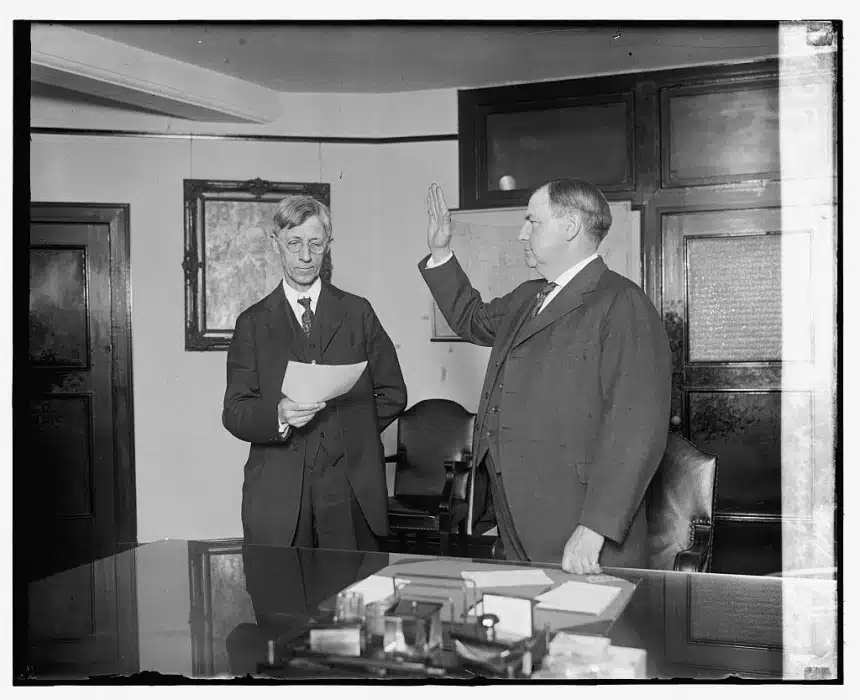
Stone swearing in to testify before the Senate Judiciary Committee for his nomination to become an Associate Justice | Credit: Free Speech Center
What the Court looked like during Chief Justice Stone’s tenure.
