FRED VINSON
Chief Justice (1946 - 1953)

QUICK FACTS
APPOINTED BY
Harry Truman
PRECEDED BY
BIRTHPLACE
Kentucky
SWORN IN
June 24, 1946
SUCCEEDED BY
LAW SCHOOL
Centre College of Kentucky
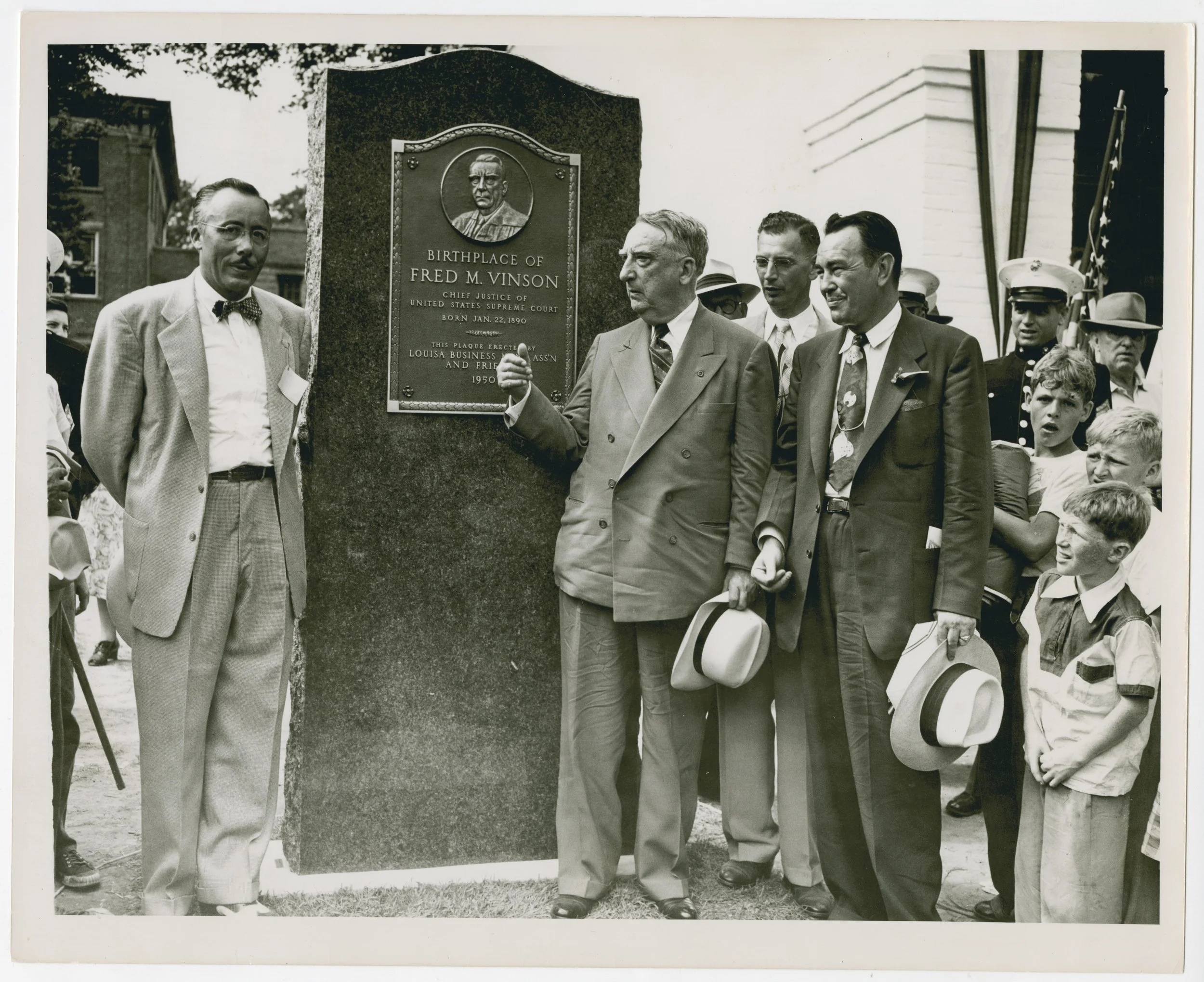
Vinson at the Birthplace of Fred M. Vinson Monument during Fred M. Vinson Day in Louisa, Kentucky (July 11, 1951) | Credit: Frederick M. Vinson Papers, University of Kentucky
Personal Life and Education
Fred Vinson was born on January 22, 1890, in Louisa, Kentucky. Vinson’s childhood home was directly in front of the Lawrence County Jail, as his father was the county jailer. As a child, he helped his father at the jail and made friends with some prisoners who would later note the kindness he showed. While in school, Vinson worked a number of odd jobs.
Vinson graduated from Kentucky Normal School in 1909. After, Vinson enrolled at Centre College of Kentucky, where he joined the Phi Delta Theta fraternity and graduated at the top of his class. Vinson remained at Centre College for law school.
On January 24, 1924, Vinson married Julia Dixon in Ashland, Kentucky. Together, they had two children.
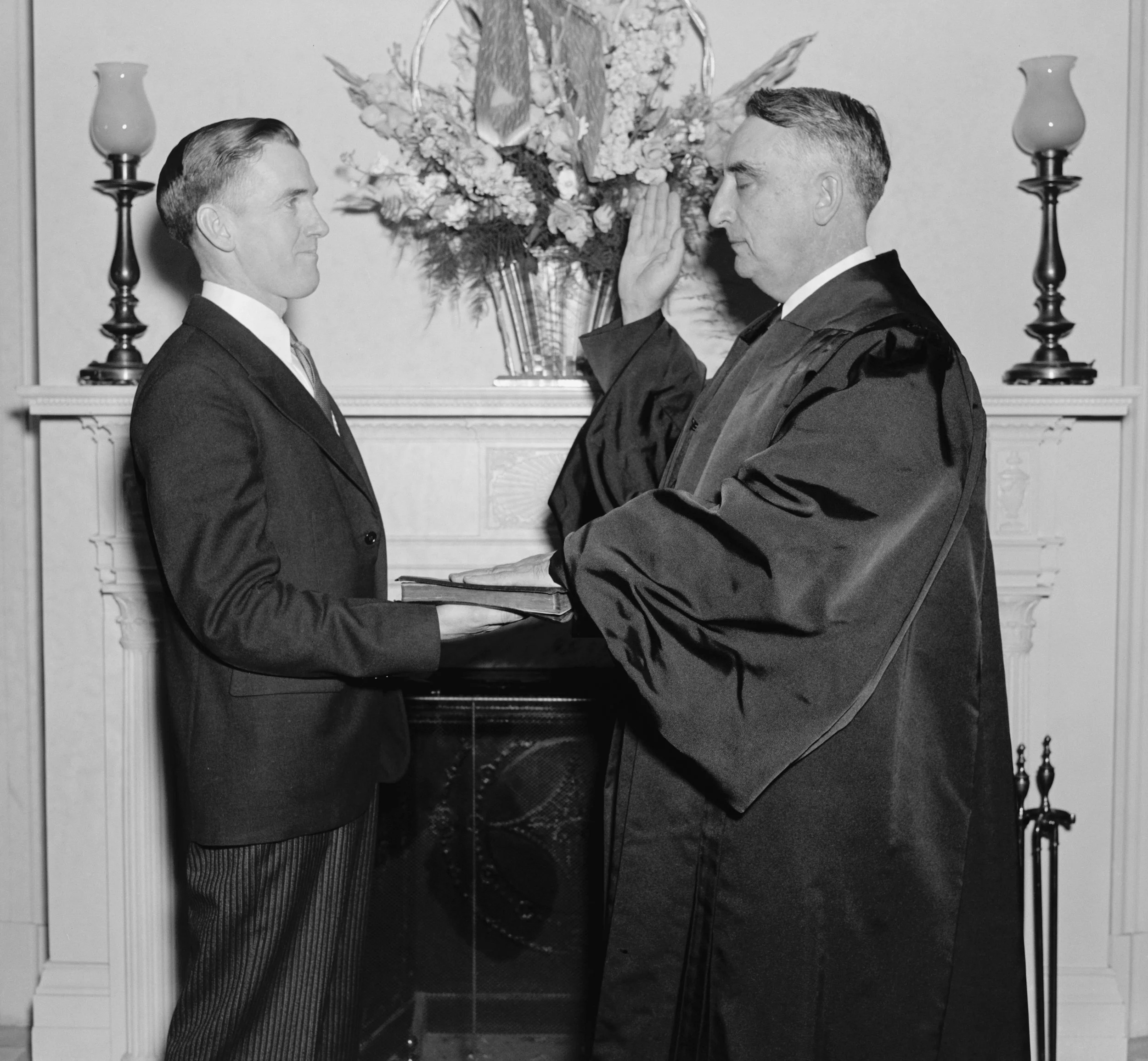
Vinson being sworn in as a judge on the U.S. Court of Appeals for the D.C. Circuit | Credit: Library of Congress, Prints and Photographs Division (Public Domain)
Early Career
After graduating from Centre College, Vinson entered private practice in his hometown, Louisa. In 1912, Vinson was elected City Attorney of Louisa.
Vinson was twice rejected for military service during World War I due to being underweight, but he supported the war effort with speeches in support of bond drives and the Red Cross. In August of 1918, Vinson was approved for service in the U.S. Army and eventually selected for officer training. Vinson was still in training in when Armistice Day arrived on November 11, 1918. When Vinson returned home from his military service, he was elected the Commonwealth’s Attorney for the 32nd Judicial District of Kentucky.
In 1924, Vinson ran in a special election for Congress after William Fields resigned to become Governor of Kentucky. Vinson won election to a full term in 1924 reelection in 1926, but ultimately lost in 1928. His loss was generally attributed to his refusal to distance himself from Democrat Alfred Smith’s losing presidential campaign. Nonetheless, Vinson returned to win his seat back in 1930, being reelected again in 1932 and 1934. In total, he served 11 years in the House of Representatives. While in Congress, Vinson became close friends with then-Missouri Senator Harry Truman.
On November 26, 1937, President Franklin Roosevelt nominated Vinson to a seat on the U.S. Court of Appeals for the D.C. Circuit. He was confirmed by the Senate on December 9 and sworn in six days later. On May 28, 1943, Vinson resigned from the D.C. Circuit to become the Director of the Office of Economic Stabilization. On July 16, 1945, President Truman nominated Vinson to serve as his Secretary of the Treasury, and he was confirmed by a voice vote in the Senate the next day.
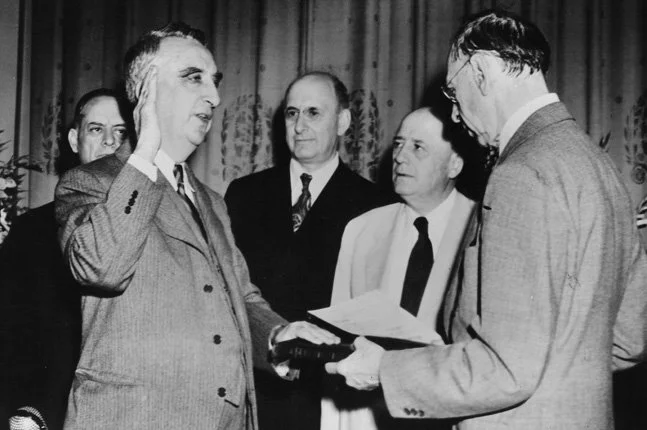
Vinson being sworn in as Chief Justice of the Supreme Court | Credit: Phi Delta Theta Museum
Nomination to the Supreme Court
In the 1940s, the Supreme Court had gained a reputation for rivalries and personal feuds between the Justices, so Truman wanted to appoint a Chief Justice that could be a peacemaker. Vinson was recommended to Truman by former Chief Justice Charles Evans Hughes and former Associate Justice Owen Roberts, both of whom emphasized Vinson’s experience in all three branches of government.
Truman nominated Vinson on June 6, 1946, and he was confirmed by a voice vote in the Senate on June 20. Due to his popular reputation in Congress, the Senate waived his hearings before the Judiciary Committee as a courtesy. Vinson was sworn in as the 13th Chief Justice on June 24, 1946.
Chief Justice Vinson’s Swearing In:
What the Court looked like during Chief Justice Vinson’s tenure.
