City of Indianapolis v. Edmond
Case Overview
CITATION
ARGUED ON
DECIDED ON
DECIDED BY
531 U.S. 32
Oct. 3, 2000
Nov. 28, 2000
Legal Issue
Do highway checkpoints aimed at interdicting unlawful drugs violate the Fourth Amendment’s protection from unreasonable search and seizure?
Holding
Yes, because the checkpoint program’s primary purpose is indistinguishable from the general interest in crime control, the checkpoints violate the Fourth Amendment.
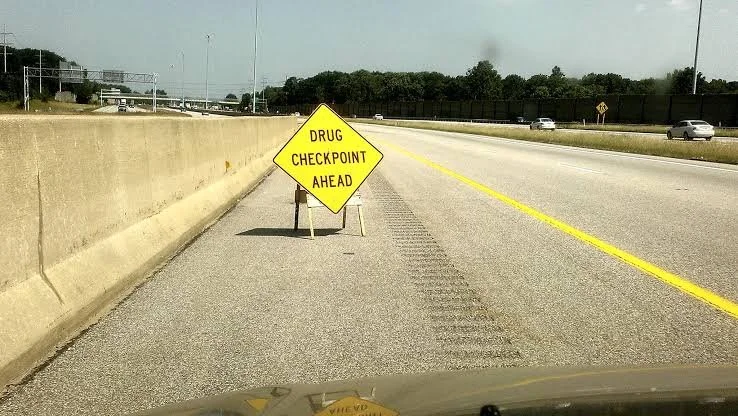
Road sign warning of a drug checkpoint | Credit: Patch
Background
In August of 1998, the City of Indianapolis began to operate vehicle checkpoints on Indianapolis roads in an effort to interdict unlawful drugs. Each checkpoint has approximately 30 officers, and a predetermined number of vehicles are stopped. When a car is stopped, an officer approaches, informs the driver of the operation, requests the driver’s license and registration, and observes for signs of impairment. At the same time, a narcotics dog sniffs the outside of the vehicle. Officers are instructed that they may only conduct a search with the consent of the driver or based on “an appropriate quantum of particularized suspicion.”
In six such road blocks conducted between August and November of 1998, 1,161 vehicles were stopped and 104 drivers were arrested. 55 of those arrests were for drug-related crimes, while 49 were for offenses unrelated to drugs. James Edmond and Joell Palmer were each stopped at a narcotics checkpoint in late September 1998. After, Edmond and Palmer filed a lawsuit on behalf of themselves and the class of all motorists who had been stopped or were subject to being stopped in the future at the drug checkpoints.
Edmond and Palmer argued that the roadblocks violated the Fourth Amendment and requested declaratory and injunctive relief for the class before moving for a preliminary injunction. The U.S. District Court for the Southern District of Indiana agreed to class certification but denied the motion for a preliminary injunction, holding that the checkpoint program did not violate the Fourth Amendment. On appeal to the U.S. Court of Appeals for the Seventh Circuit, a divided panel reversed the District Court, holding that the checkpoints violated the Fourth Amendment. The panel denied the City’s request for a rehearing, and the U.S. Supreme Court granted certiorari.
6 - 3 decision for Edmond
Delaware
Prouse


Thomas
Scalia
O’Connor


Kennedy
Stevens
Rehnquist
Souter
Ginsburg
Breyer

-
Writing for the Court, Justice Sandra Day O’Connor first established that the Fourth Amendment requires that searches and seizures be reasonable and without an individualized suspicion of wrongdoing, they are “ordinarily unreasonable.” O’Connor acknowledged that in some circumstances, the Court has upheld brief, suspicionless seizures “designed to serve ‘special needs, beyond the normal need for law enforcement.’” Drawing a distinction, however, O’Connor stated that “[i]n none of these cases… did we indicate approval of a checkpoint program whose primary purpose was to detect evidence of ordinary criminal wrongdoing.”
Comparing the City of Indianapolis’ checkpoint program to those previously upheld by the Court, O’Connor pointed out that those upheld either served a “special” need of law enforcement or were aimed at ensuring highway safety. In United States v. Martinez-Fuerte (1976), the Court upheld the constitutionality of two permanent immigration checkpoints located on highways near the U.S.-Mexico border. O’Connor explained that “the balance tipped in favor of the Government’s interests in policing the Nation’s borders,” and he emphasized “the difficulty of effectively containing illegal immigration at the border itself.” In Michigan Department of State Police v. Sitz (1990), the Court upheld a checkpoint program involving brief, suspicionless stops of vehicles to allow police to detect signs of intoxication and remove impaired drivers from the road. The program was upheld because it “was clearly aimed at reducing the immediate hazard posed by the presence of drunk drivers on the highways, and there was an obvious connection between the imperative of highway safety and the law enforcement practice at issue.” O’Connor explained that “[t]he gravity of the drunk driving problem and the magnitude of the State’s interest in getting drunk drivers off the road weighed heavily in our determination that the program was constitutional. In Delaware v. Prouse (2000), the Court found that a discretionary, suspicionless stop for a spot check of a driver’s license and registration was unconstitutional “primarily on account of [the officer’s] exercise of ‘standardless and unconstrained discretion.’” There, the Court suggested that we suggested that questioning all oncoming traffic at roadblock-type stops may be a lawful means of serving the State’s interest in highway safety.
Turning to the City of Indianapolis’ checkpoint program, O’Connor first stated that simply walking a narcotics-detention dog around the exterior of a car at the checkpoint doesn’t transform the seizure into a search as it’s “much less intrusive.” However, O’Connor pointed out that “what principally distinguishes these checkpoints from those we have previously approved is their primary purpose.” She stated that the Court has “never approved a checkpoint program whose primary purpose was to detect evidence of ordinary criminal wrongdoing. Rather, our checkpoint cases have recognized only limited exceptions to the general rule that a seizure must be accompanied by some measure of individualized suspicion.” Those exceptions, she explained, were “designed to serve purposes closely related to the problems of policing the border or the necessity of ensuring roadway safety.”
Responding to the City’s argument that the checkpoints in the Court’s previous cases had the same ultimate purpose of arresting those suspected of committing crimes, O’Connor contended that “[i]f we were to rest the case at this high level of generality, there would be little check on the ability of the authorities to construct roadblocks for almost any conceivable law enforcement purpose.” O’Connor emphasized the importance of the Fourth Amendment’s protection, writing that “[w]ithout drawing the line at roadblocks designed primarily to serve the general interest in crime control, the Fourth Amendment would do little to prevent such intrusions from becoming a routine part of American life.”
Providing guidance, O’Connor asserted that “the gravity of the threat alone cannot be dispositive of questions concerning what means law enforcement officers may employ to pursue a given purpose.” Instead, O’Connor explained, “in determining whether individualized suspicion is required, we must consider the nature of the interests threatened and their connection to the particular law enforcement practices at issue.” O’Connor stated that in the case, the Court was “particularly reluctant” to recognize an exception for the goal of pursuing general crime control. Ultimately, O’Connor concluded that “[b]ecause the primary purpose of the Indianapolis checkpoint program is ultimately indistinguishable from the general interest in crime control, the checkpoints violate the Fourth Amendment.”
-
In his dissenting opinion, Chief Justice William Rehnquist