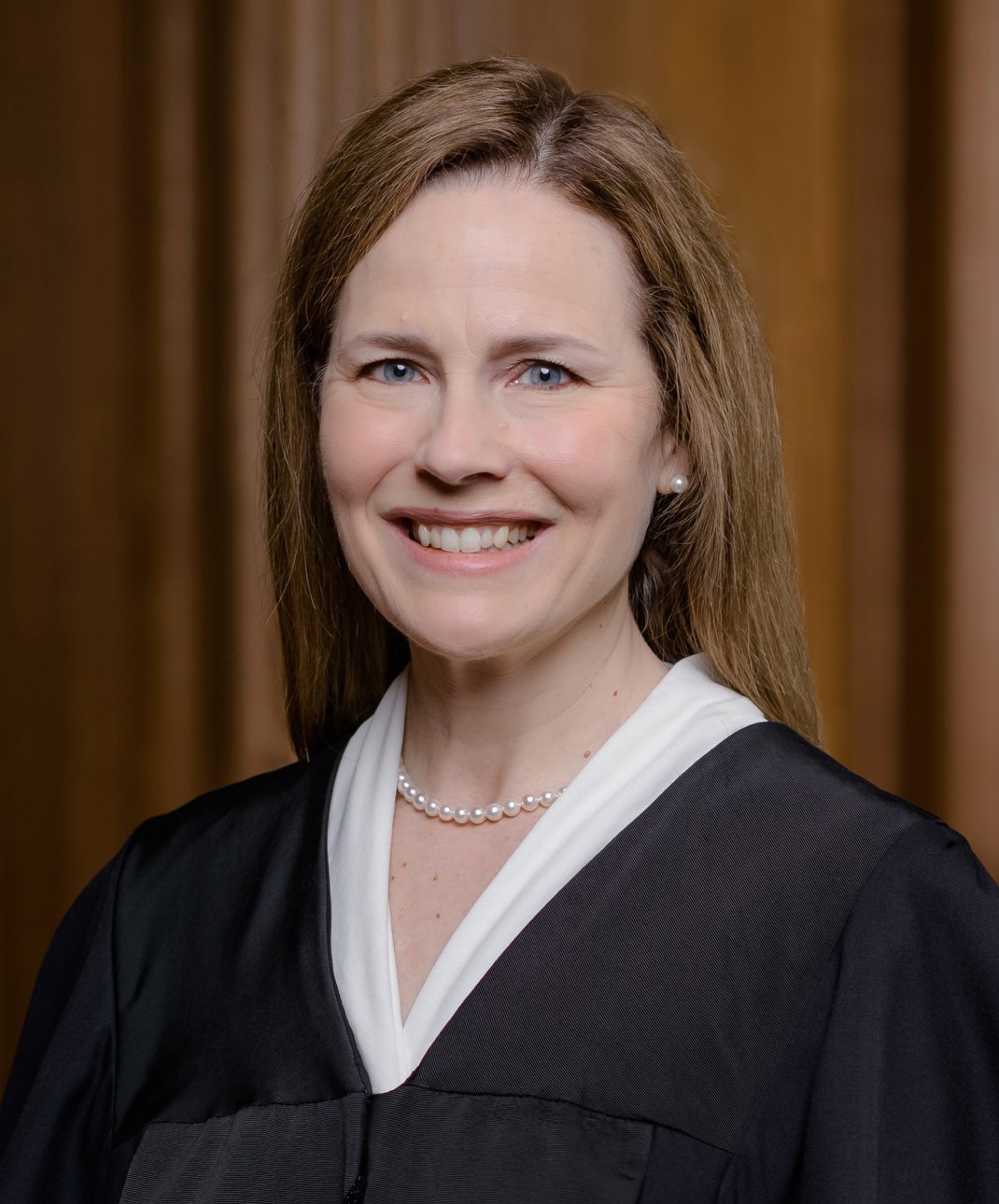
AMY CONEY BARRETT
Associate Justice
QUICK FACTS
APPOINTED BY
Donald Trump
PRECEDED BY
LAW SCHOOL
Notre Dame
SWORN IN
October 27, 2020
HOME STATE
Louisiana

Barrett pictured during law school
Personal Life and Education
Amy Coney Barrett (born Amy Vivian Coney) was born on January 28, 1972, in New Orleans, Louisiana, as the oldest of seven children. Her father, Michael Coney, served as an attorney for Shell Oil Company and later as a deacon, while her mother, Linda Coney, was a high school French teacher. Her mother’s background as a French teacher significantly influenced her education, and Barrett eventually added a minor in French during her undergraduate years.
Barrett attended St. Catherine of Siena for elementary school and graduated in 1990 from St. Mary’s Dominican High School, an all-girls Catholic institution in New Orleans. At St. Mary’s, she served as the student body vice president and was a top student. Barrett then enrolled at Rhodes College in Memphis, Tennessee, where she majored in English literature and minored in French. While at Rhodes, she was inducted into Phi Beta Kappa and Omicron Delta Kappa. Barrett graduated magna cum laude in 1994 and was named the most outstanding graduate in the English department.
After graduating from Rhodes College, Barrett attended Notre Dame Law School on a full-tuition scholarship. During her time there, she served as the executive editor of the Notre Dame Law Review and met her future husband, Jesse M. Barrett, who was also a student at the law school. She graduated in 1997 summa cum laude, ranking first in her class. Her high academic performance earned her prestigious clerkships, including with Justice Antonin Scalia during the Court’s 1998 term.
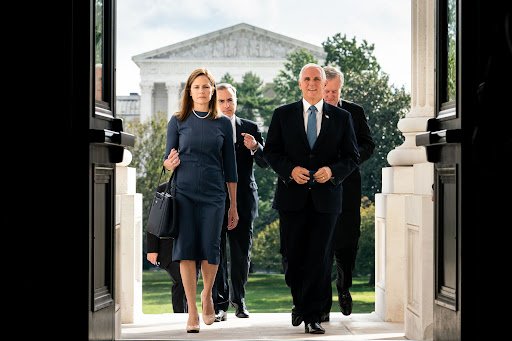
Photo of Barrett and Vice President Pence entering the Capitol building
Early Career
After completing law school, Barrett worked as a judicial clerk for Judge Laurence Silberman of the D.C. Circuit and later for Justice Antonin Scalia. Following her clerkship with Justice Scalia, in 1999, she joined the esteemed D.C. law firm of Miller, Cassidy, Larroca & Lewin. In 2001, Barrett assumed the role of the John M. Olin Fellow at Law at George Washington University Law School, and subsequently returned to her alma mater in 2002 as an assistant professor of law. During her tenure as a professor at Notre Dame, she developed a reputation as an expert in federal courts, constitutional law, and statutory interpretation. From 2014 to 2017, Barrett held Notre Dame’s Diane and M.O. Miller II Research Chair of Law, with her scholarship focusing on constitutional law, originalism, statutory interpretation, and stare decisis. In her time at Notre Dame, Barrett received the "Distinguished Professor of the Year" award three times.
In 2010, Chief Justice John Roberts appointed Barrett to serve on the Advisory Committee for the Federal Rules of Appellate Procedure. In May 2017, President Trump nominated Barrett to the Seventh Circuit. In October of that year, the Senate Judiciary Committee voted 11–9 to recommend her nomination to the Senate, after which she was confirmed by a vote of 55 to 43 in the Senate.

Photo of Barrett with President Trump at the White House on the night she was sworn in as an Associate Justice of the Supreme Court
Nomination to the Supreme Court
Barrett’s name first emerged as a contender for the Supreme Court in 2017, following her confirmation to the Seventh Circuit Court of Appeals. In July 2018, after Justice Anthony Kennedy's announced he would retire, Barrett was reported to be one of three finalists Trump considered, alongside Justice Brett Kavanaugh. After Kavanaugh's selection, Barrett remained a potential nominee for a future U.S. Supreme Court vacancy.
Following the death of Justice Ruth Bader Ginsburg on September 18, 2020, Barrett emerged as a leading candidate to succeed her. On September 26, 2020, Trump announced his intention to nominate Barrett to fill the vacancy left by Ginsburg's passing. Barrett's nomination received widespread support from Republicans, who aimed to confirm her before the 2020 United States presidential election. Democrats, however, generally opposed the nomination, citing controversy about filling the vacancy just prior to the presidential election in light of the Senate Republican majority's refusal to consider President Barack Obama's nomination of Merrick Garland in 2016, more than ten months before the end of his presidency.
On October 22, the Judiciary Committee issued a favorable report on her confirmation with a 12–0 vote, with all 10 Democrats on the committee boycotting the vote. On October 26, Barrett's confirmation to the Supreme Court was approved by the Senate with a 52–48 vote. Every Republican senator except Susan Collins voted in favor of her confirmation, and every Senate Democrat voted against it. On the evening of the confirmation vote, President Trump hosted a swearing-in ceremony at the White House. At Barrett’s request, Justice Clarence Thomas administered the oath of office to her and her husband, Jesse Barrett, held the Bible. The next day, Chief Justice John Roberts administered the judicial oath to Barrett.
What the Court has looked like since Justice Barrett joined.

Cite this page


