Youngstown Sheet & Tube Co. v. Sawyer
Case Overview
CITATION
ARGUED ON
DECIDED ON
DECIDED BY
353 U.S. 579
May 12-13, 1952
Jun. 2, 1952
Legal Issues
Does the President have the power to order the seizure of private steel mills if a stoppage in production would put the Nation’s war efforts at risk?
Holding
No, the President cannot claim power not granted to him by an Act of Congress or the Constitution.
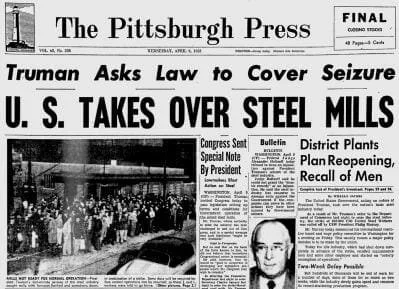
Newspaper headline about the case | Credit: The National Security Law Podcast
Background
In late 1951, a dispute between the Nation’s steel companies and their employees began regarding their new collective bargaining agreements. On December 18, the disputes remained unresolved, and the representative of the United Steelworkers of America, C.I.O. (USACIO) gave notice of an intention to strike on December 31. On December 22, President Harry Truman referred the dispute to the Federal Wage Stabilization Board, but to no avail. Finally, on April 4, 1952, the USACIO gave notice of a nationwide strike beginning on April 9.
In response, President Truman issued Executive Order 10340, which directed the Secretary of Commerce, then Charles Sawyer, to take possession of most of the country’s steel mills to keep them running. The President claimed the power to do so because a stoppage of steel production would jeopardize the Nation’s efforts in the Korean War, given the importance of steel in weapons and other war materials. The President also claimed that his action was meant to ensure the survival of legislative programs enacted by Congress to stabilize steel production and pricing and support the war effort.
6 - 3 decision for Youngstown Sheet & Tube Co.
Youngstown


Sawyer


Burton
Black
Minton
Frankfurter
Reed
Jackson
Douglas
Vinson
Clark
-
Writing for the Court, Justice Hugo Black began by establishing that any power that the President exercises must be derived from an Act of Congress or the Constitution itself. The Government acknowledged that the President was not claiming his authority under an Act enacted by Congress, and Black noted that during the debates over the Taft-Hartley Act in 1947, Congress had purposefully declined to grant the Executive the authority to seize productions in response strikes, believing it would interfere with the collective bargaining process.
Black found that the President couldn’t justify such authority with Article II’s grant of executive power, writing that “[i]n the framework of our Constitution, the President’s power to see that the laws are faithfully executed refutes the idea that he is to be a lawmaker.” He noted that the President’s role in the lawmaking process is limited to recommending laws to Congress and vetoing laws he dislikes. Black emphasized that “the Constitution is neither silent nor equivocal about who shall make laws which the President is to execute.”
Black responded to the argument that Article II’s provisions stating that “the executive Power shall be vested in a President . . . ”; that the President “shall take Care that the Laws be faithfully executed”; and that the President “shall be Commander in Chief of the Army and Navy of the United States” granted the President the authority to seize the Nation’s steel mills during a time of war. Black found that the President couldn’t claim such authority under his power as Commander in Chief, writing that while the “’theater of war’ [is] an expanding concept, we cannot with faithfulness to our constitutional system hold that the Commander in Chief of the Armed Forces has the ultimate power as such to take possession of private property in order to keep labor disputes from stopping production.” He asserted that this is a job for the Nation’s elected lawmakers, not military officials.
Ultimately, Black concluded that no matter the circumstance, the President cannot claim authority not granted to him by an Act of Congress or the Constitution. He wrote, “[t]he Founders of this Nation entrusted the lawmaking power to the Congress alone in both good and bad times. It would do no good to recall the historical events, the fears of power and the hopes for freedom that lay behind their choice.”
-
In his concurring opinion, Justice Robert Jackson began by establishing an “over-simplified grouping of practical situations in which a President may doubt, or others may challenge, his powers.”
First, Jackson stated that when the President acts “pursuant to an express or implied authorization of Congress, his authority is at its maximum” since it includes all of his executive power and all that which Congress delegated. Jackson explained that only in such cases can the President be said to “personify the federal sovereignty.” Therefore, if an act is found unconstitutional under these circumstances, then the federal government as a whole likely lacked the power to begin with.
Second, Jackson stated that when the President acts “in absence of either a congressional grant or denial of authority, he can only rely upon his own independent powers, but there is a zone of twilight in which he and Congress may have concurrent authority, or in which its distribution is uncertain.” Jackson explained that in such cases, “congressional inertia, indifference or quiescence may sometimes ... enable, if not invite, measures of independent presidential responsibility.” He noted that any challenge of power in this area is likely to depend on “the imperatives of events and contemporary imponderables rather than on abstract theories of law.”
Third, Jackson stated that when the President “takes measures incompatible with the expressed or implied will of Congress, his power is at its lowest ebb, for then he can rely only upon his own constitutional powers minus any constitutional powers of Congress over the matter.” Jackson explained that the Court can only sustain such exclusive Presidential control by “disabling” Congress from acting on the subject, but warned that a “Presidential claim to a power at once so conclusive and preclusive must be scrutinized with caution, for what is at stake is the equilibrium established by our constitutional system.”
Regarding the President’s seizure of the steel mills in light of these principles, Jackson found that it could be easily eliminated from the first two categories since Congress hadn’t granted the President the authority for the seizure nor did it leave the issue of private property seizure an “open field” that could create a zone of twilight regarding this power. Moving to the third category, Jackson explained that the Court could only sustain the President’s action “by holding that seizure of such strike-bound industries is within his domain and beyond control by Congress.”
In response to the Government’s reliance on Article II, §2’s establishment of the President as Commander in Chief, Jackson pointed out that Article I, §8 expressly grants Congress the authority “to raise and support Armies” and “to provide and maintain a Navy.” Jackson explained that Congress has the primary responsibility for supplying the armed forces and Congress alone controls the raising of revenues and appropriation of funding for military and naval procurement. He noted that Congress could choose to take over war supply as a Government enterprise, but pointed out that they had chosen to rely on “free private enterprise collectively bargaining with free labor for support and maintenance of our armed forces.”
Jackson asserted that the President’s power as Commander in Chief isn’t absolute, writing that “the Constitution did not contemplate that the title Commander-in-Chief of the Army and Navy will constitute him also Commander-in-Chief of the country, its industries and its inhabitants. He has no monopoly of ‘war powers,’ whatever they are.” Jackson explained the role of separation of powers, stating that “[w]hile Congress cannot deprive the President of the command of the army and navy, only Congress can provide him an army or navy to command. That military powers of the Commander-in-Chief were not to supersede representative government of internal affairs seems obvious from the Constitution and from elementary American history.”
Ultimately, Jackson concluded that the President’s action “originates in the individual will of the President and represents an exercise of authority without law... With all its defects, delays and inconveniences, men have discovered no technique for long preserving free government except that the Executive be under the law, and that the law be made by parliamentary deliberations. Such institutions may be destined to pass away. But it is the duty of the Court to be last, not first, to give them up.”
-
In his concurring opinion, Justice William Douglas first addressed the nature of executive power, explaining that “[a]ll executive power—from the reign of ancient kings to the rule of modern dictators—has the outward appearance of efficiency.” He noted that the emergency regarding the steel mills “did not create the power; it merely marked an occasion when power should be exercised. And the fact that it was necessary that measures be taken to keep steel in production does not mean that the President, rather than the Congress, had the constitutional authority to act.”
On the other hand, Douglas explained that legislative power is slower to exercise and may “often be cumbersome, time-consuming, and apparently inefficient.” Douglas, however, quoted Justice Brandeis in Myers v. United States to point out that “[t]he doctrine of the separation of powers was adopted by the Convention of 1787 not to promote efficiency but to preclude the exercise of arbitrary power. The purpose was not to avoid friction, but, by means of the inevitable friction incident to the distribution of the governmental powers among three departments, to save the people from autocracy.”
Douglas argued that the President’s seizure of industrial plants was an act of eminent domain, which is a power reserved for the legislature. Under the Fifth Amendment, any “taking” of property, even if it’s temporary, requires just compensation. Douglas explained that because Article I, § 8 grants Congress the exclusive “power of the purse,” only it can authorize the payment required for such a seizure. Therefore, a President cannot lawfully seize property without prior congressional authorization since the branch responsible for payment must be the one to authorize the seizure of property.
-
Item description
-
In his dissenting opinion, Chief Justice Fred Vinson focused on the “extraordinary” times in which the President was acting, writing that “[t]hose who suggest that this is a case involving extraordinary powers should be mindful that these are extraordinary times. A world not yet recovered from the devastation of World War II has been forced to face the threat of another and more terrifying global conflict.”
Vinson then explained that Congress had enacted a series of legislation in support of the Korean War, and the President has the duty to execute those legislative programs. Vinson noted that successful execution of these programs required continued production of steel and the stabilization of its price, which the President acted to preserve by averting a shutdown of steel production. He stated that this case doesn’t “consider the possibility of executive seizure of a farm, a corner grocery store or even a single industrial plant. Such considerations arise only when one ignores the central fact of this case—that the Nation’s entire basic steel production would have shut down completely if there had been no Government seizure.” Vinson rejected the idea that the mills will reopen “sooner or later,” writing “[t]hat may satisfy the steel companies and, perhaps, the Union. But our soldiers and our allies will hardly be cheered with the assurance that the ammunition upon which their lives depend will be forthcoming—‘sooner or later,’ or, in other words, ‘too little and too late.’”
Vinson asserted that the action taken by the President was exactly that which was imagined by the framers when they granted him the authority to “take Care that the Laws be faithfully executed.” He explained that Presidents have acted without explicit statutory authorization in the face of national emergencies to enforce or save legislative programs until Congress could act. Vinson argued that the President’s actions here were clearly within his duty under the Take Care Clause. Vinson emphasized that the President wrote to Congress the morning after the seizure to inform them of his action and explain that he did so to preserve the military procurement and price stabilization programs enacted by Congress.
Vinson responded to the argument that the President was attempting to claim unlimited power, writing that “[m]uch of the argument in this case has been directed at straw men. We do not now have before us the case of a President acting solely on the basis of his own notions of the public welfare. Nor is there any question of unlimited executive power in this case.” He explained that “the President himself closed the door to any such claim” when he wrote to Congress stating the purpose of his actions and that he would abide by any action of Congress, whether it approved of the seizure or not.
Ultimately, Vinson concluded in defense of the President’s seizure of the steel mills as part of his duty to execute the defense programs enacted by Congress. He wrote, “[n]o basis for claims of arbitrary action, unlimited powers or dictatorial usurpation of congressional power appears from the facts of this case. On the contrary, judicial, legislative and executive precedents throughout our history demonstrate that in this case the President acted in full conformity with his duties under the Constitution.”