U.S. Department of Agriculture v. Moreno
Case Overview
CITATION
ARGUED ON
DECIDED ON
DECIDED BY
413 U.S. 528
Apr. 23, 1973
Jun. 25, 1973
Legal Issue
Does the distinction between households of related individuals and households including non-related individuals violate the Equal Protection Clause of the Fourteenth Amendment?
Holding
Yes, the distinction violated the Equal Protection Clause because no rational basis existed for it.
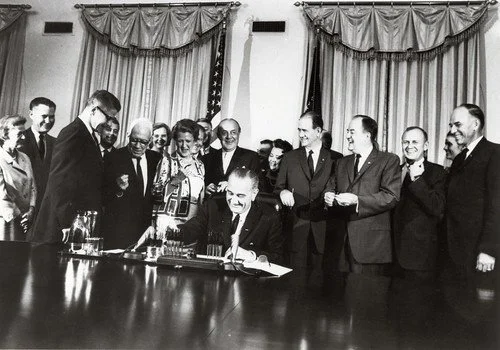
President Lyndon B. Johnson signing the Food Stamps Act into law | Credit: Community Action Coalition
Background
The federal food stamp program was established in 1964 in an effort to alleviate hunger and malnutrition among the more needy segments of society. Eligibility for participation in the program is determined on a household rather than an individual basis. An eligible household purchases sufficient food stamps to provide a nutritionally adequate diet. The household pays for the stamps at a reduced rate based upon its size and cumulative income, uses the food to purchase food at retail stores, and the Government redeems the stamps at face value, thereby paying the difference between the actual cost of the food and the amount paid by the household for the stamps.
Initially, §3(e) defined a “household” as “a group of related or non-related individuals, who are not residents of an institution or boarding house, but are living as one economic unit sharing common cooking facilities and for whom food is customarily purchased in common.” However, in January of 1971, Congress redefined the “household” to include only groups of related individuals. Subsequently, the Secretary of Agriculture promulgated regulations rendering ineligible for participation in the program any “household” whose members are not “all related to each other.”
The appellees consisted of several groups of individuals alleging that although they satisfy the income eligibility requirements for federal food assistance, they were excluded from the program solely because the persons in each group are not “all related to each other.”
7 - 2 decision for Moreno
USDA
Moreno


Stewart
Rehnquist
Powell
White
Burger
Marshall
Douglas
Blackmun
Brennan
-
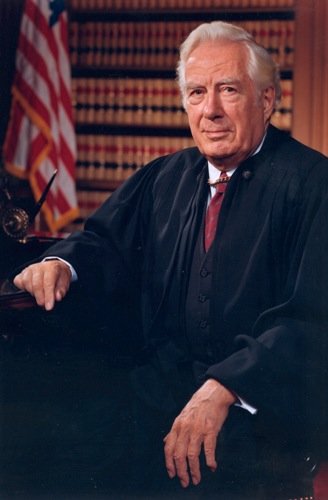
Writing for the Court, Justice William Brennan first established that under a traditional equal protection analysis, a legislative classification must be sustained if it’s rationally related to a legitimate government interest. Brennan explained that since the statutory classification of households “is clearly irrelevant to the stated purposes of the Act,” it must rationally further a government interest other than those listed in the congressional “declaration of policy.” Brennan lamented the lack of legislative history for the amendment but found evidence indicating that it was proposed to prevent “hippies” and “hippie communes” from participating in the food stamp program. Brennan found that the classification “clearly” couldn’t be supported by referencing that purpose because “if the constitutional conception of ‘equal protection of the laws’ means anything, it must at the very least mean that a bare congressional desire to harm a politically unpopular group cannot constitute a legitimate governmental interest.”
The government argued that the purpose of the amendment was to prevent fraud and that Congress might have rationally thought (1) that households with one or more unrelated members are more likely than “fully related” households to contain individuals who abuse the program by fraudulently failing to report sources of income or by voluntarily remaining poor; and (2) such households are “relatively unstable,” which increased the difficulty of detecting abuses. In response, Brennan described the government’s argument as “wholly unsubstantiated assumptions” and stated that even if the Court agreed, it couldn’t conclude that denial of essential federal assistance to all otherwise eligible households with unrelated members is a rational effort to address fraud.
Brennan noted that the Food Stamp Act already addressed the issue of fraud independent of Congress’ 1971 amendment. He wrote that “[t]he existence of these provisions necessarily casts considerable doubt upon the proposition that the 1971 amendment could rationally have been intended to prevent those very same abuses.” Brennan argued that the practical effect of the amendment is not to prevent fraud, but rather to exclude from the program “not those persons who are ‘likely to abuse the program,’ but, rather, only those persons who are so desperately in need of aid that they cannot even afford to alter their living arrangements so as to retain their eligibility.” Ultimately, Brennan concluded that the distinction created by the amendment was unconstitutional, writing that “[t]raditional equal protection analysis does not require that every classification be drawn with precise ‘mathematical nicety.’ But the classification here in issue is not only ‘imprecise,’ it is wholly without any rational basis.”
-
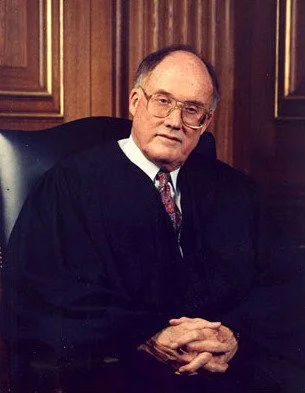
In his dissenting opinion, Justice William Rehnquist wrote that “[t]he Court’s opinion would make a very persuasive congressional committee report arguing against the adoption of the limitation in question.” Rehnquist asserted, however, that policy questions such as addressing fraud in the Food Stamps program are left to Congress, not the Court. He stated that the only proper role of the Court in this case is to determine whether any rational basis existed for Congress’ distinction between households.
Rehnquist found that Congress’ amendment of the Food Stamps Act “could, in the judgment of reasonable men, conceivably deny food stamps to members of households which have been formed solely for the purpose of taking advantage of the food stamp program.” Rehnquist explained that the food stamp program wasn’t created to be a subsidy for everyone desiring low-cost food, so the restriction enacted by Congress was permissible and “quite consistent with the underlying policy of the Act.” Ultimately, Rehnquist concluded that “[t]he fact that the limitation will have unfortunate and perhaps unintended consequences beyond this does not make it unconstitutional.”