United States v. Drayton
Home | All Cases | Criminal Procedure | United States v. Drayton
Case Overview
CITATION
ARGUED ON
DECIDED ON
DECIDED BY
536 U.S. 194
Apr. 16, 2002
Jun. 17, 2002
Legal Issue
Does the Fourth Amendment require police officers to provide notice of the right to not cooperate and refuse consent to searches?
Holding
No, the Fourth Amendment does not require police officers to advise bus passengers of their right not to cooperate and to refuse consent to searches.
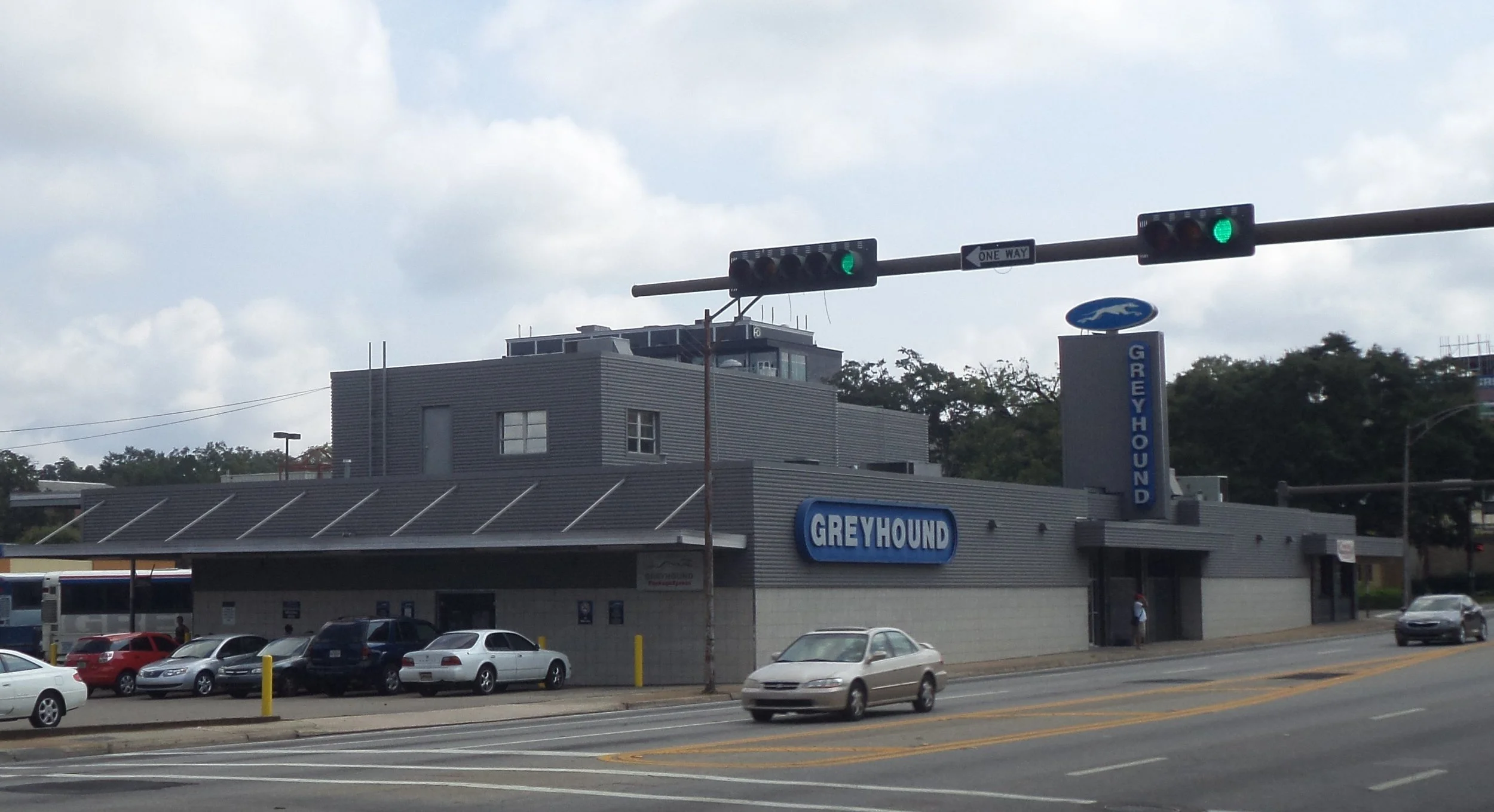
The Greyhound bus station where Drayton and Brown were searched at, located off of Tennessee Street in Tallahassee, FL | Credit: Michael Rivera/Wikipedia
Background
On February 4, 1999, Christopher Drayton and Clifton Brown, Jr., were traveling on a Greyhound bus from Ft. Lauderdale, Florida, to Detroit, Michigan. The bus made a scheduled stop at the Greyhound station in Tallahassee, Florida, and the passengers were required to disembark so the bus could be refueled and cleaned. As the passengers reboarded, the driver checked their tickets and then left to complete paperwork inside the terminal. As he left, the driver allowed three police officers with the Tallahassee Police Department to board the bus as part of a routine drug and weapons interdiction effort. The officers were dressed in plain clothes and carried concealed weapons and visible badges.
Once onboard, Officer Hoover stayed by the driver’s seat and faced the rear of the bus, Officer Blackburn stayed at the back of the bus, and Officer Lang spoke with individual passengers, asking them about their travel plans to match passengers with luggage in the overhead racks. To avoid blocking the aisle, Lang stood next to or just behind each passenger while speaking with them. According to Lang’s testimony, passengers who declined to cooperate with him or who chose to exit the bus at any time would have been allowed to do so without argument. However, Lang noted that most people are willing to cooperate and some even commend the police for their efforts to ensure the safety of their travel. He also stated that it was common for passengers to leave the bus for a cigarette or a snack while the officers were on board. Lang sometimes informed passengers of their right to refuse to cooperate, but on the day in question, he did not.
Lang approached Drayton and Brown from the rear, leaned over Drayton’s shoulder, and held up his badge identifying him as a police officer. Lang stated, “I’m Investigator Lang with the Tallahassee Police Department. We’re conducting bus interdiction [sic], attempting to deter drugs and illegal weapons being transported on the bus. Do you have any bags on the bus?” In response, Drayton and Brown pointed to a green bag on the luggage rack. Lang asked if he could check the bag, Brown consented, and nothing was found. Noticing that Drayton and Brown were wearing baggy pants in warm weather, which drug traffickers often wore to conceal weapons and narcotics, Lang asked if he could search their person. Both consented and were arrested after hard objects were detected near their thighs. A further search revealed that the objects were plastic bundles of powder cocaine duct-taped to their thighs.
Drayton and Brown were charged under 21 U.S.C. § 841(a)(1) and § 846, for conspiring to distribute cocaine and possessing cocaine with intent to distribute. They moved to suppress the cocaine as evidence, arguing that their consent to the patdown was invalid, but the U.S. District Court for the Northern District of Florida denied their motion. On appeal, the U.S. Court of Appeals for the Eleventh Circuit reversed the denial and remanded the case with instructions to grant the motion to suppress the cocaine evidence. The U.S. Supreme Court then granted certiorari.
6 - 3 decision for the United States
United States


Drayton


Thomas
Scalia
Kennedy
Stevens
Rehnquist
Souter
Brennan
Ginsburg
Breyer
-
Writing for the Court, Justice Anthony Kennedy first established that “[l]aw enforcement officers do not violate the Fourth Amendment’s prohibition of unreasonable seizures merely by approaching individuals on the street or in other public places and putting questions to them if they are willing to listen.”
Kennedy recalled the Court’s previous ruling in Florida v. Bostick (1991), where they addressed the specific question of drug interdiction efforts on buses. There, two police officers requested a bus passenger’s consent to search his luggage and discovered cocaine after the passenger consented. The Florida Supreme Court suppressed the cocaine evidence, adopting a “per se rule” that questioning individuals in the cramped environment on the bus deprived them of their freedom of movement and constituted a seizure under the Fourth Amendment. The U.S. Supreme Court reversed, with Kennedy explaining that “Bostick first made it clear that for the most part per se rules are inappropriate in the Fourth Amendment context.” Rather, Kennedy asserted that “[t]he proper inquiry ‘is whether a reasonable person would feel free to decline the officers’ requests or otherwise terminate the encounter.’” He added this test “is objective and ‘presupposes an innocent person.”
Examining the facts of Drayton and Brown’s case, Kennedy found that the officers’ actions on the bus didn’t constitute a seizure, explaining that there was “ no application of force, no intimidating movement, no overwhelming show of force, no brandishing of weapons, no blocking of exits, no threat, no command, not even an authoritative tone of voice.” Kennedy emphasized that “[i]t is beyond question that had this encounter occurred on the street, it would be constitutional. The fact that an encounter takes place on a bus does not on its own transform standard police questioning of citizens into an illegal seizure.”
Kennedy explained that while the officers didn’t inform the passengers of their right to refuse the search, his request for permission to conduct the search was significant. He opined, writing that “[i]n a society based on law, the concept of agreement and consent should be given a weight and dignity of its own. Police officers act in full accord with the law when they ask citizens for consent. It reinforces the rule of law for the citizen to advise the police of his or her wishes and for the police to act in reliance on that understanding. When this exchange takes place, it dispels inferences of coercion.” Kennedy ultimately concluded that based on the totality of the circumstances, Drayton and Brown’s consent was given voluntarily and the searches were therefore reasonable under the Fourth Amendment.
-
In his dissenting opinion, Justice David Souter