Gibbons v. Ogden
Case Overview
CITATION
ARGUED ON
DECIDED ON
DECIDED BY
22 U.S. (9 Wheat.) 1
Feb. 5, 1824
Mar. 2, 1824
Legal Issue
Can the Commerce Clause be interpreted broadly to grant Congress the authority to regulate navigation?
Holding
Yes, the language of the Commerce Clause allows a broader definition that allows more than just mere traffic and includes the trade of commodities and navigation.
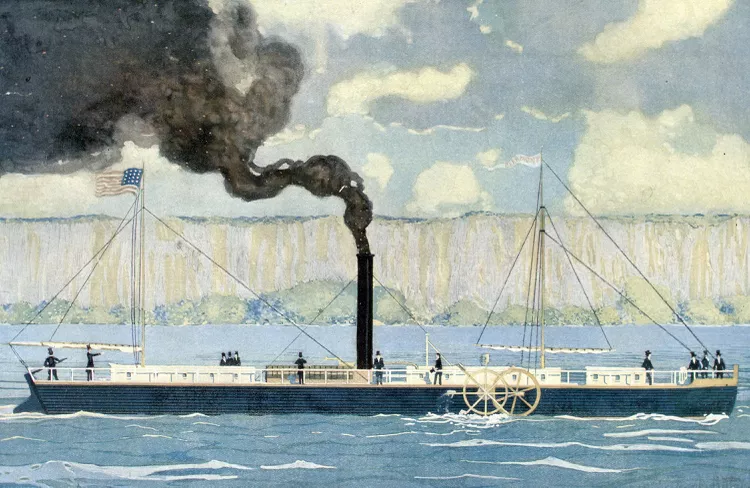
Early steamboat on the Hudson River | Credit: Smith Collection/Gado/Getty Images
Background
In 1798, the New York State Legislature granted Robert R. Livingston and Robert Fulton a 20 year monopoly over all steamboat navigation within the state’s waters. Aaron Ogden, the Governor of New Jersey, subsequently purchased a license from their assignees, granting him the exclusive right to operate a ferryboat route between Elizabethtown, New Jersey, and New York City.
Ogden initially entered into a business partnership with Thomas Gibbons to operate the route, but the partnership collapsed three years later and Gibbons began operating his own competing steamboat service on the exact same route between New Jersey and New York. Gibbons justified his independent operations by asserting that his steamboats were explicitly licensed under a 1793 act of the U.S. Congress regulating the coasting trade.
Ogden filed a complaint seeking an injunction in the New York state courts, alleging that Gibbons violated his exclusive, state-granted rights. The state courts, including the Court of Chancery and the Court of Errors, sided with Ogden and issued a permanent injunction restricting Gibbons from operating his boats in New York waters. Gibbons then appealed to the U.S. Supreme Court, arguing that his federal coasting license superseded the state-granted monopoly and that Congress possessed the exclusive national power to regulate interstate commerce under the Commerce Clause.
Unanimous decision for Gibbons
Gibbons


Ogden

Marshall

Washington
Livingston
Story
* Justice Thompson took no part in the decision or consideration of this case.
Duvall
Todd
-
Writing for the Court, Chief Justice John Marshall began by responding to the sentiment that the states are unified only by a “league”. Marshall asserted that after ratifying the Constitution, “the whole character in which the States appear, underwent a change, the extent of which must be determined by a fair consideration of the instrument by which that change was effected.”
Marshall then explained that the Constitution enumerates certain powers and posited, “[i]t has been said, that these powers ought to be construed strictly. But why ought they to be so construed? Is there one sentence in the constitution which gives countenance to this rule?”
In interpreting the Constitution, Marshall first addressed the definition of “commerce.” Marshall rejected the narrow view that commerce should be limited merely to traffic, buying and selling, or the interchange of commodities. Marshall instead argued that it should be understood much more broadly as “intercourse” and inherently includes navigation. He explained that when the Constitution was framed, all of America understood commerce to comprehend navigation, and excluding it would deprive the federal government of its long-exercised power to regulate the American shipping and coasting trade.
Marshall then examined the phrase “among the several States”, defining “among” as meaning “intermingled with”. He further stated that Congress’ regulatory power cannot stop at the external boundary lines of the states but must be capable of entering their interior. Marshall clarified, however, that Congress’ power does not extend to the exclusively internal commerce of a state that doesn’t extend to or affect other states.
Lastly, Marshall defined the power “to regulate” as the authority to prescribe the rule by which commerce is to be governed. Marshall declared that this power is complete in itself, may be exercised to its utmost extent, and acknowledges no limitations other than those expressly prescribed in the Constitution. Marshall emphasized that the sovereignty of Congress over interstate and foreign commerce is plenary, and that the primary restraints against their overreach are political rather than judicial.