Panama Refining Co. v. Ryan
Case Overview
CITATION
ARGUED ON
DECIDED ON
DECIDED BY
293 U.S. 388
Dec. 10-11, 1934
Jan. 7, 1935
Legal Issues
Can Congress delegate to the President the authority to prohibit the transportation of petroleum in interstate and foreign commerce at will?
Holding
No, Congress cannot delegate a power to the President without any policy or standard to guide or limit his discretion.
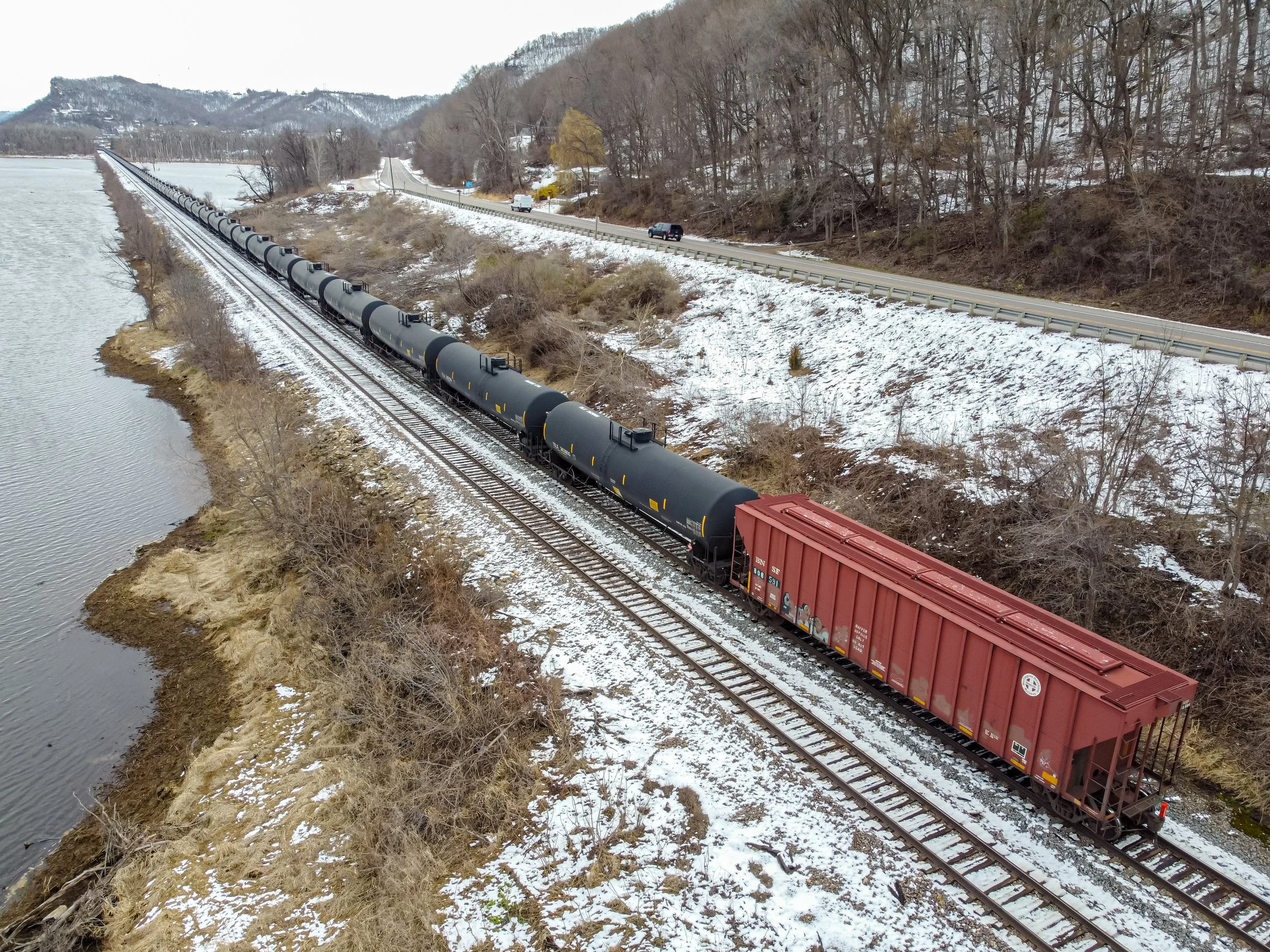
Petroleum transport train near Lacrosse, Wisconsin | Credit: Wikipedia
Background
In 1933, as a part of President Franklin Roosevelt’s New Deal legislation, Congress enacted the National Industrial Recovery Act (NIRA). Title I, § 9(c) of NIRA states: “The President is authorized to prohibit the transportation in interstate and foreign commerce of petroleum and the products thereof produced or withdrawn from storage in excess of the amount permitted to be produced or withdrawn from storage by any state law or valid regulation or order prescribed thereunder, by any board, commission, officer, or other duly authorized agency of a State. Any violation of any order of the President issued under the provisions of this subsection shall be punishable by fine of not to exceed $1,000, or imprisonment for not to exceed six months, or both.”
On July 11, 1933, President Franklin Roosevelt issued Executive Order 6199, prohibiting “the transportation in interstate and foreign commerce of petroleum and the products thereof produced or withdrawn from storage in excess of the amount permitted to be produced or withdrawn from storage by any State law or valid regulation or order prescribed thereunder, by any board, commission, officer, or other duly authorized agency of a State.” In response to the Executive Order, Secretary of the Interior Harold Ickes enacted regulations that required petroleum producers to file monthly statements under oath and keep their books and records available for federal inspection.
Panama Refining sued in the U.S. District Court for the Eastern District of Texas to enjoin federal officials from enforcing the regulations promulgated by the Secretary of the Interior. Ambrose Ryan was the Special Agent in Charge of the Division of Investigations of the Department of the Interior tasked with enforcing the regulations in the East Texas oil fields. The district court issued an injunction preventing enforcement, but the Government appealed the decision. On appeal, the U.S. Court of Appeals for the Fifth Circuit reversed the district court’s injunction. The Supreme Court then granted certiorari.
8 - 1 decision for Panama Refining Co.
Panama Refining Co.




Ryan

Cardozo
Hughes
Sutherland
Roberts
Van Devanter

Brandeis
McReynolds
Stone
Butler

-
Writing for the Court, Chief Justice Charles Evans Hughes began by stating that NIRA contains nothing regarding the circumstances or conditions in which transportation of petroleum or petroleum products should be prohibited. Hughes argued that it’s “no answer” that dangerous consequences may follow the transportation of oil exceeding state allowances because within NIRA, Congress didn’t prohibit such transportation or state that it was injurious or unfair competition. Further, Hughes noted that Congress didn’t declare the circumstances that such transportation should be prohibited or even require the President to make any determination based on any facts or circumstances.
Hughes then turned to Article II of the Constitution, which vests all legislative powers in Congress and empowers them “[t]o make all Laws which shall be necessary and proper for carrying into Execution” its general powers. Hughes stated that “Congress manifestly is not permitted to abdicate or transfer to others the essential legislative functions with which it is thus vested.”
Hughes acknowledged that legislation enacted by Congress is often required to adapt to complex conditions that Congress can’t directly address. Hughes explained that the Constitution doesn’t deny Congress “the necessary resources of flexibility and practicality” that enable it to establish policies and standards while delegating the “making of subordinate rules within prescribed limits and the determination of facts to which the policy as declared by the Legislature is to apply.” He noted that without the ability to delegate such power, “we should have the anomaly of a legislative power which in many circumstances calling for its exertion would be a futility.”
Hughes, however, responded that “the constant recognition of the necessity and validity of such provisions and the wide range of administrative authority which has been developed by means of them cannot be allowed to obscure the limitations of the authority to delegate, if our constitutional system is to be maintained.”
Hughes warned that if § 9 of NIRA were upheld, “it would be idle to pretend that anything would be left of limitations upon the power of Congress to delegate its own lawmaking function” and render a number of the Supreme Court’s decisions “vacuous” and “nugatory.” He explained that the power delegated to the executive under NIRA had broad implications, stating that “[t]he question is not of the intrinsic importance of the particular statute before us, but of the constitutional processes of legislation which are an essential part of our system of government.” Ultimately, Hughes concluded that § 9 was an unconstitutional delegation of legislative power to the executive branch.