Gerstein v. Pugh
Home | All Cases | Criminal Procedure | Gerstein v. Pugh
Case Overview
CITATION
ARGUED ON
REARGUED ON
DECIDED ON
DECIDED BY
420 U.S. 103
Mar. 25, 1974
Oct. 21, 1974
Feb. 18, 1975
Legal Issue
Does the Fourth Amendment require that a person arrested and held for trial receive a judicial determination of probable cause for detention?
Holding
Yes, the Fourth Amendment requires a judicial determination of probable cause as a prerequisite to an extended restraint of liberty following arrest.
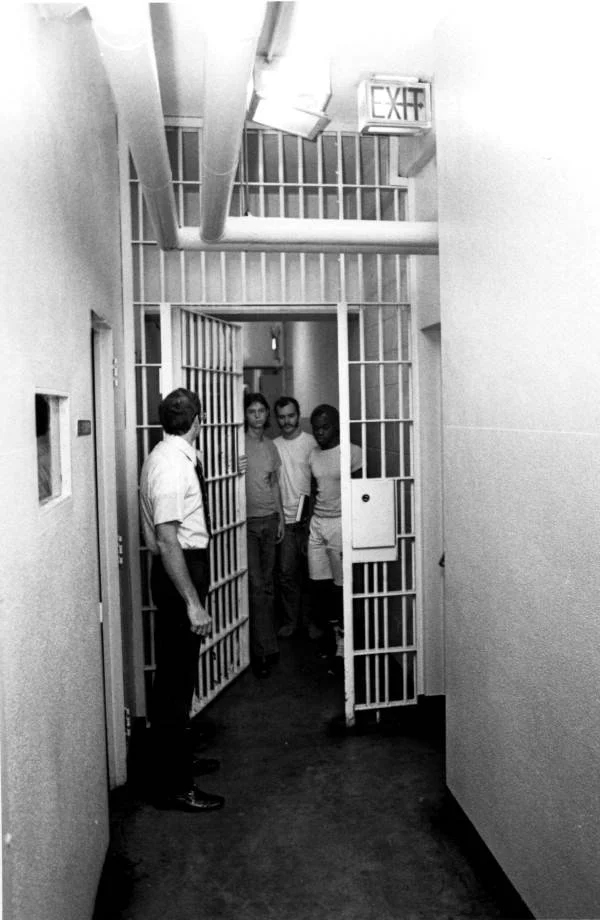
Interior of the Dade County Jail | Credit: Florida Memory
Background
In March of 1971, Harold Henderson and Robert Pugh were arrested by law enforcement officers in Dade County, Florida without an arrest warrant. Following their arrests, both men were held in custody under a prosecutor’s information, a state charging procedure that allowed prosecutors to initiate non-capital cases without a preliminary hearing and foreclosed any right to a subsequent judicial determination of probable cause. Pugh was denied bail altogether because one of his charges carried a potential life sentence, and Henderson remained incarcerated because he was unable to post a $4,500 bond. As a result, Pugh and Henderson both faced the prospect of extended pretrial detention based solely on the decision of the prosecutor, with no opportunity to challenge the factual basis of their confinement before a neutral magistrate. Under Florida’s Rules of Criminal Procedure at the time, there was no prompt mechanism for suspects to obtain judicial review of their arrest because arraignments were frequently delayed by a month or more, meaning they were entirely at the mercy of prosecutorial discretion.
Pugh and Henderson filed a class action lawsuit under 42 U.S.C. § 1983 in the U.S. District Court for the Southern District of Florida. They sought declaratory and injunctive relief against several Dade County officials, including Richard E. Gerstein, the State Attorney for Dade County, and various local law enforcement officers. Although the named plaintiffs were eventually convicted in their respective state criminal trials (ending their individual pretrial detentions) the federal civil lawsuit proceeded as a class action because the temporary nature of pretrial custody made the constitutional claim “distinctly ‘capable of repetition, yet evading review.’” The district court certified the class and held that the Fourth and Fourteenth Amendments guarantee all arrested persons charged by information a right to a judicial hearing on probable cause. Gerstein appealed the district court’s decision to the U.S. Court of Appeals for the Fifth Circuit, but while the appeal was pending, the Florida Supreme Court amended its statewide Rules of Criminal Procedure. While these new rules required a first appearance within 24 hours, they still didn’t require a probable cause determination for individuals charged by information. The case was remanded, and the district court issued a supplemental opinion declaring the amended statewide rules unconstitutional. The Fifth Circuit affirmed, and the U.S. Supreme Court subsequently granted certiorari.
Unanimous decision for Gerstein
Gerstein
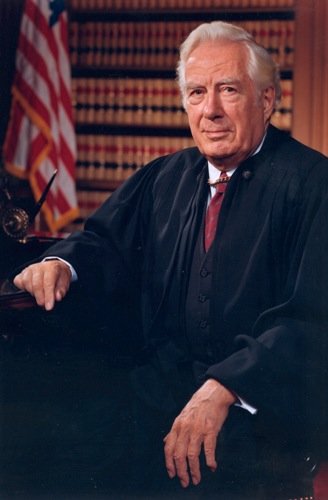


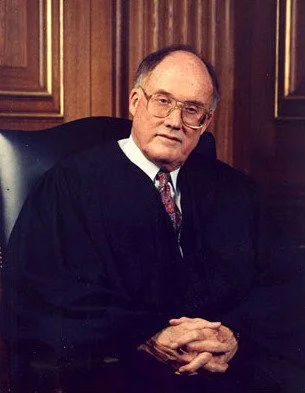
Pugh
Marshall
Stewart
Powell
Douglas
Rehnquist
White
Burger
Brennan
Blackmun
-
Writing for the Court, Justice Lewis Powell held that “the Fourth Amendment requires a judicial determination of probable cause as a prerequisite to extended restraint of liberty following arrest.” Powell explained that while a police officer’s on-the-scene assessment of probable cause provides legal justification for an arrest and a brief period of detention, the justification for disregarding a magistrate’s neutral judgment evaporate once the suspect is in custody since there’s no longer any danger that the suspect will escape or commit further crimes while the police submit their evidence for judicial review. On the other hand, Powell asserted that the suspect’s need for a neutral determination of probable cause increases significantly because the consequences of prolonged pretrial confinement are severe and “may imperil the suspect’s job, interrupt his source of income, and impair his family relationships.” He added that even if the suspect is released pending trial, they may be subjected to “burdensome conditions that effect a significant restraint of liberty.” Powell stated that when the stakes are this high, the judgment of a neutral magistrate is essential to satisfy the Fourth Amendment, which requires that inferences of probable cause “be drawn by a neutral and detached magistrate instead of being judged by the officer engaged in the often competitive enterprise of ferreting out crime.”
Powell rejected Gerstein’s argument that a prosecutor’s decision to file an information is a sufficient determination of probable cause to justify pretrial detention, asserting that prosecutorial judgment alone cannot meet the requirements of the Fourth Amendment because a prosecutor’s responsibility to law enforcement is inherently inconsistent with the constitutional role of a neutral and detached magistrate. Powell emphasized that the criminal justice system is intentionally divided into different parts so that the “awful instruments of the criminal law cannot be entrusted to a single functionary.” However, while Powell held that a judicial determination of probable cause is a prerequisite to an extended restraint of liberty, he added that “we do not imply that the accused is entitled to judicial oversight or review of the decision to prosecute… a conviction will not be vacated on the ground that the defendant was detained pending trial without a determination of probable cause.” Ultimately, Powell concluded that the Fourth Amendment requires that suspects be provided a fair determination of probable cause by a judicial officer either before or promptly after arrest.