A.L.A. Schechter Poultry
Corp. v. United States
Case Overview
CITATION
ARGUED ON
DECIDED ON
DECIDED BY
295 U.S. 495
May 2-3, 1935
May 27, 1935
Legal Issues
Can Congress enact legislation granting the President the power to unilaterally approve or create industry regulations that have the effect of criminal law?
Holding
No, Congress cannot abdicate or transfer to other branches an essential legislative function vested to it by the Constitution. Congress may designate the creation of subordinate rules within prescribed limits and determination of how a policy applies to certain facts, but it must itself establish the policies and establish standards.
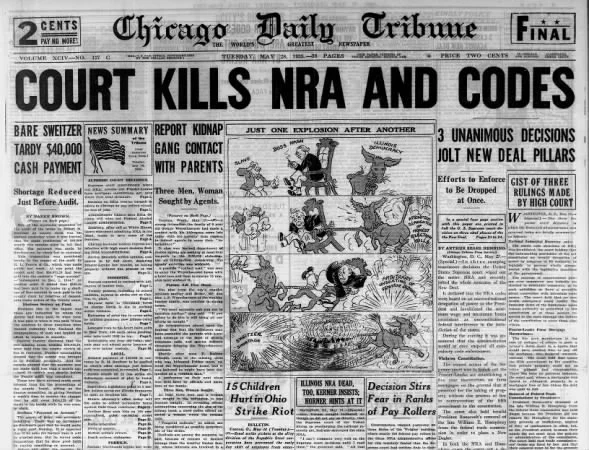
Newspaper headline about the case | Credit: The Chicago Tribune
Background
In 1933, as a part of President Franklin Roosevelt’s New Deal legislation, Congress enacted the National Industrial Recovery Act (NIRA). Title I, § 3 of the NIRA allows business groups to propose “codes of fair competition” to regulate the trades and industries they represent. The proposed codes may be approved by the President after the application of representative trade or industry associations, or the President may be proscribe the codes himself.
Once enacted, the codes are to be enforced by injunctions from the federal courts, and any violation of them “in any transaction in or affecting interstate commerce” was deemed an unfair method of competition within the meaning of the Federal Trade Commission Act and is to be punished as a crime against the United States.
On April 13, 1954, President Roosevelt approved the “Live Poultry Code” by Executive Order. The Code was established as “a code of fair competition for the live poultry industry of the metropolitan area in and about the City of New York” with the declared purpose of “effect[ing] the policies of Title I of the National Industrial Recovery Act.” Provisions of the Live Poultry Code included:
a maximum work hours requirement (40 hours per week).
a minimum wage (50 cents per hour).
a prohibition of the employment of anyone under the age of 16.
a protection of employees’ rights to collective bargaining and to join a union.
a requirement for minimum number of employees based on sales volume.
a “straight killing” requirement, which was defined as “the practice of requiring persons purchasing poultry for resale to accept the run of any half coop, coop, or coops, as purchased by slaughterhouse operators, except for culls.”
A.L.A. Schechter Poultry Corp. and Schechter Live Poultry Market (Schechter) were corporations that operated wholesale poultry markets in Brooklyn, New York City. Schechter was convicted in the U.S. District Court for the Eastern District of New York on eighteen counts of an indictment charging violations of the Live Poultry Code, and on an additional count for conspiracy to commit said violations. Schechter’s violations of the code were as follows:
One count alleged the sale to a butcher of an unfit chicken.
One count was for sales to slaughterers or dealers who were without licenses required by New York City ordinances and regulations.
Two counts alleged violations of the minimum wage and maximum hour provisions of the Code.
Two counts alleged the making of sales without having the poultry inspected or approved in accordance with New York City regulations.
Two counts alleged the making of false reports or the failure to make reports relating to the range of daily prices and volume of sales for certain periods.
Ten counts alleged violations of the “straight killing” requirement.
On appeal, the U.S. Court of Appeals for the Second Circuit sustained the conviction on the conspiracy count and on sixteen counts for violation of the Live Poultry Code, but reversed the conviction on two counts charging violations of the minimum wage and maximum work hour requirements. The Supreme Court then granted certiorari.
Unanimous decision for A.L.A. Schechter Poultry Corp.
Schechter




U.S.
Sutherland
Hughes
Cardozo
Van Devanter
Roberts
Brandeis
McReynolds
Stone
Butler
-
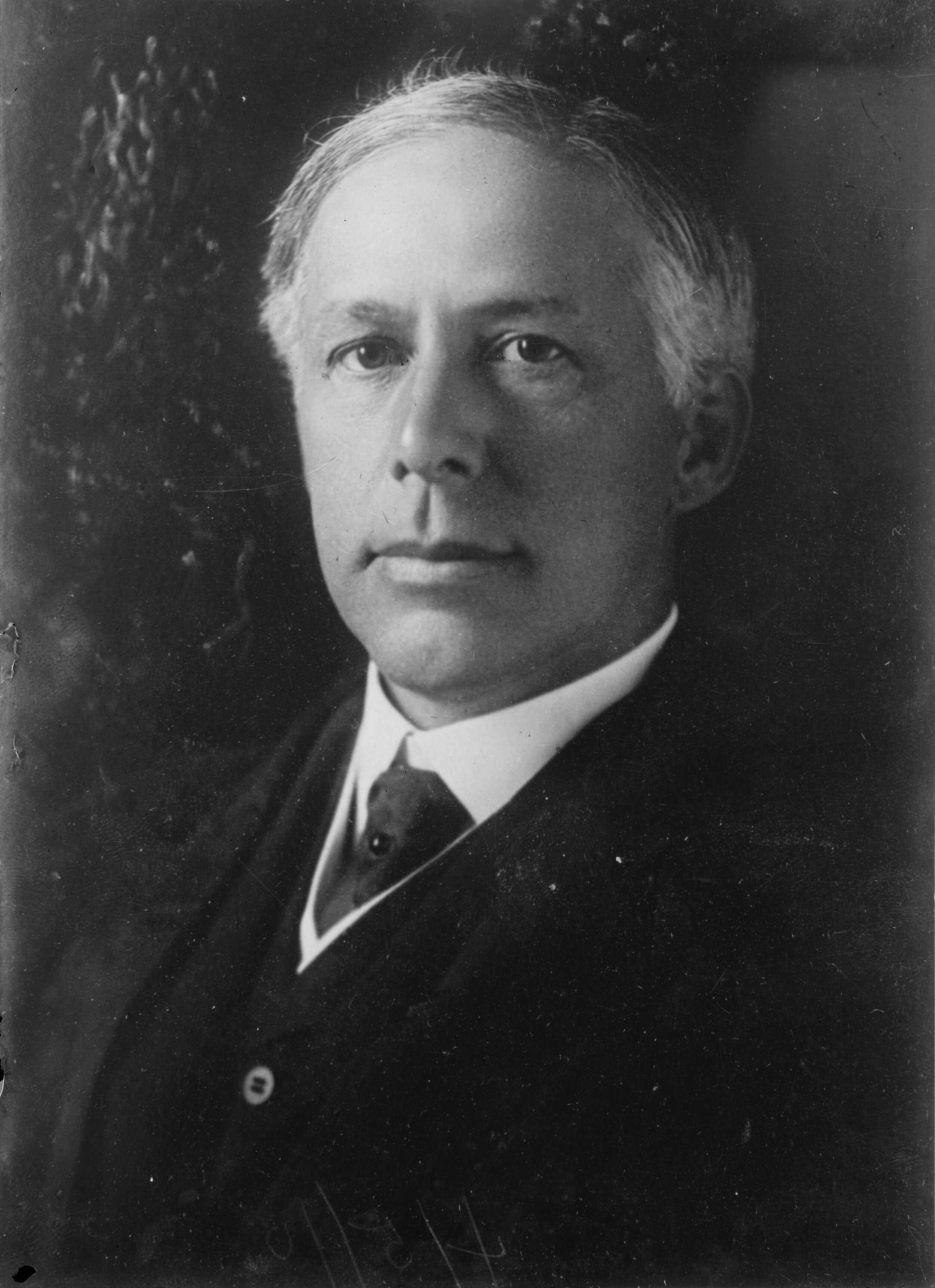
Writing for the Court, Chief Justice Charles Evans Hughes began by establishing that if any of the codes enacted under the NIRA have standing as penal statutes, it must be because of executive action. Hughes then established that “Congress cannot delegate legislative power to the President to exercise unfettered discretion to make whatever laws he thinks may be needed or advisable for the rehabilitation and expansion of trade or industry.”
Hughes then turned to the NIRA to explain the two limitations it set on the President’s exercise of power granted by it. First, the NIRA requires the President to find that the groups proposing a code “impose no inequitable restrictions on admission or membership” and are “truly representative” of the industry they claim to represent. Second, the NIRA requires the President to find that the code isn’t designed to promote monopolies, oppress competition, or discriminate against small enterprises. A proviso was added that the codes “shall not permit monopolies or monopolistic practices.”
These limitations, Hughes explained, “leave virtually untouched the field of policy envisioned by section 1” and allow proponents of a code to “roam at will” so long as its design isn’t monopolistic. Hughes found that the power granted by section 3 of the NIRA was “without precedent.” He explained that in light of its broad declaration and the few restrictions imposed, the discretion of the President in approving or prescribing codes, and thus enacting laws for the government of trade and industry throughout the country, is virtually unfettered.” Ultimately, Hughes concluded that the code-making authority conferred by the NIRA was an unconstitutional delegation of legislative power.