Washington v. Davis
Case Overview
CITATION
ARGUED ON
DECIDED ON
DECIDED BY
426 U.S. 229
Mar. 1, 1976
Jun. 7, 1976
Legal Issue
Did the Washington, D.C. Metro Police Department use racially discriminatory hiring practices in violation of the Fifth Amendment’s Due Process Clause?
Holding
No, in order to violate the Constitution, racial discrimination by the government must have both a discriminatory purpose and impact.

Officers of the Washington, D.C. Metro Police Department
Background
Two black applicants to the Washington, D.C. Metro Police were denied employment after failing a written personnel test, known as Test 21. They brought a lawsuit against the city in the federal district court, arguing that the test disproportionately excluded black candidates and was not directly related to job performance, thus violating the Due Process Clause of the Fifth Amendment and Title VII of the Civil Rights Act of 1964. City officials defended the use of Test 21, arguing that it was a race-neutral examination designed to assess verbal ability, reasoning, and general aptitude, which were relevant to police work. They asserted that the test was not intentionally discriminatory and that its use in hiring didn’t violate the Due Process Clause. The district court found that there was no evidence of discriminatory intent behind the test’s administration, given that 44% of the department’s new hires were black. On appeal, the U.S. Court of Appeals for the D.C. Circuit reversed the decision, holding that the disparate impact on black applicants was enough to establish a constitutional violation, even in the without explicit discriminatory intent. The Supreme Court then granted certiorari.
7 - 2 decision for Washington
Craig


Boren
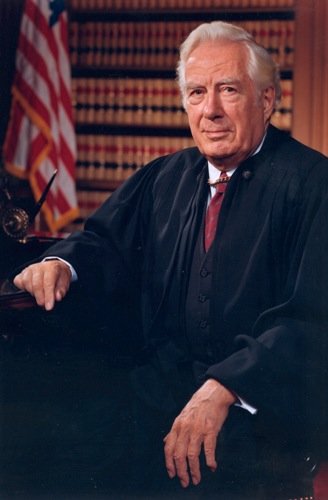

Brennan
Stewart
Marshall
Burger
Powell
Rehnquist
Stevens
Blackmun
White
-
Writing for the majority, Justice Byron White held that a law or official action with a racially disproportionate impact does not automatically trigger a constitutional violation under the Equal Protection component of the Fifth Amendment’s Due Process Clause. White argued that discriminatory intent, rather than just disparate impact, is required to establish a constitutional violation.
White acknowledged that Title VII of the Civil Rights Act of 1964 imposes stricter requirements on employment practices that result in racial disparities, even without proof of intentional discrimination. However, it distinguished the statutory standard from the constitutional one, stating that the latter does not extend to prohibiting government practices simply because they result in racial disparities. Justice White explained that the Constitution requires proof of discriminatory intent, and statistical disparities alone are insufficient to establish such intent.
Applying this framework, the Court found that Test 21, the written personnel test used by the Washington, D.C. police department, was facially neutral and designed to assess verbal skills relevant to the job. The Court concluded that its disproportionate impact on black applicants did not prove it was adopted or used with discriminatory intent. As a result, the Court reversed the Court of Appeals’ decision and upheld the District Court’s ruling that Test 21 did not violate the Constitution .
-
In his concurring opinion, Justice Lewis Powell explained that while he agrees with the Opinion of the Court, he had “reservations as to some of the discussion concerning the appropriate standard for equal protection analysis and the relevance of the statistical evidence.” Powell stated that while he agrees that the Court’s holding in Reed v. Reed (1971) is the most relevant precedent, he was concerned about the Court’s broad interpretation of it in this case. He explained, “Reed and subsequent cases involving gender-based classifications make clear that the Court subjects such classifications to a more critical examination than is normally applied when ‘fundamental’ constitutional rights and ‘suspect classes’ are not present.”
Powell also responded to Oklahoma’s statistical evidence, acknowledging that while they indicate that young men drive more and may be more inclined to drink, he was “not persuaded that these facts and the inferences fairly drawn from them justify this classification based on a three year age differential between the sexes, and especially one that is so easily circumvented as to be virtually meaningless.” He ultimately concluded that the gender based classification did not bear a “fair and substantial” relation to the state’s interest in traffic safety.