United States v. Klein
Case Overview
CITATION
ARGUED ON
DECIDED ON
DECIDED BY
80 U.S. 128
N.d.
Jan. 29, 1872
Legal Issues
Can Congress prohibit a presidential pardon from being used as evidence against the United States or require federal courts to interpret them as evidence against the defendant?
Holding
No, such an exercise of power violates the principle of separation of powers enshrined by the Constitution.
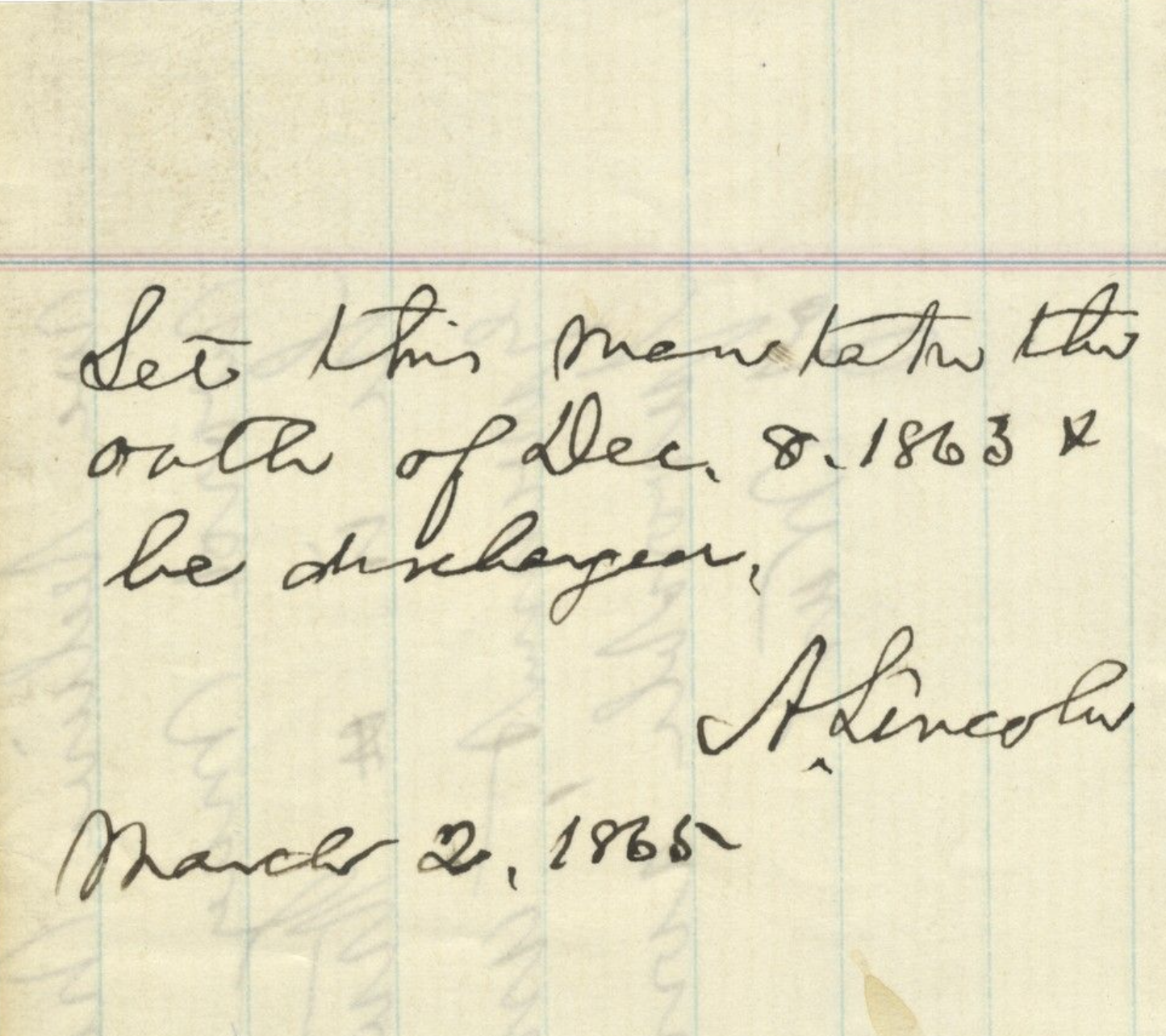
A pardon signed by President Lincoln that reads, “Let this man take the oath of December 8, 1863 and be discharged” | Credit: Shapell
Background
During the Civil War, the United States government seized property from Southern confederates, but the Abandoned and Captured Property Act of 1863 allowed owners to recover the proceeds of seized property sold by the Treasury if they could prove they had “never given any aid or comfort to the present rebellion.” Following the war, President Abraham Lincoln issued a proclamation offering a full pardon with restoration of property rights to those who took an oath of allegiance. In United States v. Padelford, the Supreme Court held that a presidential pardon effectively wiped out the offense of rebellion, making the pardoned individual as innocent as if they had never committed the crime and satisfying the statutory requirement of loyalty required by the 1863 property act.
V.F. Wilson was a Southerner who aided the Confederacy by acting as surety on official bonds, but he later took the oath of allegiance. When he died, his administrator, John A. Klein, sued in the Court of Claims to recover the proceeds of Wilson’s seized cotton. Relying on the Padelford precedent, the Court of Claims ruled in Klein’s favor, holding that the pardon cured Wilson’s prior disloyalty. The United States appealed to the Supreme Court.
While the appeal was pending in 1870, Congress passed a proviso declaring that a presidential pardon claiming to restore property rights was inadmissible as evidence in a claim against the United States. Furthermore, the statute effectively reversed the Padelford rule by mandating that if a pardon stated that the claimant had aided the rebellion, it should be taken as conclusive evidence of disloyalty. As a result, the Supreme Court and Court of Claims would lose jurisdiction and be required to dismiss the suit.
7 - 2 decision for Klein
U.S.


Klein



Davis


Field
Bradley
Nelson
Chase
Clifford
Swayne
Strong
Miller

-
Writing for the Court, Chief Justice Salmon Chase first acknowledged that Congress generally holds plenary power over the organization and appellate jurisdiction of the Court of Claims. Chase noted that if Congress had simply removed jurisdiction for a particular class of cases, the Court would have to respect that exception. However, Chase argued that the 1870 proviso wasn’t a valid exercise of congressional power under the Exceptions Clause because it attempted to prescribe a “rule of decision” for pending cases that undercut a previous decision of the Court and the President’s power under Article II’s grant of pardon power. By directing the Court to dismiss a case solely because a pardon established a right to recovery under the Court's prior settled law, Congress was effectively deciding the lawsuit in its own favor. Chase wrote, “[w]e must think that Congress has inadvertently passed the limit which separates the legislative from the judicial power.”
Chase also found that the statute was unconstitutional because it infringed upon the powers of the Executive branch. Chase explained that Article II of the Constitution entrusts the pardon power “without limit” to the President alone, and “blots out the offence pardoned and removes all its penal consequences.” He further noted, “[i]t may be granted on conditions. In these particular pardons, that no doubt might exist as to their character, restoration of property was expressly pledged, and the pardon was granted on condition that the person who availed himself of it should take and keep a prescribed oath.” Regarding Congress’ proviso, Chase argued that it attempted to alter the legal effect of a pardon by requiring the Court to treat it as conclusive evidence of disloyalty rather than as proof of restored innocence. He explained, “the language of the proviso shows that it does not intend to withhold appellate jurisdiction except as a means to an end; rather that its purpose was to deny the pardons granted by the president the effect in which the court had adjudged them to have.” Chase argued that the legislature has no more authority to change the effect of a pardon than the executive has to change a law. Ultimately, Chase declared Congress’ proviso unconstitutional and affirmed the judgment of the Court of Claims.