United States v. Butler
Case Overview
CITATION
ARGUED ON
DECIDED ON
DECIDED BY
297 U.S. 1
Dec. 9-10, 1935
Jan. 6, 1936
Legal Issues
Does the language “for the general welfare” in the Taxing and Spending Clause grant Congress a separate and distinct power to impose taxes?
Holding
Yes, Congress has a substantive power to tax and appropriate that is only limited by the requirement that it’s exercised to provide for the general welfare of the Nation.
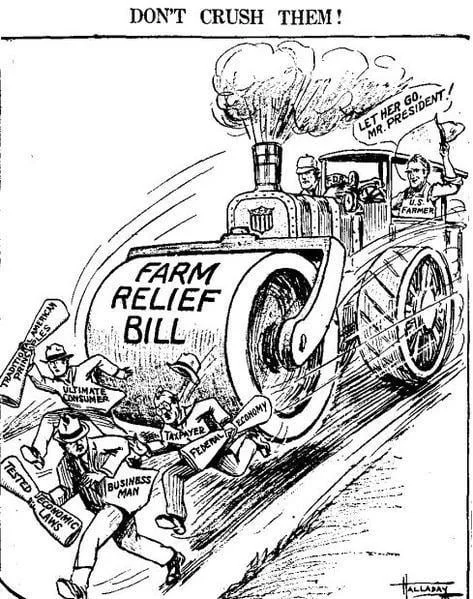
Political cartoon depicting the Agricultural Adjustment Act of 1933 | Credit: Alchetron
Background
In response to the economic turmoil brought on by the Great Depression, President Franklin D. Roosevelt signed into law the Agricultural Adjustment Act of 1933 (AAA). The AAA allowed the Secretary of Agriculture to set limits on production of certain crops and impose taxes on crops produced in excess of those limits. The AAA also authorized grants to farmers that would allow them to control production and regulate prices.
William M. Butler, a receiver for the Hoosac Mills Corporation, challenged the constitutionality of the AAA in the U.S. District Court for the District of Maryland. The district court ruled in favor of Butler, but the U.S. Court of Appeals for the First Circuit reversed the decision on appeal. The U.S. Supreme Court then granted certiorari.
6 - 3 decision for Butler
U.S.


Lopez



Hughes
Sutherland
Roberts
Cardozo
McReynolds
Van Devanter
Stone
Butler
Brandeis
-
Writing for the Court, Justice Owen Roberts first established that Congress is expressly empowered by the Taxing and Spending Clause to lay taxes to provide for the general welfare. Importantly, he stated that the language “for the general welfare” qualifies that power.
Roberts then noted the differing views on the interpretation of “for the general welfare” that have existed since the Founding Era. First, he explained Madison’s view that the clause was no more than a reference to the other powers enumerated in the same section, meaning that the clause is “tautology” since taxation and appropriation are necessary incidents of the exercise of any of the enumerated legislative powers. Next, he explained Hamilton's view that the clause confers a power that’s separate and distinct from those later enumerated and isn’t limited by them. Under this view, Congress has a substantive power to tax and appropriate that is only limited by the requirement that it’s exercised to provide for the general welfare of the Nation.
Roberts concluded in line with Hamilton’s view, writing that “[w]hile, therefore, the power to tax is not unlimited, its confines are set in the clause which confers it, and not those in section 8 which bestow and define the legislative powers of the Congress. It results that the power of Congress to authorize expenditure of public moneys for public purposes is not limited by the direct grants of legislative power found in the Constitution.”
Roberts then turned to the AAA, finding that it invades the reserved rights of the states because its “a statutory plan to regulate and control agricultural production, a matter beyond the powers delegated to the federal government.” Roberts explained that since Congress doesn’t have the power to enforce commands on farmers as sought by the AAA, “[i]t must follow that it may not indirectly accomplish those ends by taxing and spending to purchase compliance.” He stated that the taxing and appropriation power exercised by the AAA “are but means to an unconstitutional end.”
Roberts responded to the argument that similarity of local conditions throughout the country created a situation of national concern, stating that such a grant of power allow Congress to ignore constitutional limitations of its power and usurp that of the states whenever they find a similar set of local conditions on a given issue. He stated that allowing Congress such power would make its power under the Taxing and Spending Clause “the instrument for total subversion of the governmental powers reserved to the individual states.” Ultimately, Roberts concluded that since “there was no power in the Congress to impose the contested exaction, it could not lawfully ratify or confirm what an executive officer had done in that regard.”