Sabri v. United States
Case Overview
CITATION
ARGUED ON
DECIDED ON
DECIDED BY
541 U.S. 600
Mar. 3, 2004
May 17, 2004
Legal Issues
Is 18 U.S.C. §666(a)(2), which proscribes bribery of state, local, and tribal officials of entities that receive at least $10,000 in federal funds, a valid exercise of congressional authority under Article I of the Constitution?
Holding
Yes, Congress has power under the Taxing and Spending Clause to appropriate federal funds, and it has power under the Necessary and Proper Clause to ensure that federal funds are spent for the general welfare and not undermined.
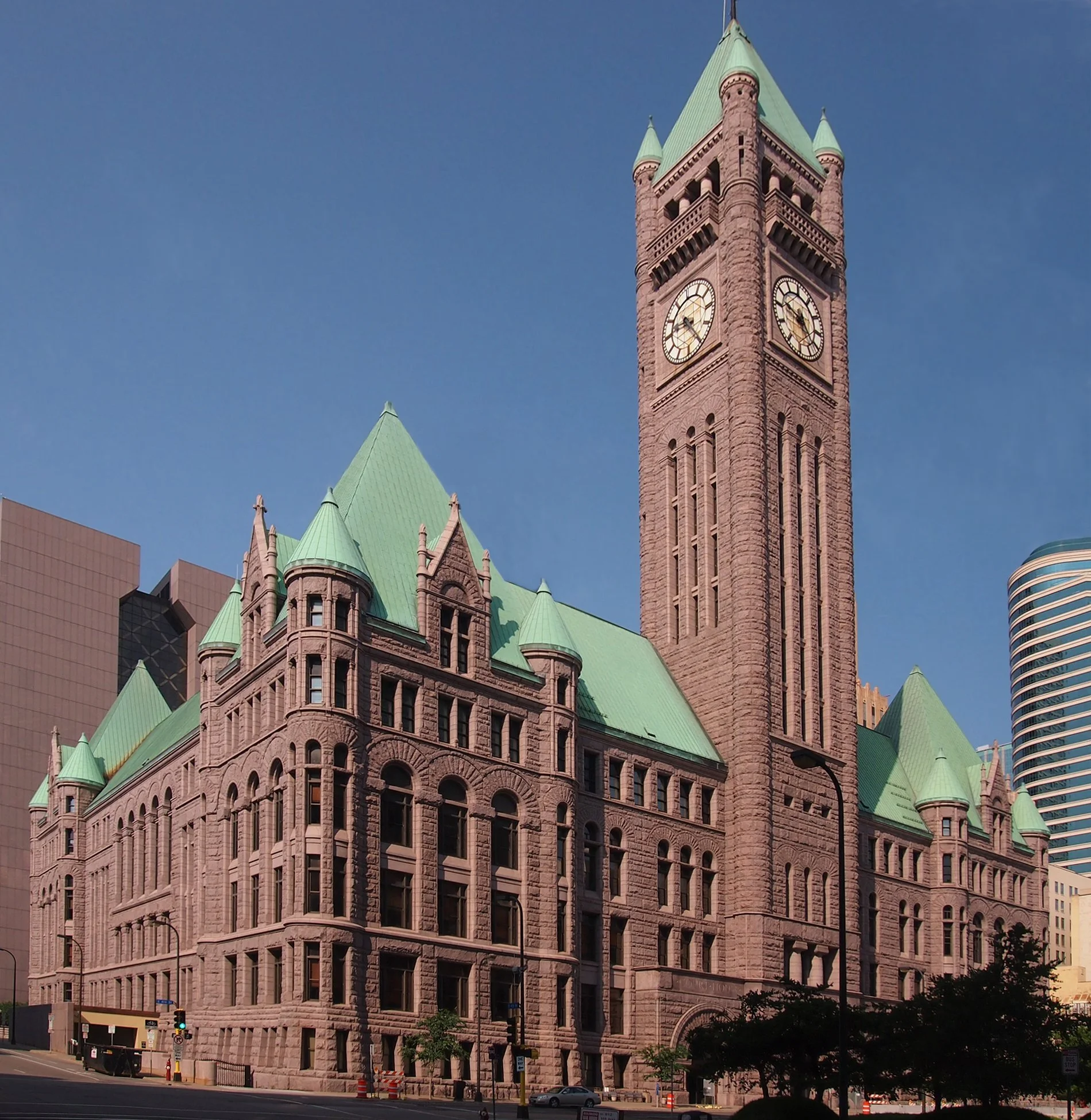
Minneapolis City Hall | Credit: McGhiever (Wikipedia)
Background
Basim Omar Sabri was a real estate developer attempting to build a hotel and retail structure in Minneapolis, Minnesota. In 2001, Sabri offered three different bribes to Brian Herron, a member of the Board of Commissioners of the Minneapolis Community Development Agency (MCDA). The MCDA was a public body created by the city council to fund housing and economic development in Minneapolis.
Sabri was charged under 18 U.S.C. §666(a)(2), which imposes criminal penalties on anyone who “corruptly gives, offers, or agrees to give anything of value to any person, with intent to influence or reward an agent of an organization or of a State, local or Indian tribal government, or any agency thereof, in connection with any business, transaction, or series of transactions of such organization, government, or agency involving anything of value of $5,000 or more.” The statute also requires that the organization being bribed receive more than $10,000 in federal funding, whether that be through “a grant, contract, subsidy, loan, guarantee, insurance, or other form of Federal assistance.” In 2001, the MCDA received approximately $23 million in federal funding.
Unanimous decision for the United States
Gonzalez



Raich


Rehnquist
Kennedy
Stevens
Breyer
Scalia
O’Connor
Ginsburg
Thomas
Souter
-
Writing for the Court, Justice David Souter began by responding to Sabri’s argument that §666(a)(2) is facially unconstitutional because it fails to require proof of any connection between a bribe and federal money. Souter stated that the Court can “readily dispose” of this position, writing that they “simply do not presume the unconstitutionality of federal criminal statutes lacking explicit provision of a jurisdictional hook, and there is no occasion even to consider the need for such a requirement where there is no reason to suspect that enforcement of a criminal statute would extend beyond a legitimate interest cognizable under Article I, §8.”
Souter then explained that Congress has the authority under the Taxing and Spending Clause to appropriate federal funding to promote the general welfare. He further explained that Congress has “corresponding authority” under the Necessary and Proper Clause to ensure that taxpayer dollars appropriated under their Taxing and Spending power are actually spent for the general welfare and not “frittered away in graft or on projects undermined when funds are siphoned off or corrupt public officers are derelict about demanding value for dollars.” Souter asserted that “Congress does not have to sit by and accept the risk of operations thwarted by local and state improbity.” Regarding §666(a)(2), Souter found that it addresses the issue of bribery by a rational means to safeguard the integrity of federal funding.
Lastly, Souter responded to Sabri’s argument that not every bribe will be traceable to specific federal payments, stating that such a possibility doesn’t indicate any enforcement beyond the scope of federal interest “for the reason that corruption does not have to be that limited to affect the federal interest.” He further noted that “[m]oney is fungible, bribed officials are untrustworthy stewards of federal funds, and corrupt contractors do not deliver dollar-for-dollar value. Liquidity is not a financial term for nothing; money can be drained off here because a federal grant is pouring in there. And officials are not any the less threatening to the objects behind federal spending just because they may accept general retainers.” Ultimately, Souter concluded that the law was a valid exercise of Congress’ authority, writing that “[i]t is certainly enough that the statutes condition the offense on a threshold amount of federal dollars defining the federal interest, such as that provided here, and on a bribe that goes well beyond liquor and cigars.”