Romer v. Evans
Case Overview
CITATION
ARGUED ON
DECIDED ON
517 U.S. 620
Oct. 10, 1995
May 20, 1996
DECIDED BY
Legal Issue
Does Amendment 2 of Colorado’s Constitution, which prohibits the protection against discrimination based on an individual’s sexual orientation, violate the Equal Protection Clause of the Fourteenth Amendment?
Holding
Yes, Amendment 2 of Colorado’s Constitution violates the Equal Protection Clause of the Fourteenth Amendment.
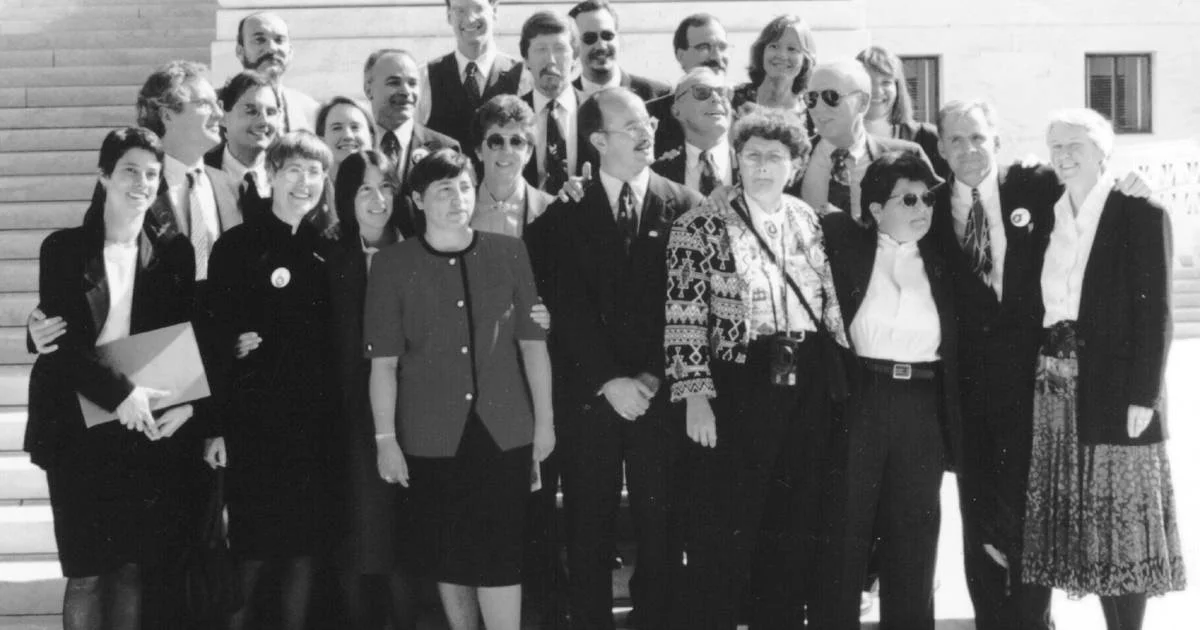
The plaintiffs in the case standing with their legal team outside of the Supreme Court | Credit: Lambda Legal
Background
In 1992, Colorado voters approved an amendment to the State’s Constitution in response to the growing number of local ordinances that had been enacted to protect the named class, “homosexual persons,” from discrimination based on sexual orientation. The Amendment, referred to as “Amendment 2,” read as follows:
Neither the State of Colorado, through any of its branches or departments, nor any of its agencies, political subdivisions, municipalities or school districts, shall enact, adopt or enforce any statute, regulation, ordinance or policy whereby homosexual, lesbian or bisexual orientation, conduct, practices or relationships shall constitute or otherwise be the basis of or entitle any person or class of persons to have or claim any minority status, quota preferences, protected status or claim of discrimination. This Section of the Constitution shall be in all respects self-executing.
After Amendment 2 passed, several individuals, including Richard Evans, a gay man who worked for the mayor of Denver, brought lawsuits against it. Initially, a state trial court issued a permanent injunction against Amendment 2. On appeal, the Colorado Supreme Court upheld the permanent injunction. The case was then granted certiorari by the U.S. Supreme Court.
6 - 3 decision for Evans
Romer


Evans


Ginsburg
Souter
Kennedy
Stevens
Thomas
O’Connor
Rehnquist
Breyer
Scalia
-
Writing for the Court, Justice Anthony Kennedy first responded to the State’s argument that Amendment 2 simply denied homosexuals special rights, putting them in the same position as all others. Kennedy stated that such a reading of the amendment’s language was “implausible” because the change in legal status caused by it is “[s]weeping and comprehensive.” He explained that “[h]omosexuals, by state decree, are put in a solitary class with respect to transactions and relations in both the private and governmental spheres. The amendment withdraws from homosexuals, but no others, specific legal protection from the injuries caused by discrimination, and it forbids reinstatement of these laws and policies.”
Further, Kennedy explained that Amendment 2 “imposes a special disability” on homosexuals alone, since they “are forbidden the safeguards that others enjoy or may seek without constraint … This is so no matter how local or discrete the harm, no matter how public and widespread the injury.” On this argument, he concluded that there is “nothing special in the protections Amendment 2 withholds. These are protections taken for granted by most people either because they already have them or do not need them; these are protections against exclusion from an almost limitless number of transactions and endeavors that constitute ordinary civic life in a free society.”
Under the Equal Protection Clause, Kennedy first established that the Fourteenth Amendment’s protections “must coexist with the practical necessity that most legislation classifies for one purpose or another, with resulting disadvantage to various groups or persons.” However, the Court has held that “if a law neither burdens a fundamental right nor targets a suspect class,” the legislative classification will be upheld so long as it has “a rational relation to some legitimate end.” Kennedy illustrated that in past cases where a class-based restrictions were challenged, the Court found them constitutional because they “were narrow enough in scope and grounded in a sufficient factual context for us to ascertain some relation between the classification and the purpose it served.” He noted that “[b]y requiring that the classification bear a rational relationship to an independent and legitimate legislative end, we ensure that classifications are not drawn for the purpose of disadvantaging the group burdened by the law.”
Kennedy found that Amendment 2 failed for two reasons. First, it imposed a broad and undifferentiated disability on a single named group. Kennedy described Amendment 2 as “at once too narrow and too broad” because it “identifies persons by a single trait then denies them protection across the board.” Kennedy explained that it’s “not within our constitutional tradition to enact laws of this sort,” as central to the idea of the rule of law and equal protection of law is the principle that the government will “remain open on impartial terms to all who seek its assistance.” He added that “[r]espect for this principle explains why laws singling out a certain class of citizens for disfavored legal status or general hardships are rare. A law declaring that in general it shall be more difficult for one group of citizens than for all others to seek aid from the government is itself a denial of equal protection of the laws in the most literal sense.”
Second, Kennedy stated that the breadth of Amendment 2 was “so discontinuous with the reasons offered for it that [it] seems inexplicable by anything but animus toward the class it affects.” The State argued that the primary rationale for Amendment 2 was respect for other citizens’ freedom of association and conserving resources to fight discrimination against other groups. Kennedy responded, however, that Amendment 2 wasn’t directed to any “identifiable legitimate purpose or discrete objective.” Instead, he described it as “a status-based enactment divorced from any factual context from which we could discern a relationship to legitimate state interests; it is a classification of persons undertaken for its own sake, something the Equal Protection Clause does not permit.”
Ultimately, Kennedy concluded that Amendment 2 was class legislation targeting homosexuals not to further a proper legislative end, “but to make them unequal to everyone else.” He wrote that “[a] State cannot so deem a class of persons a stranger to its laws. Amendment 2 violates the Equal Protection Clause.”