Railway Express Agency, Inc. v. New York
Case Overview
CITATION
ARGUED ON
DECIDED ON
DECIDED BY
336 U.S. 106
Dec. 6, 1948
Jan. 31, 1949
Legal Issue
Does New York City’s regulation of advertising on delivery vehicles violate the Equal Protection Clause?
Holding
No, the regulation had a rational basis to support its enactment, so it was not invalid under the Equal Protection Clause of the Fourteenth Amendment.
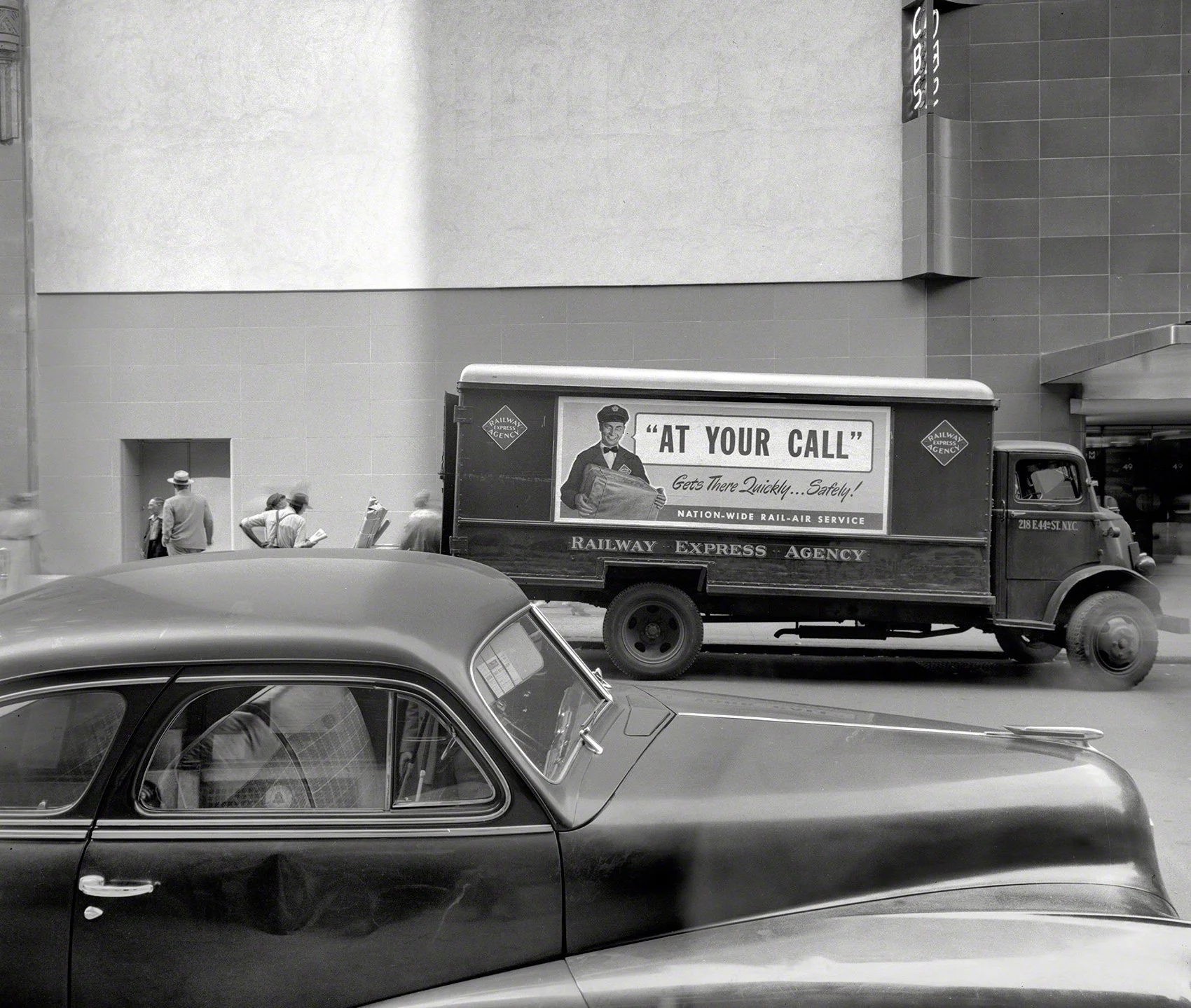
A Railway Express Agency truck featuring an advertisement | Credit: American Rails
Background
Section 124 of the Traffic Regulations of the City of New York promulgated by the Police Commissioner provides: “No person shall operate, or cause to be operated, in or upon any street an advertising vehicle; provided that nothing herein contained shall prevent the putting of business notices upon business delivery vehicles, so long as such vehicles are engaged in the usual business or regular work of the owner and not used merely or mainly for advertising.”
Railway Express Agency, Inc. (REA) was engaged in a nation-wide express business and operated about 1,900 trucks in New York City. REA sold the space on the exterior sides of their trucks for advertising, which were for the most part unconnected with its own business. REA was convicted in the magistrates court and fined.
Unanimous decision for New York
Railway
New York



Rutledge
Jackson
Black
Reed
Murphy
Douglas
Burton
Frankfurter
Vinson
-
Writing for the Court, Justice William Douglas began by responding to the argument that the regulation’s classification of advertisements for products sold by the truck owner and general advertisements constitutes unequal treatment with no justified purpose. Douglas stated that such a description of the regulation “superficial” because local authorities may have concluded that general advertisements create a larger impact on the traffic problem they sought to address than advertisements not regulated. He added that “[i]t would take a degree of omniscience which we lack to say that such is not the case. If that judgment is correct, the advertising displays that are exempt have less incidence on traffic than those of [Railway Express].” Further, Douglas explained that it’s immaterial that NYC “sees fit to eliminate from traffic this kind of distraction but does not touch what may be even greater ones in a different category, such as the vivid displays on Time Square” because “[i]t is no requirement of equal protection that all evils of the same genus be eradicated or none at all.”
-
In his concurring opinion, Justice Robert Jackson wrote that his philosophy regarding the application of the Equal Protection and Due Process Clauses of the Fourteenth Amendment is “almost diametrically opposed” to that which prevailed on the Court at the time. Jackson explained that he’s “more receptive to attack on local ordinances for denial of equal protection than for denial of due process, while the Court has more often used the latter clause.”
Regarding the Due Process Clause, Jackson wrote, “[t]he burden should rest heavily upon one who would persuade us to use the Due Process Clause to strike down a substantive law or ordinance.” Jackson explained that invocation of the Due Process Clause disables all government (federal, state, and local) from acting on an issue. He stated that “[i]nvalidation of a statute or an ordinance on due process grounds leaves ungoverned and ungovernable conduct which many people find objectionable.”
On the Equal Protection Clause, Jackson explained that “[i]t merely means that the prohibition or regulation must have a broader impact” and doesn’t disable any government from acting on an issue. Jackson illustrated his view of the clause, writing that he “regard[s] it as a salutary doctrine that cities, states and the Federal Government must exercise their powers so as not to discriminate between their inhabitants except upon some reasonable differentiation fairly related to the object of regulation.” He emphasized that “[t]his equality is not merely abstract justice,” writing that “[t]he framers of the Constitution knew, and we should not forget today, that there is no more effective practical guaranty against arbitrary and unreasonable government than to require that the principles of law which officials would impose upon a minority must be imposed generally.” Jackson concluded on this point by arguing that “[c]ourts can take no better measure to assure that laws will be just than to require that laws be equal in operation.”
Jackson ultimately concluded his concurrence by writing, “[a]s a matter of principle and in view of my attitude toward the Equal Protection Clause, I do not think differences of treatment under law should be approved on classification because of differences unrelated to the legislative purpose. The Equal Protection Clause ceases to assure either equality or protection if it is avoided by any conceivable difference that can be pointed out between those bound and those left free.”