New York v. United States
Key Principle
The federal government cannot compel the States to enact or administer a federal regulatory program.
Case Overview
CITATION
ARGUED ON
DECIDED ON
DECIDED BY
505 U.S. 144
Mar. 30, 1992
Jun. 19, 1992
Legal Issues
Does Congress have the authority to require States to take title and assume liability for radioactive waste generated within their borders if they failed to comply with federal regulations?
Holding
No, the “take title” provision violated the Tenth Amendment and exceeded Congress’ power under the Commerce Clause.
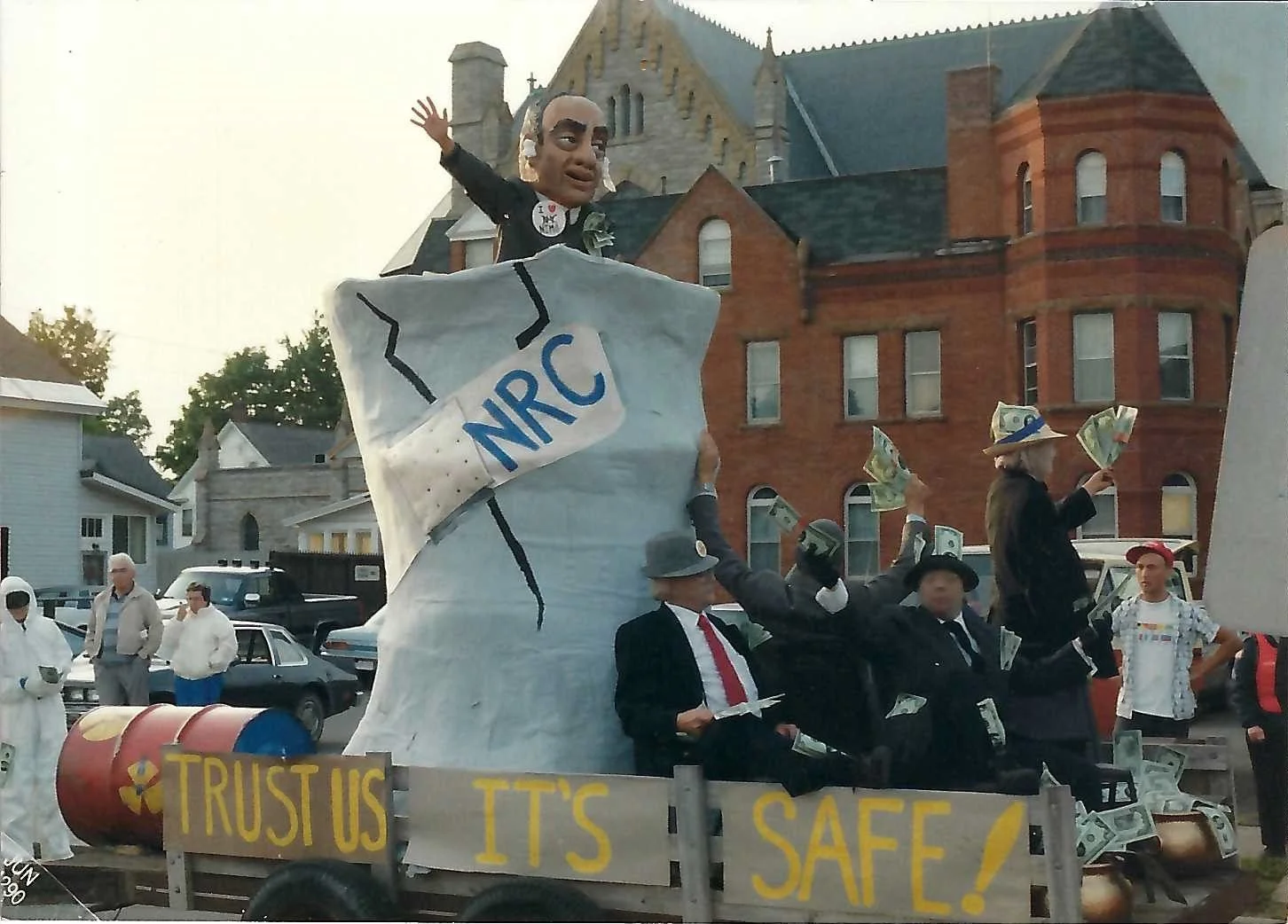
Citizens Against Radioactive Dumping’s float in a parade featuring a paper mâché depiction of then-NY Mario Governor Cuomo (1990) | Credit: Courtland County Historical Society
Background
In 1979, only three commercial disposal facilities operated in the United States, each in a different state (South Carolina, Nevada, and Washington). Due to the concentration of nuclear technology and waste products in the East, South Carolina was receiving 80-90% of low-level radioactive waste (LLW) generated commercially in the U.S. The governors of South Carolina, Nevada, and Washington testified before Congress to argue that they couldn’t bear the national responsibility for LLW disposal. The governors proposed that Congress establish a national policy governing the disposal of LLW that would make states responsible for LLW generated within its borders and encourage the creation of interstate compacts for its disposal. In response, Congress passed the Low Level Radioactive Waste Policy Act of 1980. The Act set a deadline of January 1, 1986, after which states that had entered regional compacts could legally exclude waste from non-member states.
By early 1985, slow progress had been made in constructing new LLW disposal sites. The governors of South Carolina, Nevada, and Washington again took action and negotiated a compromise with the rest of the country. They agreed to keep their existing facilities open until 1992 in exchange for strict federal milestones and the authority to impose surcharges on waste from outside their regions. Congress codified this agreement in the 1985 Amendments Act, which was passed by Congress and signed into law by President Ronald Reagan on January 15, 1986.
The 1985 Amendments provided three incentives for states to comply with the agreement. First, the monetary incentive allowed states to collect surcharges for waste received from other states. Second, the access incentive allowed states to reprimand other states that missed certain deadlines by raising surcharges or eventually denying access to disposal at their facilities. Third, “take title” incentive required states to take title and assume liability for waste generated within their borders if they failed to comply.
6 - 3 decision for New York
New York


U.S.


Rehnquist
Stevens
Scalia
Kennedy
Blackmun
O’Connor
White
Thomas
Souter