Lugar v. Edmonson Oil Co.
Case Overview
CITATION
ARGUED ON
DECIDED ON
DECIDED BY
457 U.S. 922
Dec. 8, 1981
Jun. 25, 1982
Legal Issue
Does a creditor act jointly with the State when, pursuant to its petition, a court orders attachment of an individual’s property?
Holding
Yes, constitutional requirements of due process apply to garnishment and prejudgment attachment procedures whenever state officers act jointly with a private creditor in securing the property in dispute.

Photo of “Red Hot” truck stop in Mississippi | Credit: Preservation in Mississippi
Background
Lugar, a lessee-operator of a truckstop in Virginia, was indebted to his supplier, Edmonson Oil Co. In 1977, Edmonson sued Lugar to collect on the debt in Virginia State court and sought prejudgment attachment of Lugar’s property. Under State law, the procedure only required Edmonson to allege in an ex parte petition that it believed Lugar was or might dispose of his property to avoid his creditors. Based on Edmonson’s petition, the court Clerk issued a writ of attachment, which was executed by the County Sheriff. A hearing on the attachment was later conducted, and the judge ordered the attachment be dismissed because Edmonson failed to establish the statutory grounds for attachment alleged in the petition.
After, Lugar sued Edmonson and its president under 42 U.S.C. §1983, alleging that Edmonson acted jointly with the State to deprive him of his property without due process when they attached his property. The district court held against Lugar, finding that Edmonson’s actions didn’t constitute state action. On appeal, the U.S. Court of Appeals for the Fourth Circuit affirmed. The Supreme Court then granted certiorari.
5 - 4 decision for Lugar
Lugar


Edmonson
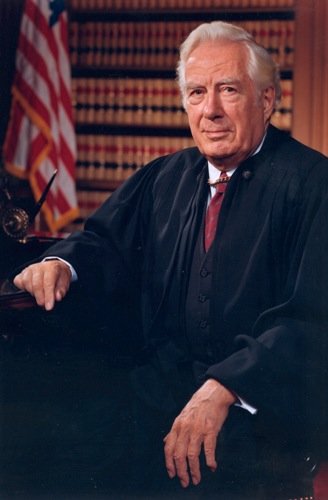

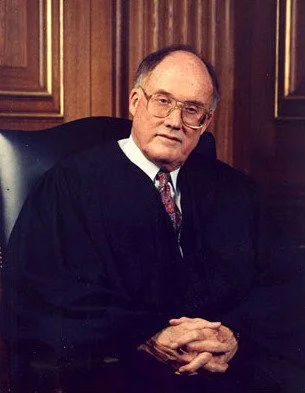
Rehnquist
Powell
White
Marshall
Burger
Stevens
O’Connor
Blackmun
Brennan

-
Writing for the Court, Justice Byron White first established that the state-action requirement is judicial recognition that most rights enshrined in the Constitution are protected only against infringement by governments, not private citizens. White explained that careful adherence to this requirement “preserves an area of individual freedom by limiting the reach of federal law and federal judicial power,” and “avoids imposing on the State … responsibility for conduct for which they cannot fairly be blamed.” He noted that a consequence of the requirement “is to require the courts to respect the limits of their own power as directed against state governments and private interests. Whether this is good or bad policy, it is a fundamental fact of our political order.”
White then established that conduct alleged to have violated a federal right must be “fairly attributable to the State” to trigger the Fourteenth Amendment. To determine whether conduct is fairly attributable, the Court uses a two-part test: 1) “the deprivation must be caused by the exercise of some right or privilege created by the State or by a rule of conduct imposed by the state or by a person for whom the State is responsible.”; 2) “the party charged with the deprivation must be a person who may fairly be said to be a state actor,” which includes state officials, those who acted together with or obtained significant aid from the state, or those whose conduct is otherwise chargeable to the State. Emphasizing the importance of this requirement, White wrote that “[w]ithout a limit such as this, private parties could face constitutional litigation whenever they seek to rely on some state rule governing their interactions with the community surrounding them.”
White then turned to Lugar’s case. On the first prong of the test, he found that while a private actor’s misuse of a state statute doesn’t constitute state action, “the procedural scheme created by the statute obviously is the product of state action.” On the second prong, he wrote that the Court has “consistently held that a private party’s joint participation with state officials in the seizure of disputed property is sufficient to characterize that party as a ‘state actor’ for purposes of the Fourteenth Amendment.”
White noted that the Court of Appeals erred in ruling that joint participation required more than invoking the aid of state officials to take advantage of state-created attachment procedures. Ultimately, he concluded that its “[w]hatever may be true in other contexts, this is sufficient when the State has created a system whereby state officials will attach property on the ex parte application of one party to a private dispute. In summary, petitioner was deprived of his property through state action; respondents were, therefore, acting under color of state law in participating in that deprivation.