Lorillard Tobacco Co. v. Reilly
Case Overview
CITATION
ARGUED ON
DECIDED ON
DECIDED BY
533 U.S. 525
Apr. 25, 2001
Jun. 28, 2001
Legal Issues
Are Massachusetts’ regulations of the sale and advertising of cigarettes and tobacco products preempted by federal law under the FCLAA?
Holding
Yes, Massachusetts’ regulations are preempted by the FCLAA because there is no distinction between the authority exercised by Congress and that which the State attempted exercise here.
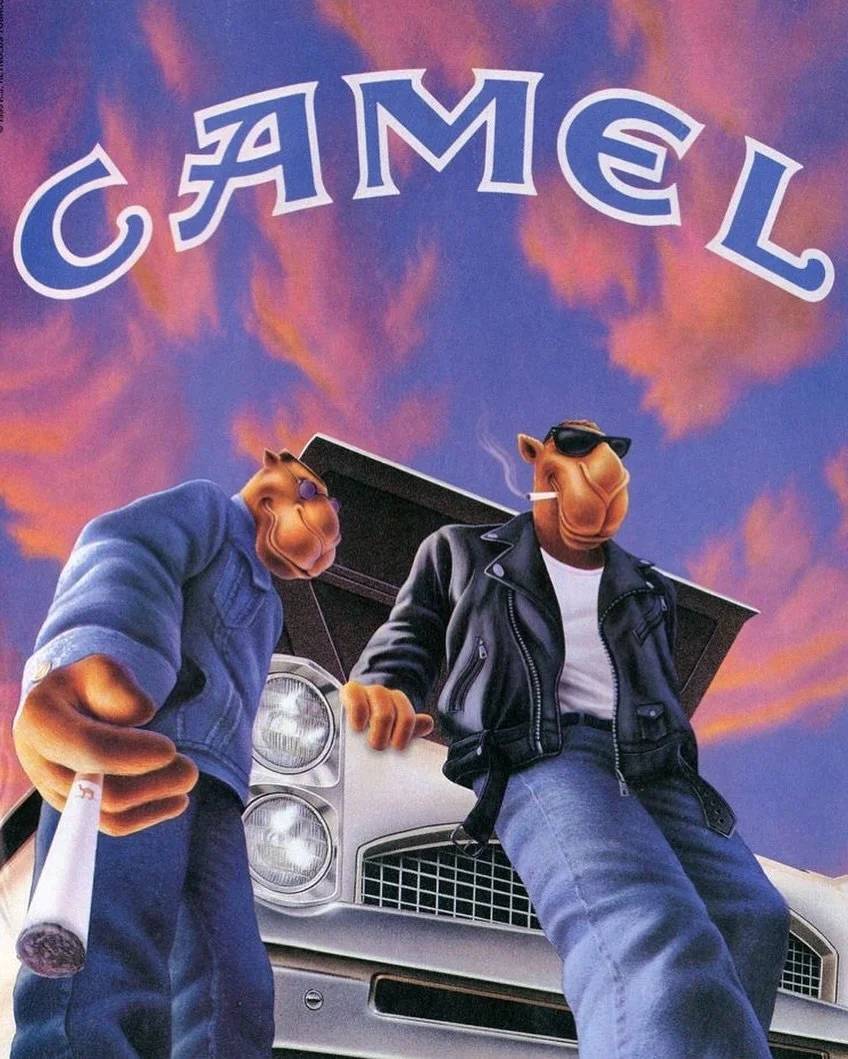
Advertisement for Camel cigarettes featuring their mascot, “Joe Camel” | Credit: @cbzlax/Threads
Background
In 1965, President Lyndon Johnson signed the Federal Cigarette Labeling and Advertising Act (FCLAA), creating a comprehensive federal scheme to govern the advertising and promotion of cigarettes. Relevant portions of the FCLAA provides:
(a) Additional statements. No statement relating to smoking and health, other than the statement required by section 1333 of this title, shall be required on any cigarette package.
(b) State regulations. No requirement or prohibition based on smoking and health shall be imposed under State law with respect to the advertising or promotion of any cigarettes the packages of which are labeled in conformity with the provisions of this chapter. The FCLAA’s pre-emption provision does not cover smokeless tobacco or cigars.
In January 1999, Massachusetts Attorney General Thomas Reilly promulgated regulations regarding the sale and advertisement of cigarettes, smokeless tobacco, and cigars in the State. The purpose of the regulations was “to eliminate deception and unfairness” in the marketing of such products to prevent underage use of tobacco. The regulations at issue provided:
(2) Retail Outlet Sales Practices. Except as otherwise provided, it shall be an unfair or deceptive act or practice for any person who sells or distributes cigarettes or smokeless tobacco products through a retail outlet located within Massachusetts to engage in any of the following retail outlet sales practices:
(c) Using self-service displays of cigarettes or smokeless tobacco products;
(d) Failing to place cigarettes and smokeless tobacco products out of the reach of all consumers, and in a location accessible only to outlet personnel.
(5) Advertising Restrictions. Except as provided, it shall be an unfair or deceptive act or practice for any manufacturer, distributor or retailer to engage in any of the following practices:
(a) Outdoor advertising, including advertising in enclosed stadiums and advertising from within a retail establishment that is directed toward or visible from the outside of the establishment, in any location that is within a 1,000 foot radius of any public playground, playground area in a public park, elementary school or secondary school;
(b) Point-of-sale advertising of cigarettes or smokeless tobacco products any portion of which is placed lower than five feet from the floor of any retail establishment which is located within a one thousand foot radius of any public playground, playground area in a public park, elementary school or secondary school, and which is not an adult-only retail establishment.
Before the regulations took effect, four cigarette manufacturers (Lorillard Tobacco Company, Brown & Williamson Tobacco Corporation, R. J. Reynolds Tobacco Company, and Philip Morris Incorporated), a maker of smokeless tobacco products (U. S. Smokeless Tobacco Company), and several cigar manufacturers and retailers challenged the regulations in the U.S. District Court for the District of Massachusetts. The district court held that the regulations weren’t preempted by the FCLAA and weren’t violative of the First Amendment (except for the point of sale requirements of § 5(b)). On appeal, the U.S. Court of Appeals for the First Circuit affirmed the district court’s ruling regarding preemption and the First Amendment, but reversed the district court’s ruling against § 5(b).
The cigarette manufacturers and U. S. Smokeless Tobacco Company appealed the First Circuit’s decision regarding the outdoor and point-of-sale advertising regulations on preemption and First Amendment grounds, and the sales practices regulations on First Amendment grounds. The cigar companies filed a separate petition, and the Supreme Court granted certiorari to both.
5 - 4 decision for Lorillard Tobacco Co.
Lorillard Tobacco Co.



Reilly


Rehnquist
Kennedy
Stevens
Breyer
Scalia
O’Connor
Ginsburg
Thomas
Souter
