In Re Kemmler
Case Overview
CITATION
ARGUED ON
DECIDED ON
DECIDED BY
136 U.S. 436
May 20, 1890
May 23, 1890
Legal Issues
Is a sentence of death by the electric chair a “cruel and unusual” punishment for the crime of murder?
Holding
No, a sentence of death by the electric chair is not a “cruel and unusual” punishment for the crime of murder.
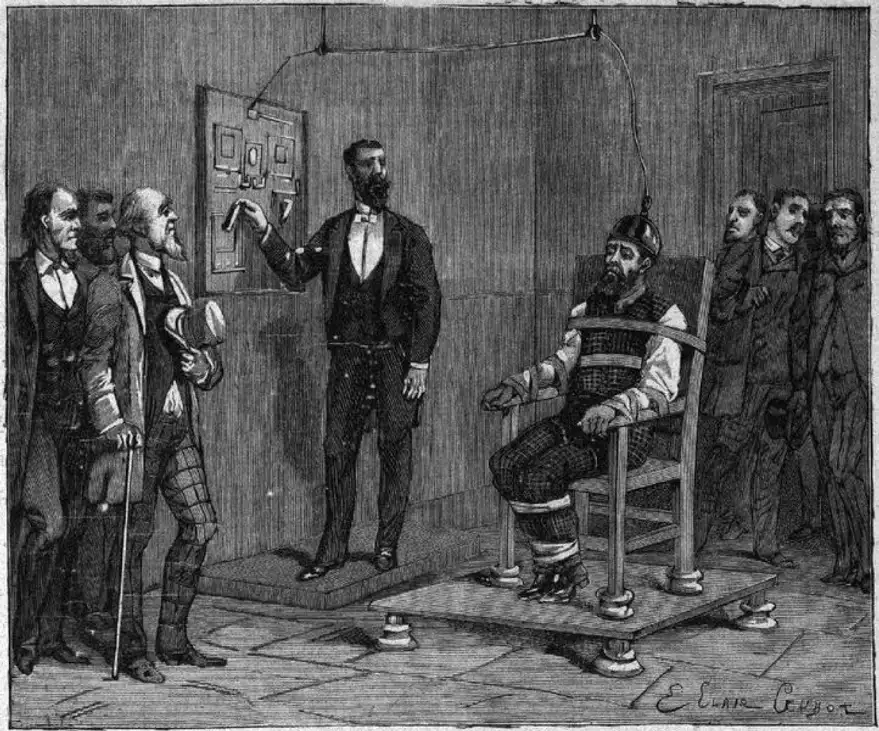
The execution of William Kemmler, August 6, 1890 | Credit: Ernest Clair-Guyot (Public Domain)
Background
In 1881, Buffalo dentist Alfred Southwick first imagined the electric chair and over the next several years, the concept was developed. In 1888, New York became the first state to institute death by electrocution to replace execution by hanging.
On March 29, 1889, William Kemmler, an alcoholic vegetable peddler in the Buffalo slums, was recovering from a drinking binge. During a heated argument with his common-law wife Tillie Ziegler, he accused her of stealing and planning to desert him. Kemmler went to his barn, retrieved a hatchet, and struck Ziegler repeatedly, killing her. He then walked to a neighbor’s house and confessed to the murder.
On May 10, 1889, Kemmler was convicted of first-degree murder. Three days later, he was sentenced to death. Kemmler was to be the first person executed in the electric chair at Auburn State Prison under New York’s new law.
The impending execution of Kemmler became part of the “War of the Currents” between Thomas Edison and his Direct Current, and George Westinghouse and his Alternating Current. To portray AC as the more dangerous “executioner’s current”, Edison’s associate, Harold P. Brown, quietly obtained a Westinghouse generator to power the chair. To protect his company’s reputation, Westinghouse hired a lawyer W. to represent Kemmler and file an appeal arguing that electrocution violated the Eighth Amendment’s prohibition against cruel and unusual punishment.
Unanimous decision for New York
Blatchford
Kemmler
New York
Brewer
Lamar
Miller
Bradley
Field
Gray
Fuller
Harlan




Opinion of the Court
Writing for the Court, Chief Justice Fuller denied Kemmler’s writ and upheld New York’s statute instituting the electric chair as the state’s method of execution. Fuller began by establishing that the Eighth Amendment’s prohibition against cruel and unusual punishment doesn’t apply directly to state governments, since a restriction solely on the federal government. Therefore, for a state’s method of execution to be challenged in federal court, it must be shown to violate the Fourteenth Amendment’s protections of “due process of law” or the “privileges or immunities” citizenship. Regarding the Eighth Amendment, Fuller stated that while it can be used as a guide for what constitutes “cruel” conduct, a state law only violates the Fourteenth Amendment if it imposes a punishment that’s “inhuman and barbarous” or involves “torture or a lingering death”, such as burning at the stake or crucifixion.
On the use of the electric chair, Fuller deferred to the findings of the New York state legislature and courts, which had determined that execution by electricity was intended to be a more humane method of reaching the result of death. He noted that the New York courts found the method might be “unusual” because it was new, but it couldn’t be assumed “cruel” simply because it was a new technology. Fuller emphasized that the judiciary shouldn’t overturn legislative determinations unless there’s a clear need to. Ultimately, Fuller concluded that the enactment of the statute was a legitimate exercise of state legislative power and found no evidence that the state had violated Kemmler’s privileges or immunities as a U.S. citizen or deprived him of due process.