INS v. Chadha
Case Overview
CITATION
ARGUED ON
DECIDED ON
REARGUED ON
DECIDED BY
462 U.S. 919
Feb 22, 1982
Dec. 7, 1982
Jun. 23, 1983
Legal Issue
Does an action by one House of Congress, without input from the other House of Congress or the President, violate the Constitution?
Holding
Yes, the independent action taken by the House of Representatives under §244(c)(2) violates the Constitution because it amounted to a legislative act that is subject to the Article I requirements of presentment and bicameralism.
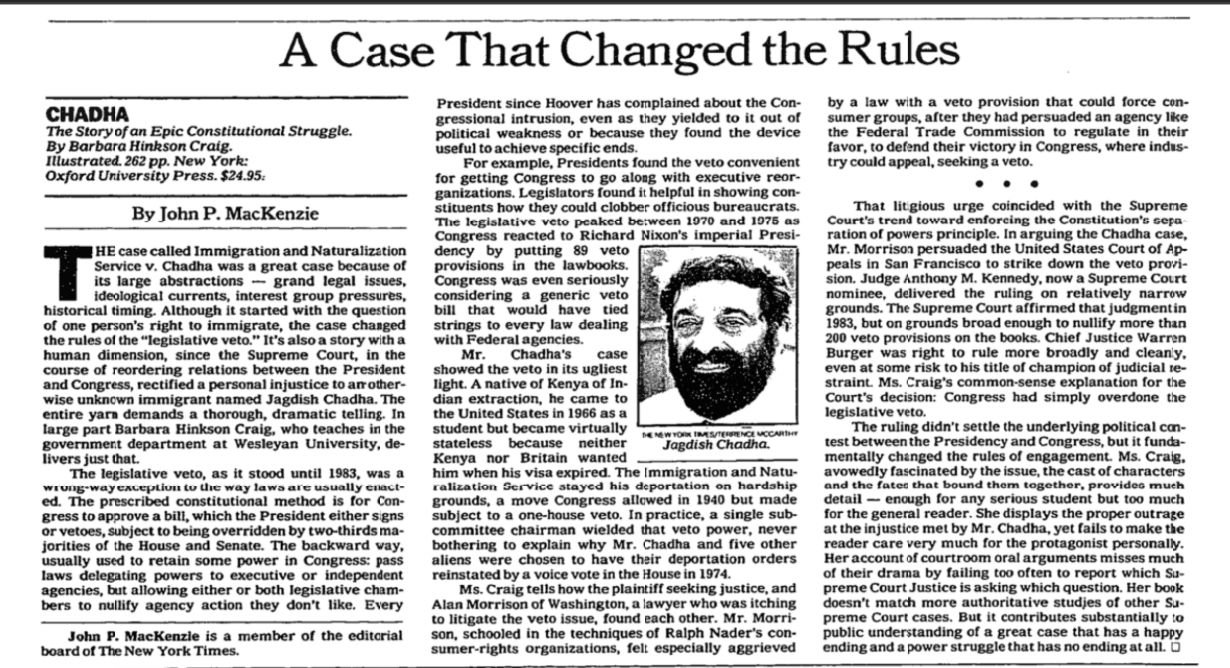
An article in the New York Times about Chadha’s case (January 17, 1988) | Credit: NYT TimesMachine
Background
Jagdish Rai Chadha was an East Indian who was born in the British Colony of Kenya and held a British passport. In 1996, Chadha was lawfully admitted to the U.S. on a nonimmigrant student visa, but it expired on June 30, 1972. After Kenya declared independence from Britain in 1963, Chadha wasn’t recognized as a legitimate citizen or resident of Kenya since parents were Indian, nor India since he was born in Kenya. Further, Chadha’s “right of abode” in the United Kingdom was stripped under the Immigration Act 1971 because he lacked a connection with the UK. After his non-immigrant student visa expired in 1972, none of the three countries would accept him onto their territory, rendering him de facto stateless.
On October 11, 1973, the District Director of the Immigration and Naturalization Service ordered Chadha to show cause why he should not be deported for having “remained in the United States for a longer time than permitted.” On January 11, 1974, a deportation hearing was held before an immigration judge pursuant to §242(b) of the Immigration and Nationality Act. Chadha admitted that he was deportable for overstaying his visa and the hearing was adjourned so he could file an application for suspension of deportation under §244(a)(1).
The deportation hearing resumed on February 7, 1974, after Chadha submitted his application for suspension of deportation. On June 25, the immigration judge found that Chadha met the requirements of §244(a)(1) since he had resided continuously in the United States for over seven years, was of good moral character, and would suffer “extreme hardship” if deported. The immigration judge ordered Chadha’s deportation be suspended and transmitted a report to Congress, pursuant to §244(c)(1).
After the Attorney General’s recommendation for suspension of Chadha’s deportation was sent to Congress, Congress had the power (by a resolution of either the Senate or the House of Representatives)under §244(c)(2) of the Act to veto the Attorney General’s determination that Chadha should not be deported .
On December 12, 1975, Representative Joshua Eilberg (D-PA 4), Chairman of the Judiciary Subcommittee on Immigration, Citizenship, and International Law, introduced a resolution opposing “the granting of permanent residence” to a number of aliens, one of which was Chadha. The resolution was referred to the House Judiciary Committee and discharged from further consideration by the committee on December 16, 1975. It was subsequently submitted to the full House of Representatives for a vote. The resolution was passed without debate or a recorded vote. Since the resolution was pursuant to §244(c)(2), it wasn’t treated as an Article I legislative act, meaning it wasn’t submitted to the Senate or presented to the President.
7 - 2 decision for Chadha
INS

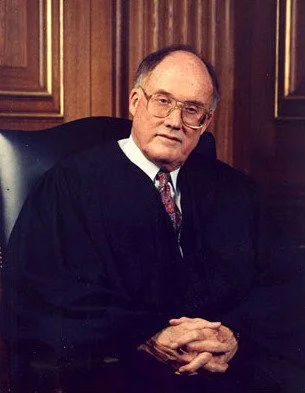
Chadha
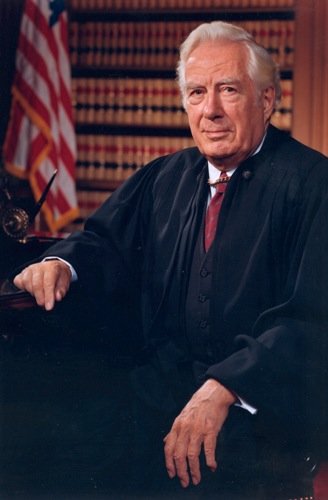


Rehnquist
Marshall


Powell
Burger
White
Brennan
Blackmun
Stevens
O’Connor
-
Writing for the Court, Chief Justice Warren Burger began by establishing the presumption that a challenged statute is valid, but explained that just because a statute “is efficient, convenient, and useful in facilitating functions of government, standing alone, will not save it if it is contrary to the Constitution.” Burger noted that since 1932, 295 congressional vetoes have been inserted into 196 different statutes and wrote that “[c]onvenience and efficiency are not the primary objectives—or the hallmarks—of democratic government and our inquiry is sharpened rather than blunted by the fact that Congressional veto provisions are appearing with increasing frequency in statutes which delegate authority to executive and independent agencies.”
Burger addressed the Presentment Clauses, explaining that the records from the Constitutional Convention show that requiring all legislation to be presented to the President before becoming law was “uniformly accepted by the framers.” He stated that “[p]resentment to the President and the Presidential veto were considered so imperative that the draftsmen took special pains to assure that these requirements could not be circumvented.” Burger explained that the “limited and qualified” veto power “was based on the profound conviction of the framers that the powers conferred on Congress were the powers to be most carefully circumscribed.” On this point, Burger concluded that it’s “beyond doubt that lawmaking was a power to be shared by both Houses and the President.”
Burger then turned to the interdependent concept of bicameralism, which was born from the Great Compromise at the Constitutional Convention. Burger stated that bicameral nature of Congress was created to ease fears and balance the interests of large and small states, and noted that “the framers were acutely conscious that the bicameral requirement and the Presentment Clauses would serve essential constitutional functions.” He explained, “[t]he President’s participation in the legislative process was to protect the Executive Branch from Congress and to protect the whole people from improvident laws. The division of the Congress into two distinctive bodies assures that the legislative power would be exercised only after opportunity for full study and debate in separate settings. The President’s unilateral veto power, in turn, was limited by the power of two thirds of both Houses of Congress to overrule a veto thereby precluding final arbitrary action of one person.” Here, Burger concluded that Article I’s prescription for legislative action “represents the framers’ decision that the legislative power of the Federal government be exercised in accord with a single, finely wrought and exhaustively considered, procedure.”
Moving to the constitutionality of §244(c)(2), Burger first established that not every action taken by a House of Congress is subject to Article I’s presentment and bicameralism requirements. Burger explained that to determine if an act is subject to those requirements, the Court must evaluate whether the action “contain[s] matter which is properly to be regarded as legislative in its character and effect.”
Regarding the House’s action under §244(c)(2), Burger found that the nature of it “manifests its legislative character” and stated that “the House took action that had the purpose and effect of altering the legal rights, duties and relations of persons, including the Attorney General, Executive Branch officials and Chadha, all outside the legislative branch.” Burger explained that Congress’ decision to deport Chadha involved a determination of policy that Congress can only implement through bicameral passage and presentment to the President. He added that Congress must abide by its own delegations of authority until it’s legislatively altered or revoked.
Burger then took note of the fourth specific provisions of the Constitution that are “explicit and unambiguous” as to a single House of Congress’ authority to act alone. These include the House of Representatives’ power to initiate impeachments (Art. I, §2, cl. 6; (b)); the Senate’s power to conduct impeachment trials and convict following trial (Art. I, §3, cl. 5; (c)); the Senate’s power to approve or disapprove presidential appointments (Art. II, §2, cl. 2; (d)); the Senate’s power to ratify treaties negotiated by the President (Art. II, §2, cl. 2.). Burger explained that when the framers sought to grant special powers to one House independent of the other or of the President, “they did so in explicit, unambiguous terms.” He argued that these exceptions are “narrow, explicit, and separately justified” and that the “carefully defined exceptions from presentment and bicameralism underscore the difference between the legislative functions of Congress and other unilateral but important and binding one-House acts provided for in the Constitution.”
Burger held that since §244(c)(2) wasn’t within any of the express constitutional exceptions that would allow the House of Representatives to act alone, it was subject to the Article I requirements of presentment and bicameralism. He emphasized that bicameralism and presentment were intended “to erect enduring checks on each Branch and to protect the people from improvident exercise of power by mandating certain prescribed steps.” He argued that “[t]o preserve those checks, and maintain the separation of powers, the carefully defined limits on the power of each Branch must not be eroded. To accomplish what has been attempted by one House of Congress in this case requires action in conformity with the express procedures of the Constitution’s prescription for legislative action: passage by a majority of both Houses and presentment to the President.”
Burger acknowledged that choices about the structure of our government made at the Constitutional Convention may “impose burdens” that “often seem clumsy, inefficient, even unworkable.” However, he noted that “those hard choices were consciously made by men who had lived under a form of government that permitted arbitrary governmental acts to go unchecked.” He argued that nothing in the Constitution or the Court’s precedent supports the idea “that the cumbersomeness and delays often encountered in complying with explicit Constitutional standards may be avoided, either by the Congress or by the President,” and ultimately concluded that “[w]ith all the obvious flaws of delay, untidiness, and potential for abuse, we have not yet found a better way to preserve freedom than by making the exercise of power subject to the carefully crafted restraints spelled out in the Constitution.”
-
In his concurring opinion, Justice Lewis Powell wrote that he agreed with the judgment of the Court because “[w]hen Congress finds that a particular person does not satisfy the statutory criteria for permanent residence in this country it has assumed a judicial function in violation of the principle of separation of powers.” However, Powell noted that he wrote separately because “the breadth of this holding gives one pause,” and he believed that the case should’ve been decided on a narrower ground that didn’t abolish the legislative veto.
Powell explained that the doctrine of separation of powers can be violated in two ways: when one branch impermissibly interferes with another’s “performance of its constitutionally assigned function,” or “when one branch assumes a function that more properly is entrusted to another.”
Powell found that the House’s action was “clearly adjudicatory” because it made its own determination regarding a group of aliens rather than enacting a general rule. Powell argued that such an exercise of power raises the danger of “the exercise of unchecked power,” which is what the framers sought to avoid. He pointed out that “[t]he only effective constraint on Congress’s power is political, but Congress is most accountable politically when it prescribes rules of general applicability. When it decides rights of specific persons, those rights are subject to ‘the tyranny of a shifting majority.’”
Ultimately, Powell concluded that Congress exceeded the scope of its constitutionally prescribed authority when it reviewed Chadha’s deportation, but he argued that the Court shouldn’t decide “the broader question whether legislative vetoes are invalid under the Presentment Clauses.”
-
In his dissenting opinion, Justice Byron White criticized the majority for sounding the “death knell” for the legislative veto that Congress included in nearly 200 statutes. White wrote that the Court’s decision is of “surpassing importance” and should’ve been decided on the narrower grounds of separation of powers.
White described “the apparent sweep” of the Court’s ruling as “regrettable.” He wrote that “[c]ourts should always be wary of striking statutes as unconstitutional; to strike an entire class of statutes based on consideration of a somewhat atypical and more-readily indictable exemplar of the class is irresponsible.”
Powell defended the legislative veto, arguing that its prominence “in our contemporary political system and its importance to Congress can hardly be overstated.” He explained that the legislative veto “has become a central means by which Congress secures the accountability of executive and independent agencies.” Without it, “Congress is faced with a Hobson’s choice: either to refrain from delegating the necessary authority, leaving itself with a hopeless task of writing laws with the requisite specificity to cover endless special circumstances across the entire policy landscape, or in the alternative, to abdicate its law-making function to the executive branch and independent agencies.” White argued that “[t]o choose the former leaves major national problems unresolved; to opt for the latter risks unaccountable policymaking by those not elected to fill that role.”
White argued that the legislative veto is more than just a useful or convenient tool, writing that it’s “an important if not indispensable political invention that allows the President and Congress to resolve major constitutional and policy differences, assures the accountability of independent regulatory agencies, and preserves Congress’ control over lawmaking.” He added that the history of its use shows that “it has not been a sword with which Congress has struck out to aggrandize itself at the expense of the other branches. Rather, the veto has been a means of defense, a reservation of ultimate authority necessary if Congress is to fulfill its designated role under Article I as the nation’s lawmaker.”
White pushed back against the argument that the legislative veto grants the power to write new law without bicameral approval or presentment because it must be authorized by a specific statute and can only be exercised to negate what an Executive department or independent agency proposed. He explained that “the legislative veto no more allows one House of Congress to make law than does the presidential veto confer such power upon the President.”
White addressed the legislative veto’s absence from the Constitution and argued that the Court’s task should be to determine whether it’s consistent with the purposes of Article I and principles of separation of powers. White explained that the legislative veto only became necessary in the last half century because of the federal government’s growth, making its absence from history unsurprising. However, White argued that “the wisdom of the framers was to anticipate that the nation would grow and new problems of governance would require different solutions. Accordingly, our Federal Government was intentionally chartered with the flexibility to respond to contemporary needs without losing sight of fundamental democratic principles.”
White explained that the “central concern” regarding the presentation and bicameralism is that departures from the legal status quo be done with the approval of the President and both Houses of Congress (or 2/3 of both Houses of Congress if the President vetoes the bill). White argued that this interest is “fully satisfied” by §244(c)(2), since disagreement by House, Senate, or Executive maintains the alien’s pre-existing status. He stated that “[t]he effect on the rights and obligations of the affected individuals and upon the legislative system is precisely the same as if a private bill were introduced but failed to receive the necessary approval.”
Ultimately, White concluded that §244(c)(2) “fully effectuates” the requirements of bicameralism and presentation imposed by Article I. He added that he regretted being in disagreement with his colleagues regarding the “fundamental questions” present in this case, but stated that “even more I regret the destructive scope of the Court’s holding.” White argued that the decision “reflects a profoundly different conception of the Constitution than that held by the Courts which sanctioned the modern administrative state” and “strikes down in one fell swoop provisions in more laws enacted by Congress than the Court has cumulatively invalidated in its history ... I must dissent.”