Gundy v. United States
Case Overview
CITATION
ARGUED ON
DECIDED ON
DECIDED BY
588 U.S. 128
Oct. 2, 2018
Jun. 20, 2019
Legal Issues
Did Congress make an unconstitutional delegation of legislative power when it instructed the Attorney General to apply SORNA’s registration requirements to pre-Act offenders as soon as feasible?
Holding
No, because Congress specifically identified the power being delegated and established sufficient guidelines for its exercise.
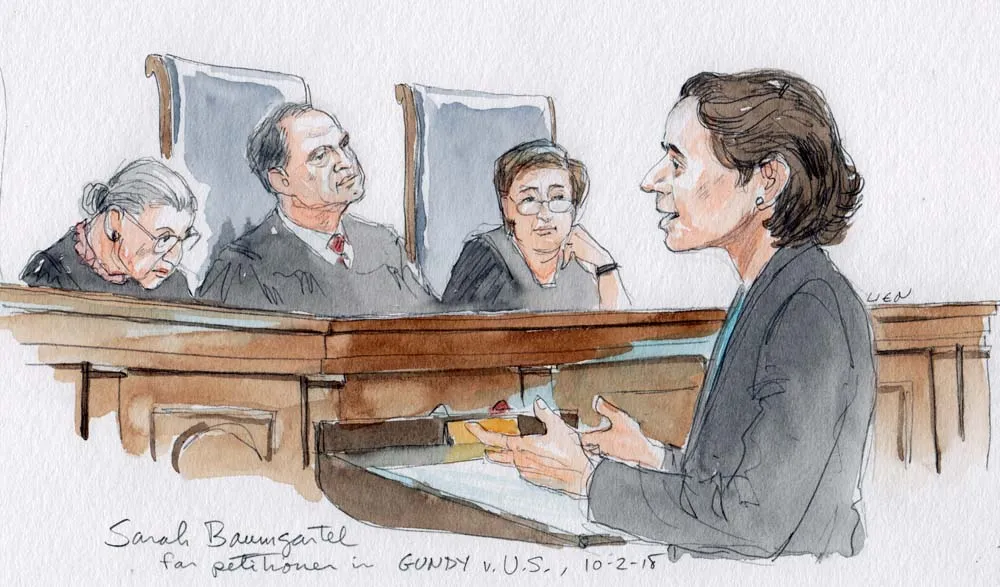
Attorney Sarah Baumgartel arguing before the Supreme Court for petitioner Herman Gundy | Credit: SCOTUSblog
Background
In 2006, Congress enacted SORNA to address disparities in sex offender registration across the states. The stated purpose of SORNA was to “establish a comprehensive national system” for sex offender registration “to protect the public from sex offenders and offenders against children.”
Under SORNA, any person required to register that doesn’t may be imprisoned for up to ten years, given that they travel in interstate commerce. §20913 states the registration requirements, and subsection (d) grants the Attorney General the authority to determine the applicability of the requirements to offenders convicted before SORNA was enacted and prescribe the rules for their registration. The final rule issued by the Attorney General in 2010 reiterated that SORNA applies to all pre-SORNA offenders.
In 2005, a year before SORNA was enacted, Herman Gundy pleaded guilty to sexual assault of a minor under Maryland law. After Gundy was released in 2012, he moved to New York but didn’t register as a sex offender. He was later convicted in the U.S. District Court for failing to register. Gundy appealed, but the U.S. Court of Appeals for the Second Circuit upheld his conviction. The Supreme Court then granted certiorari.
5 - 3 decision for the United States
Gundy




U.S.


Kagan
Ginsburg
Gorsuch
Breyer
Thomas
Sotomayor
Alito
Roberts
-
Writing for a plurality of the Court, Justice Elena Kagan first established that while Article I of the Constitution vests in Congress “[a]ll legislative Powers,” a statutory delegation of power by Congress is constitutional so long as it contains “an intelligible principle” that the exercise of the delegated authority must conform to. Kagan then explained that an inquiry under the nondelegation doctrine always begins with statutory interpretation to determine the task delegated and instructions provided with it.
Regarding §20913(d) of SORNA, Kagan stated that “the constitutional question all but answers itself.” Kagan rejected argument that the provision grants the Attorney General plenary power to determine the applicability of SORNA to pre-Act offenders, explaining that the Court has already interpreted the provision to require the Attorney General to apply SORNA to all pre-Act offenders as soon as is feasible. She wrote that “[t]he text, considered alongside its context, purpose, and history, makes clear that the Attorney General’s discretion extends only to considering and addressing feasibility issues... Section 20913(d)’s delegation falls well within permissible bounds.”
Kagan then evaluated what §20913(d) allows the Attorney General to do. She first pointed to SORNA’s declared purpose, which was to protect the publish and “establish a comprehensive national system of registration” of sex offenders. Kagan explained that the term “comprehensive” in SORNA has a clear meaning that is “all-encompassing or sweeping.” She stated that such a definition couldn’t fit the system created by SORNA if it granted the Attorney General the power to decline to apply SORNA to pre-Act offenders for any reason or no reason at all. She found that “the mismatch between SORNA’s statement of purpose and Gundy’s view of §20913(d) is as stark as stark comes.” Kagan then added that the legislative history of SORNA backs up her argument by showing that “the need to register pre-Act offenders was front and center in Congress’s thinking.”
Moving to whether the delegation made under SORNA was unconstitutional, Kagan succinctly stated, “that question is easy. Its answer is no.” Kagan explained that under the “intelligible principle” standard, Congress must make clear the general policy to be pursued and the boundaries of the authority conferred. She noted, that while those standards “are not demanding,” the Court rarely feels qualified to second-guess Congress regarding the permissible degree of policy judgment that can be left” to those charged with execution of the law.
Kagan noted that only twice in history has the Court found a delegation of excessive, and that was because Congress failed to articulate any policy or standard to confine discretion. She then explained that the Court has “over and over upheld even very broad delegations,” including those regulating issues in the public interest, public health, and prices. She argued that if SORNA’s delegation is unconstitutional, then most of the Government is too given the necessity for Congress to delegate power to executive officials to implement its programs. Thus, Kagan found that in the context of the Court’s jurisprudence, SORNA “easily passes muster.” She ultimately concluded that SORNA was a constitutional delegation by Congress, writing that it’s “wisdom and humility alike that this Court has always upheld such “necessities of government.”
-
In his brief concurrence, Justice Samuel Alito began by stating his frustration with the Court’s established approach to nondelegation arguments, emphasizing that the Constitution confers legislative powers to Congress and doesn’t allow it to delegate those powers to another branch of government. He wrote that “[i]f a majority of this Court were willing to reconsider the approach we have taken for the past 84 years, I would support that effort. But because a majority is not willing to do that, it would be freakish to single out the provision at issue here for special treatment.”
Ultimately, Alito explained that he joined the plurality because SORNA has a “discernable standard that is adequate under the approach this Court has taken for many years.”
-
In his dissenting opinion, Justice Neil Gorsuch emphasized the vast authority granted to the Attorney General under SORNA, stating that Congress’ delegation “gave the Attorney General free rein to write the rules for virtually the entire existing sex offender population.” Gorsuch pointed out that different Attorneys General have exercised the discretion granted by SORNA in different ways to illustrate the inconsistency created by it. He argued that “[t]hese unbounded policy choices have profound consequences for the people they affect,” since the requirements for sex offender registration differs substantially depending on who’s in office at the time.
Gorsuch then turned to the Constitution, explaining that the framers understood that allowing Congress to “announce vague aspirations and then assign others the responsibility of adopting legislation to realize its goals” would frustrate our system of government. He stated that through the Constitution, “the people had vested the power to prescribe rules limiting their liberties in Congress alone. No one, not even Congress, had the right to alter that arrangement.”
Explaining the importance of this principle, Gorsuch stated that the framers believed that the most dangerous power of the federal government was the power to enact laws restricting people’s liberty. To avoid an “excess of lawmaking,” the framers intentionally made the process difficult and designed it to promote deliberation. He also explained that the framers insisted on a legislature composed of different bodies to ensure that any new law had to secure the approval of a supermajority of Congress, and limiting that role would negatively impact its accountability to the people. He argued that “[w]ithout the involvement of representatives from across the country or the demands of bicameralism and presentment, legislation would risk becoming nothing more than the will of the current President.”
Gorsuch then established the test used to determine whether Congress unconstitutionally divested legislative powers, breaking it into three parts. First, Congress may authorize another branch to “fill the details” so long as it made the policy decisions regulating private conduct. Second, Congress may make the application of its rule depend on executive fact-finding. Third, Congress may assign the executive and judicial branches certain non-legislative responsibilities.
Gorsuch argued that “no one thinks that the Court’s quiescence can be attributed to an unwavering new tradition of more scrupulously drawn statutes.” Instead, he found that the most likely explanation lies with the “intelligible principle” doctrine that originated in J.W. Hampton, Jr., & Co. v. United States (1928). Gorsuch explained that the principle “eventually began to take on a life of its own,” and criticized the “mutated version” of it as having “no basis in the original meaning of the Constitution, in history, or even in the decision from which it was plucked.” He stated that “[t]o leave this aspect of the constitutional structure alone undefended would serve only to accelerate the flight of power from the legislative to the executive branch, turning the latter into a vortex of authority that was constitutionally reserved for the people’s representatives in order to protect their liberties.”
Regarding SORNA, Gorsuch wrote that “[i]t’s hard to see how SORNA leave the Attorney General with only details to fill up.” He pointed out that the Attorney General has the power to choose which, if any, pre-Act offenders are subject to its requirements and that those requirements may be changed at any time. He also noted that this delegation “appears to have been deliberate” because members of Congress couldn’t agree on how to treat pre-Act offenders. He emphasized that SORNA doesn’t contain “a single policy decision concerning pre-Act offenders on which Congress even tried to speak, and not a single other case where we have upheld executive authority over matters like these on the ground they constitute mere ‘details.’”
Gorsuch noted that “[i]t would be easy enough to let this case go” since sex offenders “are one of the most disfavored groups in society.” However, he emphasized that “the rule that prevents Congress from giving the executive carte blanche to write laws for sex offenders is the same rule that protects everyone else,” and it’s not hard to imagine the power of a prosecutor to require a certain group to register with the government under threat of criminal penalty could be abused in other settings. He stated that “[t]o allow the nation’s chief law enforcement officer to write the criminal laws he is charged with enforcing . . . would be to mark the end of any meaningful enforcement of our separation of powers and invite the tyranny of the majority that follows when lawmaking and law enforcement responsibilities are united in the same hands.”
Responding to the argument that revival of the non-delegation doctrine would “spell doom” for the administrative state, Gorsuch explained that “Congress is hardly bereft of options to accomplish all it might wish to achieve.” He stated that Congress can commission agencies or experts to study and recommend legislative language. Further, Congress may authorize executive branch officials to fill in a large number of details, find facts to trigger a generally applicable rule, or exercise non-legislative powers.
Gorsuch concluded that the Court failed to rectify the consequences invited by SORNA, “resolving nothing and deferring everything.” He noted that “[i]n a future case with a full panel, I remain hopeful that the Court may yet recognize that, while Congress can enlist considerable assistance from the executive branch in filling up details and finding facts, it may never hand off to the nation’s chief prosecutor the power to write his own criminal code. That ‘is delegation running riot.’”