Evans v. Newton
Case Overview
CITATION
ARGUED ON
DECIDED ON
DECIDED BY
382 U.S. 296
Nov. 9-10, 1965
Jan. 17, 1966
Legal Issue
Does the operation of a segregated park by a private individual or group violate the Fourteenth Amendment?
Holding
Yes, the public character of the park requires that it be treated as a public institution subject to the Fourteenth Amendment, regardless of who has title under state law.
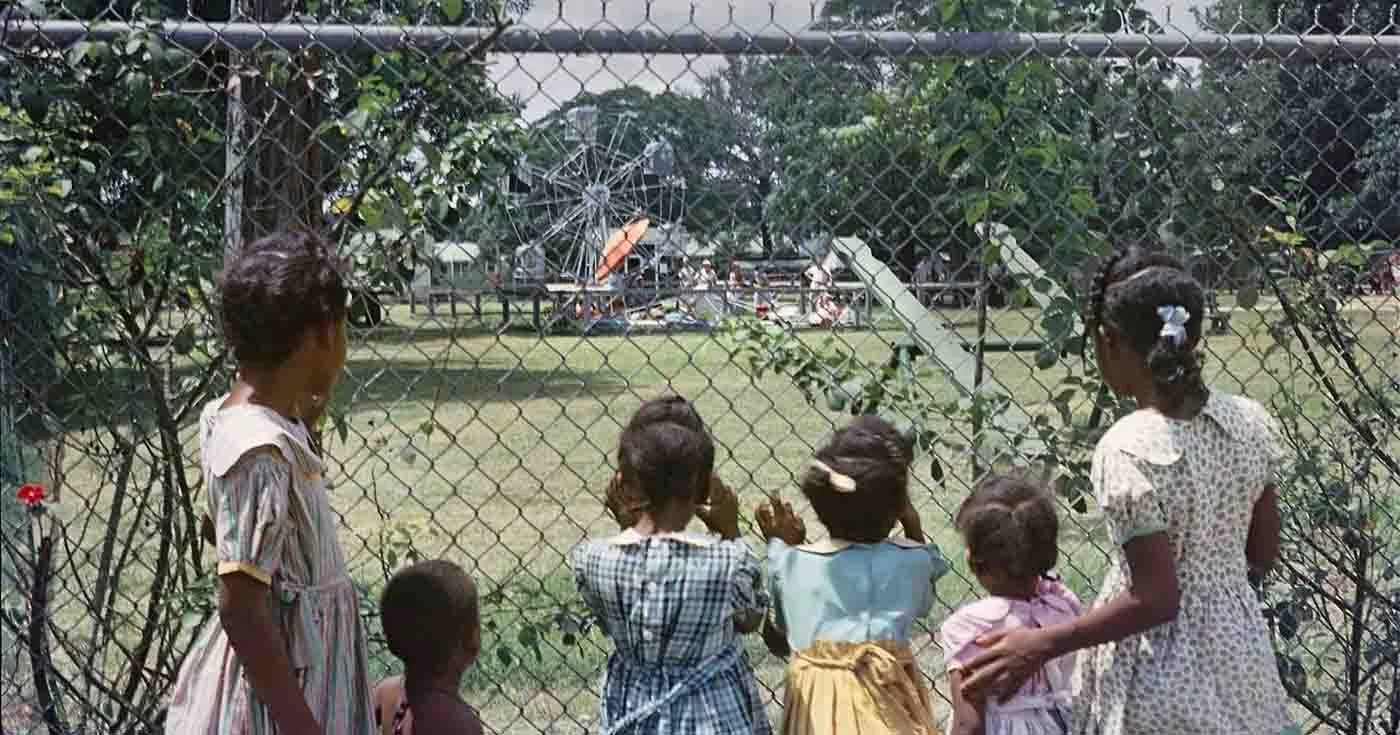
Children looking in to Baconsfield Park from behind a fence | Credit: Equal Justice Initiative
Background
In 1911, Senator Augustus Bacon (D-GA) executed a will that devised a tract of land to the Mayor and Council of the City of Macon, Georgia to be used as “a park and pleasure ground” for white people only. The will provided that the park should be under the control of a Board of Managers of seven persons, all of whom were to be white. The city kept the park segregated but later desegrated the park, arguing that it was a public facility and couldn’t be segregated on the basis of race.
In response, Charles Newton and other members of the Board of Managers of the park sued the City of Macon and certain beneficiaries of Bacon’s estate in the Superior Court of Bibb County, Georgia. The members sought to remove the city as trustee and have the court appoint new trustees, to whom title to the park would be transferred. The city responded that it couldn’t legally enforce racial segregation in the park, but the other defendants requested that the city be removed as trustee.
Several black citizens of Macon, led by Reverend E.S. Evans, intervened in the case to ask that the court refuse to appoint private trustees. Additionally, other heirs of Bacon intervened on the side of Bacon’s beneficiaries, asking for reversion of the property to the Bacon estate if new trustees weren’t appointed. The city subsequently resigned as trustee. The Georgia court accepted the resignation of the city as trustee, appointed three individuals as new trustees, and passed on the other claims of the heirs. The black citizens of Macon appealed, but the Supreme Court of Georgia affirmed. The Supreme Court then granted certiorari.
6 - 3 decision for Evans
Evans


Newton


Black
Warren
Harlan II
White
Clark
Douglas
Stewart
Fortas
Brennan
-
Writing for the Court, Justice William Douglas first established “two complementary principles to be reconciled in this case.” First, the right of the individual to freely associate with the people they choose. Second, the constitutional ban against state-sponsored racial inequality enshrined in the Equal Protection Clause of the Fourteenth Amendment. The latter, Douglas explained, “of course” prohibits a city from acting as a trustee under a private will promoting racial segregation.
Douglas explained that distinguishing “private” versus “state” actions can be difficult but is done “by sifting facts and weighing circumstances.” Douglas added that “[t]he range of government activities is broad and varied, and the fact that government has engaged in a particular activity does not necessarily mean that an individual entrepreneur or manager of the same kind of undertaking suffers the same constitutional inhibitions.”
Douglas then applied these principles to the context of a will. Douglas stated that if an individual wished to leave a school or center to be used by only one race, but didn’t implicate the State in its supervision, control, or management, the Court would “assume arguendo that no constitutional difficulty would be encountered.” However, Douglas found that Baconsfield Park was “in a different posture,” as it was regularly maintained by the city for years. He asserted that “[i]f the municipality remains entwined in the management or control of the park, it remains subject to the restraints of the Fourteenth Amendment.” Douglas dismissed the substitution of trustees as instantly transferring the park from the public to the private sector, given that “the tradition of municipal control had become firmly established.”
Douglas added that the “nature of the service rendered the community by a park,” even if privately owned, “is municipal in nature.” Unlike private social clubs, a park is more like a fire department or police department that traditionally serves the community. Relying on precedent, Douglas found that “[l]ike the streets of the company town in Marsh v. State of Alabama (1946), and the elective process of Terry v. Adams (1953), the predominant character and purpose of this park are municipal.” Douglas explained that “[m]ass recreation through the use of parks is plainly in the public domain; and state courts that aid private parties to perform that public function on a segregated basis implicate the State in conduct proscribed by the Fourteenth Amendment.”
Ultimately, Douglas concluded, writing “the public character of this park requires that it be treated as a public institution subject to the command of the Fourteenth Amendment, regardless of who now has title under state law.”